
Affiliate Program vs Referral Program A Guide to Choosing Your Strategy
Let's cut right to the chase. An affiliate program is all about paying external marketers to broadcast your message to a wide audience, focusing on scalable customer acquisition. On the other hand, a referral program is designed to reward your existing happy customers for recommending you to people they actually know, tapping into the power of personal trust.
Affiliate vs Referral Program A Quick Comparison
To really see how these two models play out in the real world, we've put together a direct comparison. This visual breakdown highlights the core DNA of each approach, giving you a clear, high-level map before you get lost in the weeds. Nailing these distinctions is the first critical step in figuring out which growth engine is right for your business.
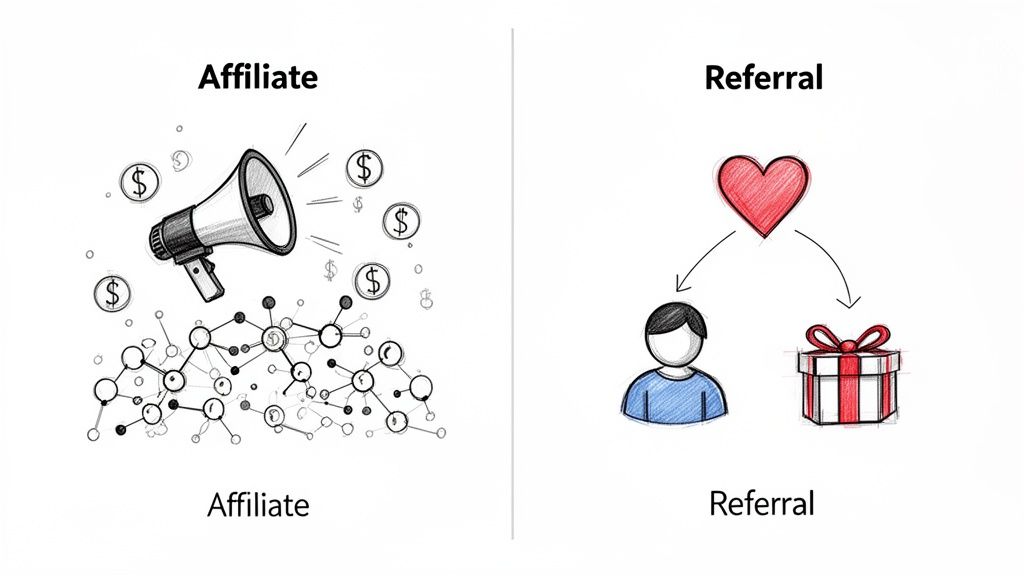
Getting this high-level view is crucial. The right choice depends entirely on where your business is today, who you're trying to reach, and what you're ultimately trying to achieve.
Key Differences Affiliate Programs vs Referral Programs
To make it even clearer, this table offers a side-by-side look at the fundamental attributes of affiliate and referral programs. It's a quick way to see which model lines up with your specific business goals.
| Attribute | Affiliate Program | Referral Program |
|---|---|---|
| Who Promotes | External partners (influencers, bloggers, marketers) | Existing, satisfied customers |
| Motivation | Financial commissions (cash payouts) | Brand loyalty, social connection, and smaller rewards (discounts, store credit) |
| Relationship to Brand | May or may not be a user of the product | An existing user and brand advocate |
| Incentive Structure | One-sided (only the affiliate earns a reward) | Often dual-sided (both the referrer and their friend receive a reward) |
| Primary Goal | Broad reach, brand awareness, and customer acquisition at scale | Customer loyalty, retention, and high-quality, trusted conversions |
After looking over this breakdown, it starts to become obvious how each model serves a very different strategic purpose. While both are incredibly powerful, they are definitely not interchangeable.
For businesses looking to put a formal structure around their word-of-mouth marketing, exploring a dedicated affiliate and referral management platform is the logical next step. Now, let's dig into the mechanics behind each of these programs.
The Nuts and Bolts: How Each Program Actually Works
Definitions are a good start, but the real difference between affiliate and referral programs is in their day-to-day operation. At its heart, an affiliate program is a structured business partnership. You're collaborating with professional marketers, seasoned content creators, or industry influencers who have already done the hard work of building an audience.
These partners—your affiliates—don't even need to be your customers. Their job is to function as a performance-based sales channel. They drive traffic and sales using unique tracking links they place in their content, whether that's a detailed blog post, a YouTube review, or a quick social media shout-out. Their motivation is almost always financial: a cash commission for every sale they send your way.
Referral programs, on the other hand, are built on something entirely different: genuine brand advocacy and personal trust. You're not recruiting external marketers; you're activating your existing base of happy customers and turning them into a volunteer marketing army. This approach taps into the incredible power of social proof.
Relationships and Trust: The Core Differentiator
The engine of a referral is a personal recommendation from someone you trust—a friend, a family member, a colleague. Study after study confirms that people trust recommendations from people they know far more than any ad. A referral from a friend simply converts better because it comes with built-in credibility.
This difference in the underlying relationship is everything. An affiliate promotes a product to a wide audience, and that audience understands it's a commercial arrangement. A customer, however, refers a product to their personal network because they genuinely think it will help them.
The crucial distinction is the source of the recommendation. An affiliate's promotion is a business transaction aimed at a broad audience. A customer's referral is a personal endorsement built on authentic experience and trust. This is the fundamental split in the affiliate program vs referral program debate.
How Incentives and Goals Tell the Whole Story
The reward structures for each program are a direct reflection of these different relationships and motivations. Affiliate programs are designed to attract professional marketers who are focused on monetization.
Affiliate Incentives: Almost always cash. Think a 10-20% commission on sales or a flat fee for each conversion. The structure is typically one-sided, rewarding only the affiliate for their performance.
Referral Incentives: Often non-cash rewards that encourage loyalty and repeat business. You'll see things like discounts, store credit, or free products. These rewards are often two-sided, giving something to both the referrer and the new customer, which reinforces that social connection.
Ultimately, the mechanics reveal two completely different strategic goals. Affiliate marketing is an acquisition engine built for broad reach and scale. It's about getting your brand in front of as many relevant eyeballs as possible. Referral marketing is a loyalty and conversion engine. The goal here is to acquire high-quality, high-LTV customers by leveraging the trust that's already baked into your community.
Analyzing Performance Metrics and Long-Term ROI
When you're weighing an affiliate program against a referral program, the conversation has to move past the mechanics and get straight to the results. Both are designed for growth, but they pull different levers, impacting your key performance indicators (KPIs) like customer acquisition cost (CAC), conversion rates, and lifetime value (LTV) in completely different ways. Getting this right is critical for understanding your long-term return on investment (ROI).
Affiliate programs are built for scale and brand exposure. They're fantastic at casting a wide net, making them a powerful engine for top-of-funnel awareness. But that broad reach often comes at a cost: lower conversion rates. The audience's connection to the affiliate is usually commercial, not personal, and that makes a huge difference.
Referral programs, on the other hand, consistently bring in higher-quality leads because they run on trust. A recommendation from a friend is just more believable than a marketer's pitch. That trust translates directly into better performance where it counts the most—at the point of conversion.
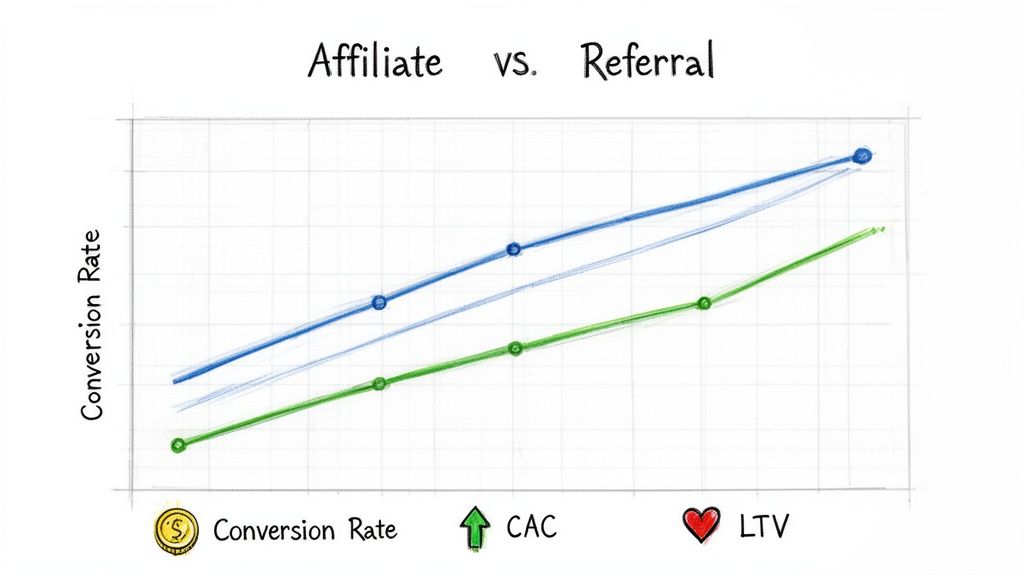
Conversion Rates and Lead Quality
The biggest performance gap between these two models is in conversion rates. Referrals win here, hands down. The trust baked into a personal recommendation is marketing gold. A landmark Nielsen study found that 92% of consumers trust endorsements from people they know more than any other form of advertising, which is a massive driver for customer acquisition. The data backs this up: referral programs hit an average conversion rate of 3.74%, while affiliate marketing often lags behind because the audience trust just isn't as strong.
This gap in lead quality creates a ripple effect. Customers who come from referrals are usually a much better fit for your brand, which leads to higher satisfaction and better retention. They show up with confidence already built-in, shortening their path from a curious prospect to a loyal fan.
Customer Acquisition Cost and Lifetime Value
The way you pay for each program creates a clear divide in your CAC and LTV. Affiliate programs come with hard costs that can stack up fast.
Cash Commissions: You're paying out a percentage of every sale, often between 5-30%.
Network Fees: Many affiliate networks charge monthly fees or take a cut of your payouts.
Management Overhead: Finding, vetting, and managing affiliates is a significant time investment.
Referral programs, by contrast, usually have a much lower and more efficient CAC. The rewards are often non-cash perks like store credit or discounts. These serve a dual purpose: they reward the referrer while also encouraging repeat business from both your existing customer and the new one they brought in. It creates a powerful loop that drives up LTV.
A key ROI differentiator is the nature of the reward. Affiliate cash commissions represent a direct cost of sale. Referral rewards, like product credits, are an investment back into the customer ecosystem, fostering loyalty and increasing future purchase frequency.
This structure means you're not just buying a new customer; you're strengthening your bond with an existing one. A well-run referral program can turn your best customers into a sustainable, low-cost acquisition machine. To pull this off, you need rock-solid tracking. Using tools like custom email tracking links ensures every referral is properly credited, giving you a crystal-clear view of your program's performance and ROI.
Long-Term ROI and Sustainable Growth
While affiliate marketing can give you quick hits of traffic and sales, referral marketing builds a more sustainable, long-term growth engine. The customers you get from referrals often have a higher LTV because they start their journey with more trust and are far more likely to become advocates themselves. This creates a compounding effect, where every happy customer has the potential to bring in another one just like them.
Ultimately, the choice isn't just about this quarter's sales numbers. It's about the kind of growth you want to build for the long haul. Affiliate programs are excellent for scaling your reach quickly, but referral programs are simply unmatched for building a loyal, high-value customer base that grows organically over time.
Recruiting the Right Partners for Growth
Your program's success doesn't just hang on its structure; it's all about the people you bring into the fold. The difference between an affiliate program and a referral program snaps into focus when you look at who you're recruiting and how you're getting them to act. The approaches couldn't be more different.
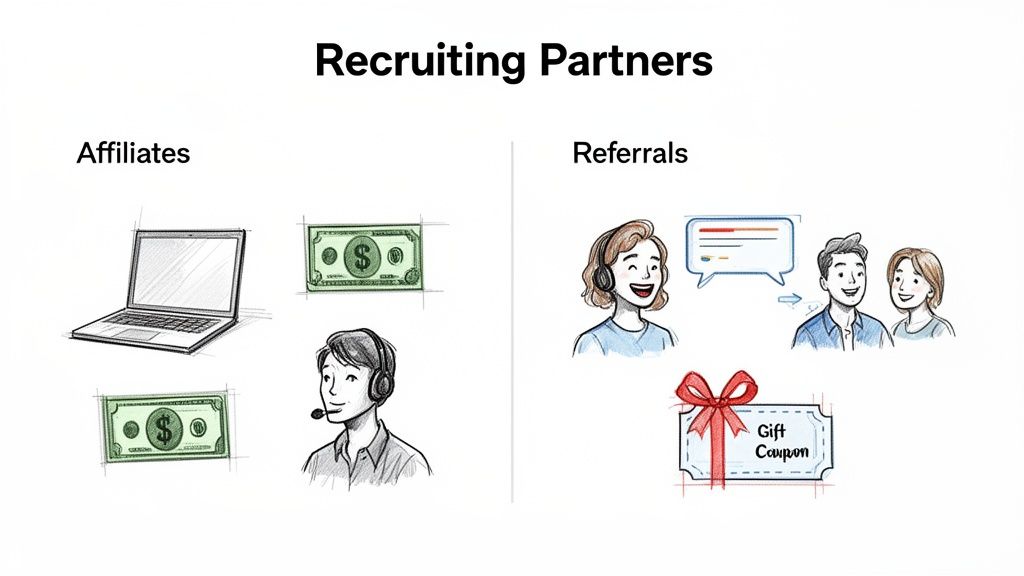
Affiliate programs are built on formal business relationships. Your ideal recruits aren't just happy customers; they're professional marketers, niche bloggers, YouTubers, and established industry players. These are people who have already put in the hard work of building their own audience and credibility.
Sourcing and Motivating Affiliates
Finding and signing affiliates is an active, outbound effort that feels a lot like a B2B sales cycle. Your job is to make a rock-solid case for your program's earning potential.
Proactive Outreach: This means hunting down content creators whose audience is a perfect match for your ideal customer. You'll need to reach out with a compelling pitch that gets straight to the point: commission rates, cookie duration, and average order value.
Negotiation and Onboarding: Affiliates expect a professional setup. That means clear contracts, a dedicated partner portal loaded with creative assets, and tracking they can trust to make sure they get paid for every single conversion.
Financial Motivation: Let's be clear: the number one driver for an affiliate is financial compensation. They are running a business, and promoting your product is just one of their monetization strategies. Cold, hard cash is the only incentive that matters.
This requires a real investment in partner management. You're not just flipping a switch on a program; you're building and nurturing a network of professional marketing partners.
The affiliate relationship is transactional and performance-based. Their motivation is driven by potential earnings, not brand love. Your recruitment strategy has to focus on demonstrating a clear path to profitability for them.
Activating Your Customer Advocates
Referral programs, on the other hand, go after a totally different crowd: your existing, happy customers. These folks aren't professional marketers. Their motivation is a mix of genuine loyalty, the social cred that comes from sharing something awesome, and the simple desire to help out their friends.
The recruitment process here isn't about outbound sales. It's about activation. You just need to make it ridiculously easy for happy customers to share their great experience.
Turning Customers Into a Growth Engine
Activating these brand advocates is all about integrating the referral opportunity right into their journey. The trick is to ask for a referral at the very moment their satisfaction is peaking.
Post-Purchase Prompts: The moment a customer clicks "buy" is a golden opportunity. A simple prompt on the confirmation page or a link in the confirmation email can work wonders.
In-App Notifications: For SaaS or mobile app users, a well-timed notification asking for a referral right after they've hit a key milestone is incredibly effective.
Targeted Email Campaigns: Segment your most loyal customers—the ones with a high LTV or a history of repeat purchases—and invite them to an exclusive referral program. This makes them feel like VIPs and far more likely to participate.
The reward here just reinforces that positive feeling. While affiliates want cash, referrers are often thrilled with discounts, store credit, or freebies—incentives that pull them even deeper into your brand. Managing these relationships is simpler, as explored in guides to modern partner programs, but it's just as crucial for building sustainable growth.
A Practical Guide to Implementation and Management
Moving from a whiteboard strategy to a real-world launch is where you'll feel the biggest operational split between affiliate and referral programs. Both absolutely need solid tracking software to work, but their day-to-day demands are worlds apart. Getting either program off the ground means being honest about these practical realities from day one.
Running an affiliate program is a hands-on, relationship-heavy job. It's definitely not a "set it and forget it" channel. You start by actively recruiting and vetting potential partners to make sure their brand and audience are a good fit. From there, you're negotiating contracts, setting up commission structures, and constantly supplying them with fresh creative assets like banners, ad copy, and unique landing pages.
On top of that, affiliate programs come with a heavier compliance burden. You're on the hook for making sure your partners follow FTC disclosure guidelines, which means you have to keep an eye on them and provide ongoing education. All this operational grit means you need powerful tools—and likely a dedicated manager—to keep the engine running.
Streamlining Your Referral Program Launch
Referral programs, on the other hand, are built for simplicity and automation. The setup is usually much lighter, with the main goal being to weave the program right into your existing customer journey. Here, management isn't about nurturing individual relationships; it's about fine-tuning a system so that sharing becomes effortless for everyone.
The main tasks usually boil down to this:
Integrating a lightweight tool: Most modern platforms use a simple JavaScript SDK or offer one-click integrations with tools like Stripe to get you live in minutes.
Automating reward distribution: A good system will automatically track every successful conversion and dish out rewards—like discounts or store credits—without you lifting a finger.
Optimizing user prompts: Your core job becomes testing and tweaking when and where you ask customers to make a referral. Is it on the post-purchase page? Inside their account dashboard? That's where you'll focus your energy.
This streamlined design slashes the administrative workload, freeing you up to think about growing the program instead of getting lost in the operational weeds.
The real management difference comes down to focus. Affiliate management is all about cultivating individual partner relationships and staying compliant. Referral management is about optimizing an automated system that empowers your entire customer base to become advocates.
Comparing Costs and Operational Overhead
The cost structures are where these two models really start to look different, which is why referral programs are so appealing for businesses that prioritize efficiency. Referral rewards are only paid out after a successful conversion, and they usually come in the form of discounts (10-25% of AOV) or store credits. This model fuels high ROI through viral, trust-based sharing and completely avoids the upfront costs of affiliate recruitment or network fees that can bloat your acquisition costs.
In contrast, affiliates need a much bigger operational setup. You're tracking cash commissions (5-30%) and managing legal disclosures for every single partner, which drives up both the cost and the complexity.
Choosing the Right Management Platform
Whether you land on an affiliate or a referral program, the right technology is non-negotiable. Your platform is the engine that powers everything—tracking, attribution, and payouts.
For an affiliate program, you need software that can handle:
Detailed partner dashboards for tracking performance.
Flexible commission structures (percentage, flat-rate, tiered).
Easy management of all your creative assets.
Reliable and timely payout processing.
For a referral program, the ideal platform should offer:
Seamless integration with your website or app.
Automated tracking of every share and conversion.
Effortless reward fulfillment for both the referrer and their friend.
Clear analytics to monitor the program's health and engagement.
Platforms like Blossu are built specifically to eliminate these operational headaches. By automating tracking, providing real-time dashboards for you and your partners, and handling all the reward distribution, they cut down the manual work significantly. This lets you scale your program efficiently, shifting your focus from administrative chores to strategic growth.
Making the Right Choice for Your Business
Alright, let's get down to it. You've seen how affiliate and referral programs work, but the real question is: which one is right for your business? Turning all this analysis into a concrete decision comes down to your specific goals, where your business is right now, and the resources you can actually commit.
This isn't a one-size-fits-all answer. The right choice hinges on what you're trying to achieve. This framework will help you cut through the noise and pick the strategy that truly aligns with your vision for growth.
The flowchart below breaks down the core decision. Are you chasing rapid, broad-scale growth, or are you focused on building a loyal, high-value customer base efficiently? Your primary goal is the signpost that points you in the right direction.
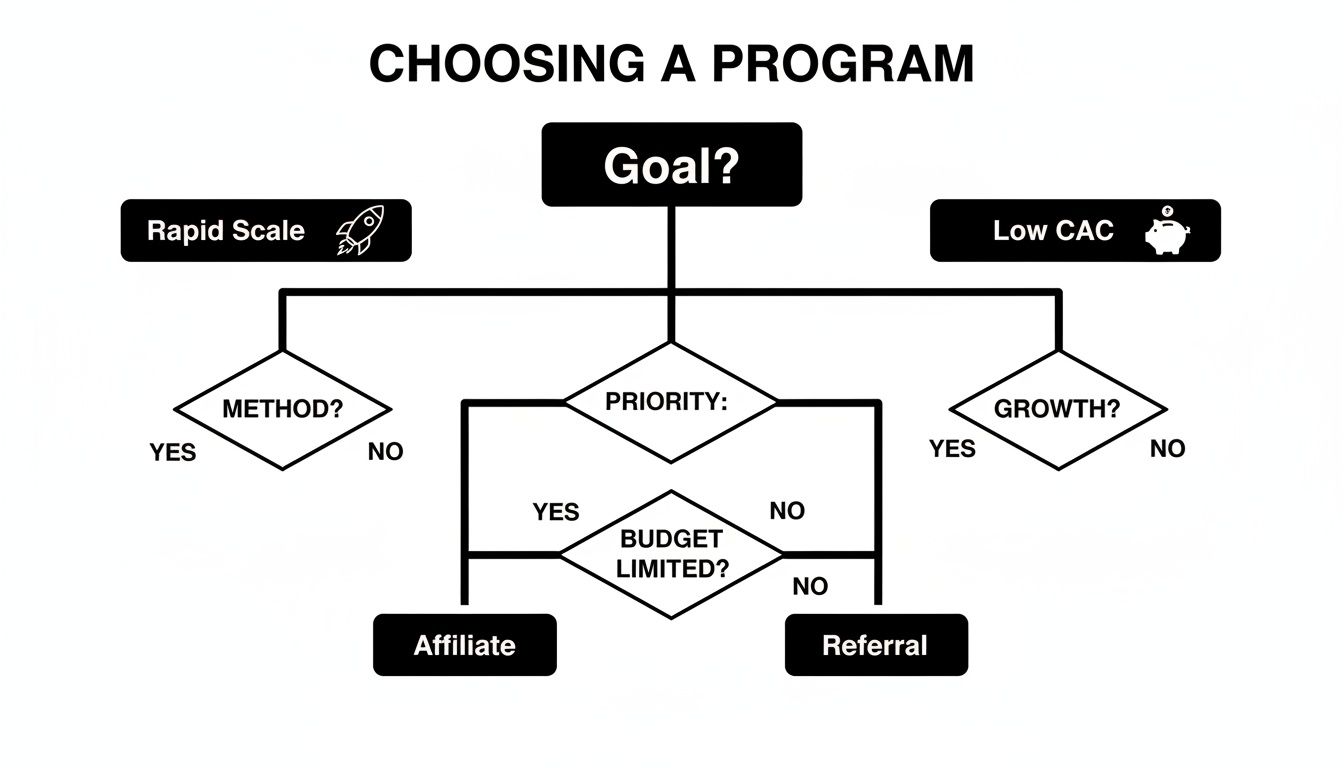
The takeaway here is simple but critical: your goal dictates your strategy. Affiliates are built for massive reach, while referrals are unbeatable for efficient, trust-driven growth.
Choose an Affiliate Program for Rapid Scale and Reach
An affiliate program is your go-to when the main objective is aggressive, large-scale growth and getting your brand name everywhere. Think of it as a powerful top-of-funnel engine, putting your product in front of countless new audiences you could never reach on your own.
You should seriously consider launching an affiliate program if you're in one of these situations:
You're breaking into a new market. Affiliates who already have a local following can give you instant credibility and a solid foothold in unfamiliar territory.
You need to drive a ton of traffic, fast. For a big product launch or a major sale, affiliates can generate a massive surge in awareness and clicks almost overnight.
Your product converts cold traffic well. If your value proposition is so clear and compelling that first-time visitors are likely to buy, an affiliate strategy will pay off.
But this approach isn't a "set it and forget it" deal. It demands a dedicated management effort. You need the resources to recruit, vet, and manage professional marketers, which includes everything from negotiating contracts and providing creative assets to ensuring everyone stays compliant.
Opt for a Referral Program for Loyalty and Efficiency
A referral program is the perfect move when your focus is on sustainable growth, building a loyal community, and acquiring high-LTV customers without breaking the bank. It works by tapping into your most powerful marketing asset: your existing happy customers.
A referral program is the right call if:
You have a strong base of delighted customers. If you're already getting great reviews and seeing repeat business, a referral program simply puts a structure (and a reward) around that organic word-of-mouth.
Your customer acquisition costs are creeping up. Referrals provide a much more cost-effective channel than paid ads, especially since rewards are often store credits that fuel repeat purchases.
You want to attract high-LTV customers. People who are referred to your brand start with a high level of trust, which leads to better retention and a higher lifetime value. In fact, data consistently shows that referred customers are 18% more loyal than those acquired through other channels.
The core idea of a referral program is to turn customer satisfaction into a predictable growth channel. It's about nurturing your existing community to build a sustainable, trust-based acquisition engine.
The Power of a Hybrid Approach
For many established businesses, the answer isn't choosing one or the other. Often, the most powerful strategy is to run both programs at the same time, with each one serving a distinct purpose in your marketing funnel.
Here's how a hybrid model can work wonders:
Affiliate Program for Top-of-Funnel Awareness: Use professional marketers and influencers to introduce your brand to broad, new audiences and drive that initial discovery.
Referral Program for Mid-to-Bottom-Funnel Conversion: Turn those newly acquired customers into brand advocates, empowering them to bring in high-trust, high-conversion leads from their personal networks.
This dual strategy lets you cast a wide net for brand awareness while simultaneously building a deep well of loyal, high-value customers. By keeping the programs and their partners separate—external pros for affiliates, existing customers for referrals—you create a comprehensive growth machine that covers the entire customer journey.
Frequently Asked Questions
When you're weighing an affiliate program vs. a referral program, a few key questions always pop up. Let's tackle the big ones head-on so you can move forward with clarity.
Frequently Asked Questions
Have a question not in here? Contact us
- Can a Business Run Both Programs at the Same Time?
Absolutely. In fact, many of the smartest companies do. Running both isn't redundant—it's a layered growth strategy, because each program targets a completely different stage of the marketing funnel. Think of it this way: your affiliate program is your top-of-funnel engine, working with marketers and content creators to cast a wide net and build brand awareness. Meanwhile, your referral program is your bottom-of-funnel powerhouse, activating your happiest customers to convert their trusted network into high-quality leads. The key is using a platform that can manage both without tangling up your tracking.
- What Are the Most Common Rewards for Each Program?
The rewards you offer are a direct line to your partners' motivations, and they couldn't be more different for each program. Affiliate Programs are all about the cash. Affiliates are professional marketers, and their incentive is almost always a cash commission. This is usually a percentage of a sale (anywhere from 5-30%) or a flat fee for each conversion. They're running a business, and cash is how they keep score. Referral Programs get way more creative. Here, the rewards are designed to build loyalty and strengthen the customer relationship. You'll see things like two-sided discounts (e.g., you and your friend both get 15% off), store credit, free products, or even tiered rewards that unlock bigger perks for more referrals.
- Which Program Is Better for a New Startup?
For most new SaaS or ecommerce startups watching their budget and nurturing a small but passionate user base, a referral program is the clear winner to start. It taps into the authentic word-of-mouth that is the lifeblood of any new venture and comes with a much lower customer acquisition cost (CAC). Customers who come from a referral already have a built-in layer of trust, which means they tend to stick around longer and have a higher lifetime value. Once your brand is on solid ground and you have the resources to manage external partners, you can layer in an affiliate program to really hit the accelerator on brand awareness.
🎯 Key Takeaways
Affiliate programs focus on external marketers for broad reach and brand awareness at scale
Referral programs leverage existing customers for high-quality, trust-based conversions
Referrals typically have higher conversion rates (3.74%) due to built-in trust from personal recommendations
Affiliate programs require more management but offer faster market penetration and reach
A hybrid approach can be most effective: affiliates for awareness, referrals for loyalty and retention
🚀 Transform Your Growth with Blossu
Turn your brand's biggest fans into your most effective growth channel. With Blossu, you can launch a powerful affiliate or referral program in minutes, not months. Automate tracking, manage payouts, and get the insights you need to scale predictable revenue.
✅ Unlimited affiliates & conversions - No restrictions on any plan
✅ Automated Stripe payouts - Set it and forget it
✅ Real-time analytics - Track every click and conversion
✅ Beautiful partner portal - Keep your affiliates engaged
✅ Visual workflow builder - Create complex automations in minutes
✅ White-label experience - Your brand, not ours