
How Does Referral Work: A Practical Guide to Word-of-Mouth Revenue
Referral marketing isn't about some clever new ad trick. It's about turning your happiest, most loyal customers into your most authentic and effective sales team.
At its heart, it's a simple, structured way for a business to reward existing customers (we call them advocates) for telling their friends about the products or services they love. When those friends become new customers, everyone wins. It's the digital evolution of pure, unadulterated word-of-mouth.
Turning Customers Into Advocates
Think about the last time you were looking for a great new restaurant. Did you trust a flashy billboard on the highway, or did you take the passionate recommendation from a friend who knows your taste?
Exactly. We all trust our friends. This is the simple, powerful truth that fuels every great referral program. It's not about shouting louder; it's about empowering genuine conversations and building on real-world trust.
A referral system just puts a little structure around this natural behavior. It introduces three key players:
The Company: The business with a product worth talking about.
The Advocate: A happy customer ready to share their great experience.
The Referred Friend: A potential new customer who trusts the advocate's judgment.
This creates a perfect win-win-win scenario. The company gets a high-value customer, the advocate gets a tangible reward for their loyalty, and the friend discovers something awesome from a source they already trust.
The Power of Trust in Marketing
Unlike traditional ads that customers have learned to tune out, referrals are built on a bedrock of social proof and genuine trust. That trust isn't just a feel-good concept; it translates directly into incredible business results.
Referred customers are a staggering 4x more likely to make a purchase than people who come from other channels. Even better, they deliver conversion rates 3-5x higher than what you'd typically see from paid advertising. These aren't just one-time buyers, either—they tend to stick around longer and spend more. You can dig into more of the referral marketing statistics and their impact on customer loyalty to see just how powerful this is.
With modern platforms like Blossu, what used to be a messy, hard-to-track process is now an automated and completely measurable growth engine.
Here's a peek at the Blossu dashboard, which cuts through the complexity of tracking and managing your program.
This gives you a clear, real-time view of your partners, their commissions, and the revenue they're driving, turning word-of-mouth from a fuzzy concept into predictable data.
From Manual Hassle to Automated Growth
Not too long ago, trying to run a referral program meant getting tangled up in messy spreadsheets and spending hours manually sending out reward payouts. It was a nightmare to manage and nearly impossible to scale.
Today, smart software handles all the heavy lifting. It automates everything from generating unique tracking links for each advocate to calculating commissions and paying them out on time. This frees you up to focus on what actually matters: building strong relationships with your advocates, not getting buried in administrative busywork. This is how referrals really work—by evolving from a simple idea into a powerful, sustainable business strategy.
The Technology Behind Modern Referral Tracking
For any referral program to work, you need a rock-solid way to connect a new customer back to the person who sent them. This isn't magic; it's a stack of clever, interconnected technologies working quietly behind the scenes. Getting a handle on how this tracking actually works is the key to building a program that's both fair and effective.
At the very center of it all is the unique referral link. Think of this as a digital fingerprint given to each of your advocates. When they share this link, it carries a special code—a unique identifier—that tells your system exactly who sent it.
This process makes sure every click and every sale can be accurately credited back to the right person. It kills the guesswork and builds a ton of trust in your program.
This visual flow breaks down the simple but powerful journey from you, to your advocate, and finally to their friend, the new customer.
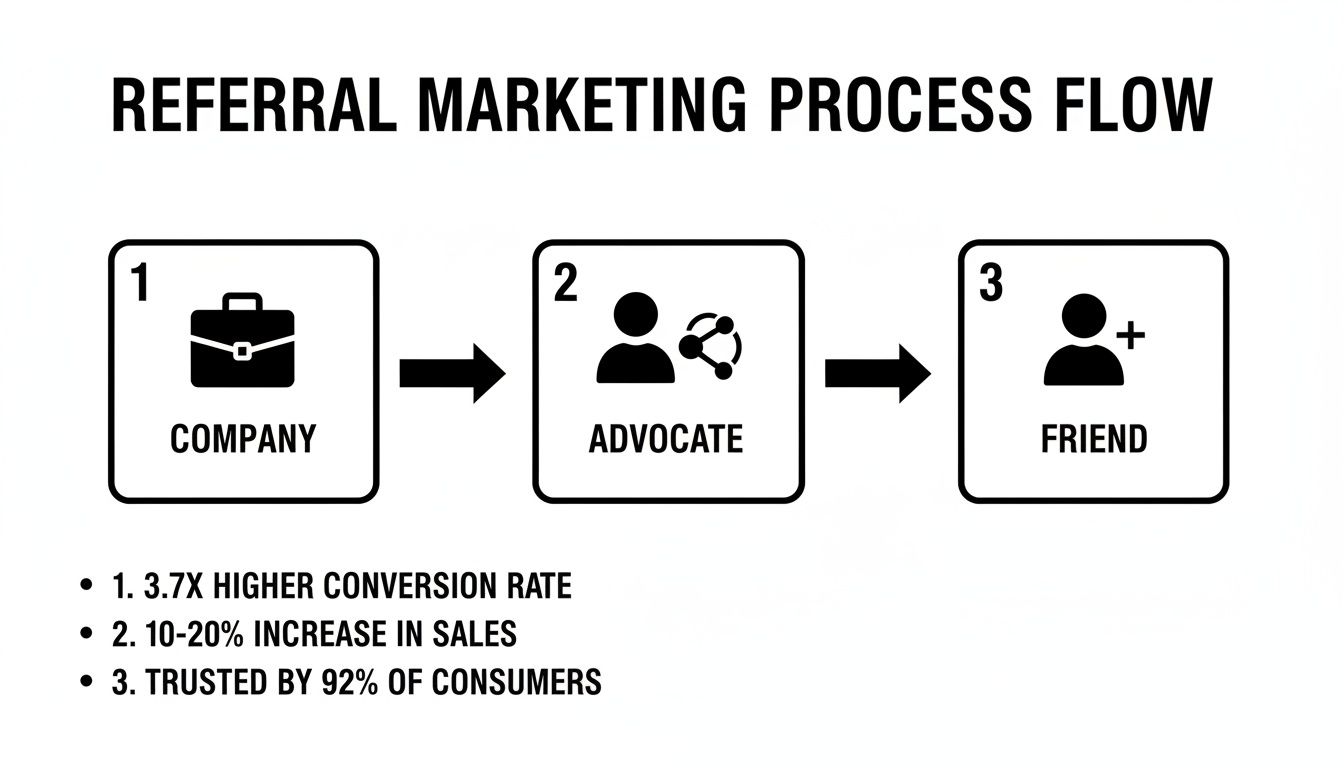
As you can see, a simple share from a trusted advocate directly results in a new, high-value customer for your business, creating a win for everyone involved.
The Role of Browser Cookies
So, what happens if the friend clicks the link, pokes around your site, but doesn't buy anything right away? This is where browser cookies save the day. A cookie is just a small piece of data that the web browser stores, acting like a little digital sticky note.
When a friend clicks the referral link, your referral software drops a cookie on their browser that contains the advocate's unique ID. If that friend comes back to your site days or even weeks later to finally make a purchase, the system reads that cookie and knows exactly who to credit for the sale.
This "cookie window" is a critical part of the setup. Most programs set a specific duration, like 30, 60, or 90 days, where the advocate can still earn their reward. This ensures they get recognized for their influence, even when the conversion isn't immediate.
A well-defined cookie policy is the foundation of a trustworthy referral program. It gives advocates confidence that their efforts will be rewarded, encouraging them to share more frequently and with greater enthusiasm.
Without this tech, you'd only be able to track instant purchases, leaving a huge chunk of referral-driven sales on the table. This is a core function that the best referral marketing software handles for you automatically, so you never have to sweat the technical details.
Tracking Beyond the Browser
While links and cookies are perfect for websites, the modern customer journey often jumps over to mobile apps. This requires a different, more direct way of tracking.
For mobile apps, tracking is usually handled with a Software Development Kit (SDK). An SDK is a small bit of code from the referral platform that you integrate directly into your mobile app.
Here's how it works:
Click & Redirect: The referred friend taps a referral link on their phone.
App Store Journey: The link sends them to the right app store (Apple App Store or Google Play) to download the app.
Attribution: Once the app is installed and opened for the first time, the SDK talks to the referral platform to match the new install back to the original advocate's click.
This method creates a durable connection that survives the whole app store download process, making sure your advocates get credit for mobile conversions, too.
Click Tracking vs. Conversion Tracking
Finally, it's really important to get the difference between two fundamental types of tracking. Understanding how referrals work means knowing what to measure.
Click Tracking: This is the most basic form of tracking. It simply counts how many times an advocate's unique link has been clicked. While it's useful for seeing engagement and reach, it doesn't tell you if those clicks are actually making you money. An advocate could get hundreds of clicks but zero sales.
Conversion Tracking: This is the metric that truly matters. It tracks when a referred friend completes the action you care about—usually, making a purchase. This is the trigger that issues a reward and is the ultimate measure of your program's success. Platforms like Blossu connect directly with payment processors like Stripe to automate this, ensuring rewards are only paid out on actual, verified sales.
By combining unique links, cookies, and more advanced tools like SDKs, a modern referral program can accurately follow the entire customer journey, from the first share to the final sale, no matter where it happens.
How to Design Your Reward Structure for Maximum Motivation
The tech behind referral tracking is the engine, but let's be honest—the reward is the fuel. Without a compelling reason for your customers to share, even the slickest tracking system will just gather dust. Figuring out the right reward isn't about giving stuff away; it's about understanding what actually motivates your audience to become genuine advocates for your brand.
The trick is to find the sweet spot where your incentive aligns with both your business model and your customers' desires. What works for a high-volume e-commerce shop will almost certainly fall flat for a B2B SaaS company. A great reward feels generous, fair, and worth the tiny bit of effort it takes to share.
Choosing Your Core Incentive Model
Every solid program is built on a core reward model. This is the main way your advocates will earn something for bringing in new business. Let's walk through the most common and effective options.
Percentage-Based Commission: With this model, your advocate gets a slice of the sale they bring in. It's a huge hit in e-commerce because it scales perfectly with the purchase size—the bigger the order, the bigger their payout. It's a fantastic way to motivate advocates to encourage larger sales.
Fixed-Amount Reward: This is as straightforward as it gets. You offer a set dollar amount for each successful referral, like "$25 for every new customer." This approach is perfect for subscription services or any business where the customer lifetime value (LTV) is pretty consistent. The simplicity makes it dead simple for advocates to grasp what's in it for them.
Store Credit or Product-Based Rewards: Instead of cash, you can reward advocates in a way that brings them right back to your business. Think store credit, a free product, or an extra month on their subscription. This is a brilliant way to supercharge loyalty and retention while keeping cash in your company. Dropbox famously used this to fuel its explosive growth by offering free storage space.
The choice often boils down to your profit margins and the kind of vibe you want your program to have. Percentage commissions can feel like a true partnership, while fixed amounts are clean, predictable, and easy to understand.
Your reward structure should be a direct reflection of the value a new customer brings to your business. Calculate your average Customer Lifetime Value (LTV) and Customer Acquisition Cost (CAC) to set a reward that is both motivating for advocates and profitable for you.
Choosing the Right Referral Reward Model
To help you decide, this table breaks down the common models, highlighting their strengths and where they fit best.
| Reward Model | How It Works | Best For | Key Benefit |
|---|---|---|---|
| Percentage Commission | Advocate earns a percentage of the referred customer's purchase. | E-commerce, high-ticket items, businesses with variable order sizes. | Scales reward with the value of the sale, motivating bigger purchases. |
| Fixed-Amount Reward | Advocate earns a set cash amount for each successful referral. | SaaS, subscription services, businesses with a predictable LTV. | Simple, predictable, and easy for advocates to understand their earnings. |
| Store Credit / Product | Advocate earns credits or free products for use with your business. | Companies with repeat customers, strong brand loyalty, and digital goods. | Boosts customer retention and keeps cash flow within the business. |
| Two-Sided Incentive | Both the advocate and the new customer receive a reward. | All business types, especially those looking for rapid, viral growth. | Increases the incentive to share by giving the friend an immediate benefit. |
Ultimately, the best model is one that feels like a win-win for everyone involved and aligns perfectly with your business goals.
Adding Layers for Deeper Engagement
Once you've got your core model locked in, you can start adding more advanced structures to keep your top performers hooked and prevent the program from getting stale. These layers can turn a simple referral program into a gamified experience that encourages people to share again and again.
A fantastic place to start is with a two-sided incentive, where you reward both the advocate and their referred friend. For example, the advocate gets $20, and the new customer gets 15% off their first order. This makes the offer way more compelling because the advocate is giving their friends an immediate, tangible benefit.
Here are a few other powerful structures you can layer on top:
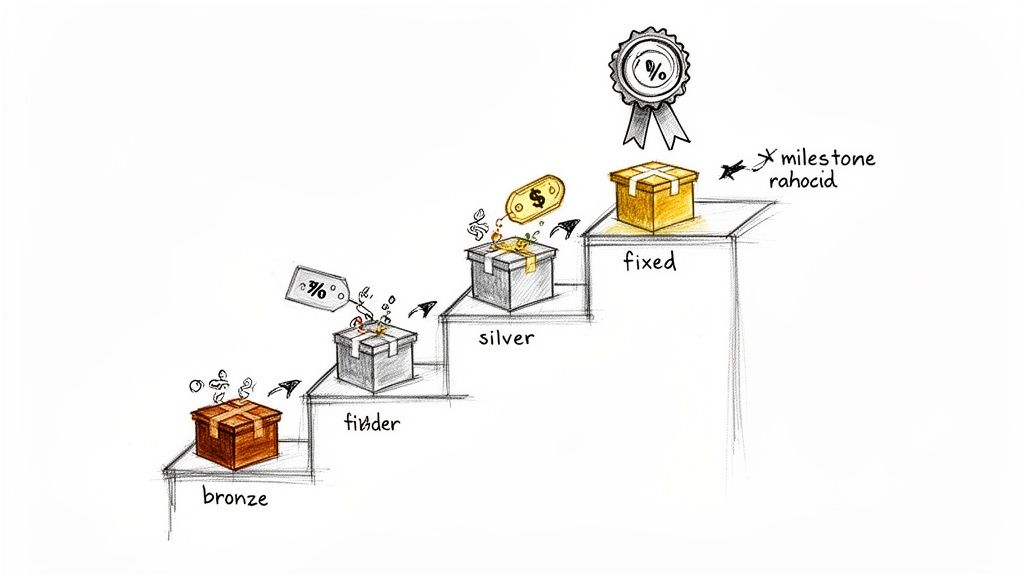
Milestone Bonuses: Reward advocates when they hit specific goals, like "Earn an extra $100 after your 10th successful referral." This drives consistency and gives your most active sharers something exciting to aim for.
Tiered Rewards: Create different levels for your advocates. A "Bronze" partner might earn a 10% commission, but once they drive 20 sales, they level up to "Silver" and start earning 15%. This creates a clear path for growth and recognizes your most valuable partners for their long-term loyalty.
These more advanced structures are powerful, but they require serious management. This is exactly where a platform like Blossu becomes a lifesaver. Trying to manually track tiers and milestone payouts is a recipe for headaches and human error. A dedicated platform automates the entire process, making sure rewards are calculated correctly and paid out on time, every single time. This lets you build a more sophisticated and motivating program without burying yourself in spreadsheets, so you can focus on building great relationships with your advocates.
Key Metrics for Measuring Referral Program Success
Launching a referral program without tracking its performance is like flying blind. You're moving, but you have no idea if you're actually heading in the right direction. To figure out if your program is really working, you have to look past vanity metrics like link clicks and focus on the numbers that tie directly to revenue and growth.
When you measure what matters, you can prove the program's value, make smarter decisions backed by data, and fine-tune your strategy over time. It turns your referral channel from a hopeful experiment into a predictable, scalable engine for winning new customers.
Gauging Advocate Engagement and Activity
Before a single sale is made, you need to know if your customers are even participating. These early metrics give you a clear pulse check on your program's health and how much it appeals to your existing user base. If these numbers are low, it's a big red flag that you might need to make your program more visible or sweeten the deal.
Two metrics are absolutely critical here:
Participation Rate: This is simply the percentage of your total customers who've signed up to be an advocate. It answers the most basic question: "Are people even interested?" A low rate might mean your customers don't know the program exists, or the initial offer just isn't compelling enough to get them to sign up.
Share Rate (or Referral Rate): This metric digs a little deeper, tracking what percentage of your enrolled advocates are actually sharing their unique links. This is a crucial sign of real engagement. A high participation rate paired with a low share rate could mean there's friction in the sharing process, or maybe your advocates just need a little nudge to get started.
A healthy program sees steady growth in both participation and sharing. If you have 1,000 customers and 100 sign up, your participation rate is 10%. If 50 of those advocates then share their link, your share rate is 50%.
Tracking Conversion and Financial Performance
Okay, so your advocates are active. Great. Now the focus shifts to the bottom line: are their efforts actually turning into business? This is where you measure the real return on investment (ROI) and see how your referral program stacks up against other marketing channels.
These are the financial KPIs that truly define success.
Referral Conversion Rate: This is arguably the most important metric of all. It measures the percentage of referred friends who click a link and actually make a purchase. If 100 friends click a referral link and 15 become paying customers, your conversion rate is 15%. A strong conversion rate is proof that your advocates are bringing you high-quality, relevant leads who are ready to buy.
Cost Per Acquisition (CPA): This tells you exactly how much you're spending to get each new customer through referrals. You calculate it by dividing your total rewards paid out by the number of new customers you gained. For example, if you paid out $500 in rewards and got 25 new customers, your CPA is $20. This number is your golden ticket for comparing the efficiency of your referral program to paid ads or other channels.
Using a Dashboard to Make Sense of It All
Trying to calculate all these metrics by hand is a recipe for headaches and mistakes. This is where a dedicated platform like Blossu becomes an absolute game-changer. It gives you a real-time dashboard that automatically tracks everything—from participation rates to CPA—all in one clean, simple interface.
Instead of getting lost in spreadsheets, you can see at a glance what's working and what isn't. This clarity empowers you to make quick, informed decisions, like testing a new reward if conversion rates are lagging or running a quick promo to boost your share rate. With all the data right at your fingertips, you can stop guessing and start optimizing your program for maximum impact.
Learning From the Best: What Makes a Referral Program Great?
Theory is one thing, but seeing how legendary brands put these ideas into practice is where the real learning begins. The most effective referral programs aren't just about throwing money at customers; they are masters of psychology, simplicity, and creating a seamless experience.
By breaking down what makes them tick, you can borrow proven strategies and apply them directly to your own business. These programs get one thing right: they make sharing feel less like a marketing task and more like helping out a friend. They nail the reward, remove all friction from the process, and make the value prop crystal clear for everyone involved.
Dropbox: A Masterclass in Simplicity
Dropbox's early growth is the stuff of startup legend, and it was fueled almost entirely by one of the simplest, most brilliant referral programs ever created. Instead of offering cash, they offered the one thing every user craved: more of their own product.
More free storage space. It was genius for a few reasons:
Product-Led Value: The reward directly made the product better for the user. More space meant they could rely on Dropbox more, making them stickier and more loyal.
A True Two-Sided Incentive: Both the person sharing and their friend received 500 MB of bonus space. This framing made the referral feel like a genuine gift, not a selfish act.
Frictionless Sharing: The invitation to refer was baked right into the onboarding and user interface. You couldn't miss it, and it was incredibly easy to use.
The takeaway from Dropbox is huge: the best reward isn't always cash. Often, it's something that deepens a customer's relationship with your product. If you're looking for more inspiration, you can explore other top-tier examples of referral programs that have mastered this art.
Airbnb: Building Trust in a New Market
Airbnb had a totally different problem to solve. It had to build trust between complete strangers who were about to sleep in each other's homes. Their referral program was designed to do exactly that, using a dual-sided reward to make both parties feel secure and excited.
Here's how it works: an Airbnb user refers a friend, and that friend gets a nice discount on their first trip. Simple enough. But the magic happens after that friend completes their stay—the original user then gets a travel credit for their own next adventure. This model is powerful because it drives both trial (for the new user) and retention (for the existing one).
The lesson from Airbnb is the power of a dual-sided reward to overcome hesitation. By giving the new person an immediate discount, the friend's recommendation carries more weight and feels less self-serving.
Today's programs take this even further by showing up where these conversations are already happening. Social media now dominates sharing; Facebook referrals can convert at 12%, while 43% of all referrals come from Instagram. Even better, data shows that referred customers are up to 5x more likely to refer others themselves, creating the kind of viral loops that legendary brands are built on. You can discover more insights about the impact of social sharing on referral marketing.
These examples prove that a great referral program is about more than just tech. It's about aligning your program with your product's core value and truly understanding the social dynamics that make people want to share.
Common Referral Program Pitfalls and How to Avoid Them
Even with the best intentions, a lot of referral programs just never get off the ground. They usually trip over the same avoidable hurdles that frustrate users and kill any excitement before it can even start.
Knowing what these pitfalls are is the secret to designing a program that feels effortless for your customers and actually drives results for your business.
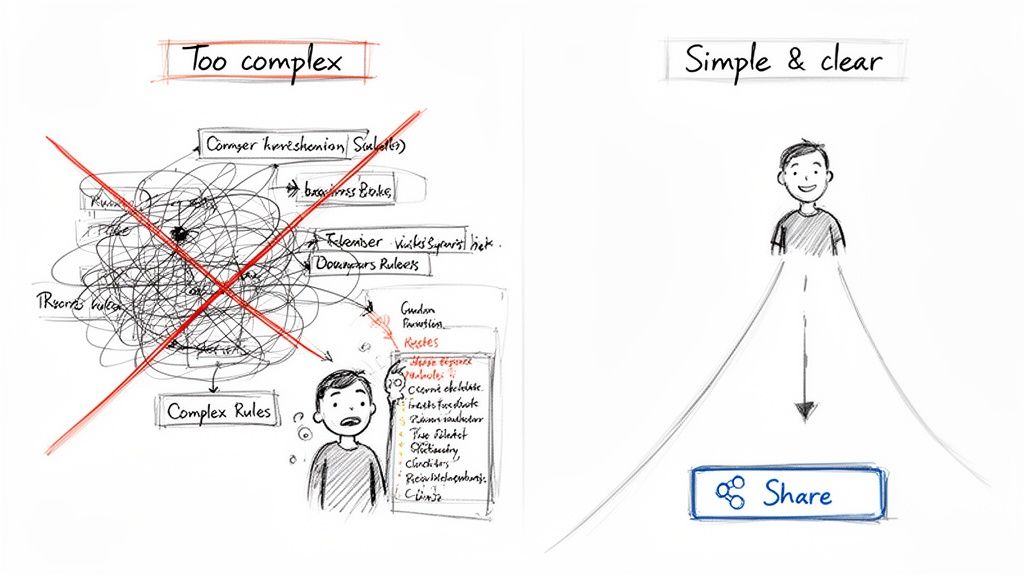
The single biggest mistake is making things too complicated. If your rules read like a legal document or sharing involves a bunch of confusing steps, your advocates will just give up. Simplicity isn't a feature; it's a requirement.
Overly Complex Rules and Processes
The second an advocate has to stop and wonder how does referral work for your specific program, you've already lost. Friction is the mortal enemy of sharing. Any confusion about how credit is earned, what counts as a successful referral, or when rewards are paid out creates hesitation.
This friction usually looks like this:
Confusing Terms: Making the advocate wait until their friend has subscribed for three months before they get credit.
Hidden Links: Burying the referral dashboard three layers deep in the account settings where no one ever looks.
Clunky Sharing: Not offering simple, one-click sharing options for social media, email, or messaging apps.
The solution is to put yourself in your customer's shoes. The entire process needs to be intuitive, from finding their unique link to understanding exactly what needs to happen for them to earn a reward. A great program feels like a natural part of your product, not an obstacle course.
The golden rule of referrals is to remove every possible point of friction. The easier you make it for someone to share and get rewarded, the more likely they are to do it. One extra click can be the difference between a share and a lost opportunity.
Mismatched Incentives and Poor Communication
Another classic mistake is offering a reward that just doesn't connect with your audience. A $5 coupon for a $500 product doesn't feel motivating; it feels a little cheap. The reward has to feel proportional to the effort involved and the value of the new customer.
But even the perfect reward can fall flat if communication is poor. Advocates who feel like they're shouting into the void will quickly lose interest. They want to know when a friend has signed up and when a reward is heading their way. That feedback loop is crucial.
To avoid this, you absolutely have to:
Offer a Valuable Reward: Make sure the incentive is something that genuinely excites your customers.
Provide Transparency: Give advocates a simple, clear dashboard where they can track their clicks, conversions, and earnings in real time.
Communicate Proactively: Set up automated email notifications for key events, like a successful referral or a reward payout.
Building a program that works comes down to truly understanding your customers and committing to a frictionless experience. For a deeper dive into creating a program that actually gets results, check out our guide to referral program best practices. By sidestepping these common mistakes, you can build a system that runs on trust, transparency, and genuine motivation.
Answering Your Referral Program Questions
Even with a solid game plan, a few practical questions always pop up right before you hit "go." Let's clear the air on the most common things business owners ask when they're ready to get a referral program off the ground.
How Long Does It Take to See Results From a Referral Program?
You'll probably see a few referrals trickle in within the first few days, which is always a great sign. But the real, sustainable momentum takes a little time to build.
Give it 1-3 months to gather enough meaningful data. This is the sweet spot for understanding how many people are participating and, more importantly, how well those referrals are converting into actual customers. The key to speeding this up is consistent promotion—the more you remind your happy customers that the program exists, the faster you'll build a reliable growth engine.
What Is the Difference Between a Referral and an Affiliate Program?
This one trips a lot of people up, but the difference is actually pretty simple. It all comes down to the relationship you have with the person doing the promoting.
Referral Programs are for your existing customers—the people who already know and love your product. They're sharing it with friends, family, and colleagues. The whole thing is built on genuine, personal trust.
Affiliate Programs are typically for professional marketers, partners, or influencers. They promote your product to a much broader, often colder, audience. It's less about personal relationships and more of a formal marketing partnership, usually driven by a cash commission.
Do I Need Special Software to Run a Referral Program?
If you only have a handful of customers, you could technically try to manage it all with a spreadsheet. But that will become a messy, error-prone nightmare almost immediately.
To run a program that people actually trust and want to be a part of, specialized software isn't just a nice-to-have; it's essential.
A dedicated platform isn't a luxury; it's a necessity for building trust. It automates tracking, guarantees accurate reward payouts, and provides the clear analytics both you and your advocates need to see the program is working fairly and effectively.
Trying to do it manually is a surefire way to frustrate your best customers and kill the program before it even gets going.
Ready to turn your customers into your best marketing channel without the manual hassle? Blossu automates your entire referral program, from tracking to payouts, so you can focus on growth. Launch your referral program in minutes with Blossu.
Frequently Asked Questions
Have a question not in here? Contact us
- How long does it take to see results from a referral program?
You'll probably see a few referrals trickle in within the first few days, which is always a great sign. But the real, sustainable momentum takes a little time to build. Give it 1-3 months to gather enough meaningful data. This is the sweet spot for understanding how many people are participating and, more importantly, how well those referrals are converting into actual customers. The key to speeding this up is consistent promotion—the more you remind your happy customers that the program exists, the faster you'll build a reliable growth engine.
- What is the difference between a referral and an affiliate program?
This one trips a lot of people up, but the difference is actually pretty simple. It all comes down to the relationship you have with the person doing the promoting. Referral Programs are for your existing customers—the people who already know and love your product. They're sharing it with friends, family, and colleagues. The whole thing is built on genuine, personal trust. Affiliate Programs are typically for professional marketers, partners, or influencers. They promote your product to a much broader, often colder, audience. It's less about personal relationships and more of a formal marketing partnership, usually driven by a cash commission.
- Do I need special software to run a referral program?
If you only have a handful of customers, you could technically try to manage it all with a spreadsheet. But that will become a messy, error-prone nightmare almost immediately. To run a program that people actually trust and want to be a part of, specialized software isn't just a nice-to-have; it's essential. A dedicated platform isn't a luxury; it's a necessity for building trust. It automates tracking, guarantees accurate reward payouts, and provides the clear analytics both you and your advocates need to see the program is working fairly and effectively.
- What's the ideal reward structure for a referral program?
The reward structure should be a direct reflection of the value a new customer brings to your business. Calculate your average Customer Lifetime Value (LTV) and Customer Acquisition Cost (CAC) to set a reward that is both motivating for advocates and profitable for you. Common models include percentage-based commission (great for e-commerce), fixed-amount rewards (perfect for SaaS), and store credit or product-based rewards (excellent for building loyalty).
- How do I prevent fraud in my referral program?
Implement clear terms of service that outline prohibited activities like self-referrals, cookie stuffing, and bidding on your branded keywords. Use tracking software to monitor for unusual patterns like sudden traffic spikes from single sources or abnormally high conversion rates. Create a warning system for minor infractions before account suspension, and require manual review for high-volume partners. Having a comprehensive partner agreement gives you clear grounds for enforcement.
🎯 Key Takeaways
Referral programs turn happy customers into advocates by structuring word-of-mouth with rewards and tracking
Modern tracking uses unique links, browser cookies, and mobile SDKs to accurately credit advocates for conversions
Reward structures should align with business models: percentage commissions for e-commerce, fixed amounts for SaaS, product rewards for loyalty
Focus on conversion tracking over click tracking to measure what actually drives revenue and ROI
Simplicity is crucial - complex rules and processes kill advocate participation and program effectiveness
Dedicated software platforms automate tracking, payouts, and analytics to build trust and scale programs efficiently
🚀 Launch Your Referral Program with Blossu
Ready to transform word-of-mouth into predictable revenue? With Blossu, you can implement the tracking, rewards, and analytics covered in this guide in just minutes. Our platform handles the complexity while you focus on building relationships with your advocates. Start building your referral engine today and turn your customers into your most powerful growth channel.