
Pro Guide: how to calculate commission on sales for your team
At its core, the math for calculating sales commission is simple: you just multiply the commissionable revenue by the commission rate. A $10,000 sale with a 10% commission rate means a $1,000 payout. Easy enough.
But that simple formula is just the beginning. The real work—and the real impact—comes from choosing the right commission structure for your business in the first place.
Decoding Your Sales Commission Structure
Before you can even think about running the numbers, you need a solid foundation. The commission structure you build isn't just a math problem; it's a strategic lever that shapes your team's motivation and points them directly at your company's most critical goals.
A well-designed commission structure is a roadmap. It tells your sales team exactly what behaviors the company values most. Are you laser-focused on acquiring new customers as fast as possible? Maximizing the profit on every single deal? Or are you playing the long game, driving sustainable growth? Each of these goals demands a different approach.
Aligning Models with Business Goals
The most common commission models are popular for a reason—they each solve a specific business problem. Choosing the right one is all about getting honest about your top priorities.
Percentage-Based Commission: This is the classic model where salespeople earn a direct cut of the revenue they bring in. It's perfect for businesses that want to drive top-line revenue growth with a simple, predictable incentive.
Tiered Commission: This structure rewards your top performers by bumping up their commission rate as they smash through sales targets. It's a fantastic way to motivate a competitive team and pour fuel on the fire once you have solid product-market fit.
Fixed-Rate Commission: Paying a flat dollar amount per sale (or per action, like a booked demo) keeps the math incredibly simple. This works well for products with a standardized price point or when the main goal is just to generate leads or set appointments.
This decision tree gives you a quick visual guide for picking a model based on whether you're chasing sales volume, protecting your margins, or hitting the accelerator on growth.
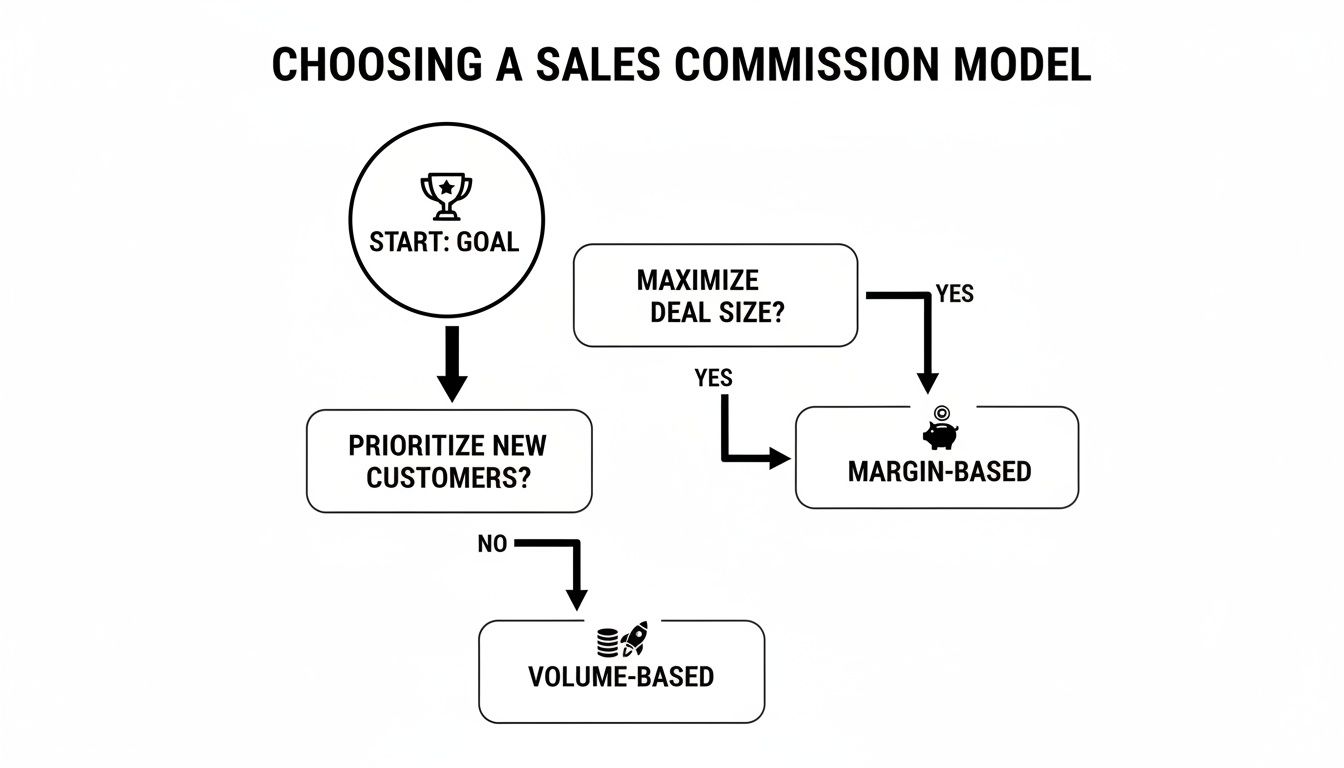
As the flowchart shows, high-volume businesses with tighter margins often lean on fixed-rate or simple percentage models. On the other hand, companies obsessed with profitability will likely get more value from margin-based or tiered structures that reward bigger, more profitable deals.
Industry Benchmarks and Key Metrics
Commission rates can swing wildly from one industry to another, driven by things like profit margins, sales cycle length, and deal complexity. Globally, most rates fall somewhere between 5% and 20% of the sale value.
High-margin industries like real estate or enterprise software can often support rates in the 10-20% range. Meanwhile, lower-margin businesses like retail might stick closer to 1-5% to stay profitable. It's worth taking a look at a deeper analysis of commission rates for sales to see where your industry typically lands.
Your commission structure should be a living document, not a "set it and forget it" policy. As your business evolves—you launch new products, enter new markets, or tweak your sales process—your comp plan has to adapt right along with it to keep everyone aligned.
Finally, none of this works without clean, consistent data. Establishing and tracking the right Sales KPIs is crucial for building a fair structure and calculating commissions accurately. When everyone is working from the same playbook, you ensure that rewards are tied directly to the outcomes that actually move the business forward.
The Essential Formulas for Commission Calculation
Alright, you've got the strategy down. Now it's time to get into the nuts and bolts—the actual math that makes a commission plan work. Knowing how to calculate sales commissions isn't just about cutting checks; it's about giving your sales team or partners the crystal-clear transparency they need to stay hungry and motivated.
Let's break down the most common formulas you'll run into. We'll use real-world examples and even drop in a few spreadsheet functions you can use right away.
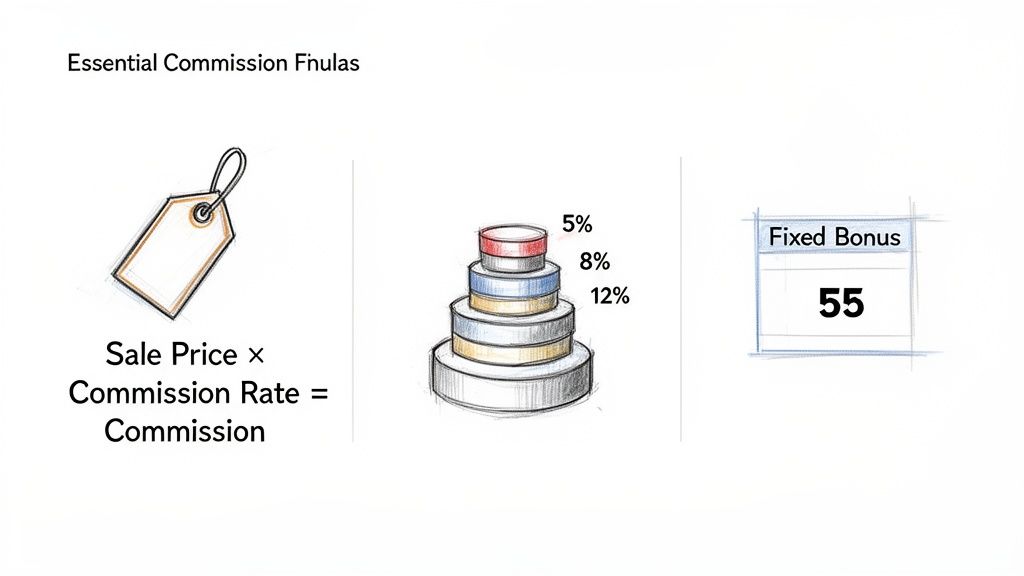
Straight Commission Formula
This is the bread and butter of commission structures. It's simple, direct, and incredibly common for a reason: it's easy for everyone to understand. The commission is just a flat percentage of the total sale amount.
The formula couldn't be simpler: Commission = Sale Amount × Commission Rate
Let's say a direct-to-consumer brand sells a premium coffee machine for $500. They offer their affiliate partners a generous 15% commission for every sale they send their way.
When an affiliate's link leads to a purchase, the math is straightforward:
Sale Amount: $500
Commission Rate: 15% (which is 0.15 in decimal form)
Commission Earned: $500 × 0.15 = $75
This model is so effective because the incentive is perfectly clear. More revenue generated means more money earned, with no confusing thresholds or tiers to worry about.
Spreadsheet Tip: In Google Sheets or Excel, if your sale amount is in cell A2 and the commission rate (as a decimal, like 0.15) is in B2, the formula is simply =A2*B2. Easy.
Tiered Commission Formula
A tiered structure is where things get more interesting. This model is built to reward your top performers by bumping up their commission rate as they hit higher sales volumes. It's a fantastic motivator for ambitious reps, giving them a clear incentive to blow past their targets.
Calculating tiered commissions involves a few more steps, since you're applying different rates to different chunks of revenue.
Let's take a SaaS startup as an example. The SaaS world lives and breathes commission-based pay. On average, reps pull in a total compensation of around $126,000, split between their base salary and commissions. A standard commission often lands around 10% of the Annual Contract Value (ACV), making it a massive part of their take-home pay. You can dig into more SaaS sales compensation statistics on everstage.com.
Imagine this tiered plan for a SaaS rep's monthly sales:
Tier 1: 8% commission on sales up to $10,000
Tier 2: 10% commission on the portion of sales from $10,001 to $20,000
Tier 3: 12% commission on all sales above $20,000
If that rep closes a massive $25,000 in new business for the month, you don't just multiply the total by 12%. You have to calculate the commission for each tier separately:
Tier 1 Commission: $10,000 × 8% = $800
Tier 2 Commission: ($20,000 - $10,000) × 10% = $10,000 × 10% = $1,000
Tier 3 Commission: ($25,000 - $20,000) × 12% = $5,000 × 12% = $600
Their total commission for the month is the sum of all three tiers: $800 + $1,000 + $600 = $2,400.
Fixed-Amount and Milestone Commissions
Not every commission needs to be a percentage. Sometimes, a flat dollar amount is cleaner and makes more sense, especially when you want to reward specific actions or major achievements.
Fixed-Amount per Sale
This model pays a set dollar figure for each unit sold or customer signed. It's perfect for products with a consistent price point or for lead generation programs where the main goal is driving volume.
The formula is: Commission = Number of Sales × Fixed Rate per Sale
For instance, a company selling a $299 online course might offer partners a flat $50 commission for every single enrollment. If a partner drives 20 sign-ups, their payout is:
Commission: 20 enrollments × $50/enrollment = $1,000
Milestone Bonus
A milestone bonus is a one-time kicker for hitting a big, specific target. It isn't tied to any single sale but to an overall achievement, acting as a powerful nudge to reach a stretch goal.
Let's say a business offers a $1,000 bonus to any sales rep who lands 10 new clients in a single quarter. This bonus gets paid out on top of their regular percentage-based commissions. It's a great way to reward both consistency and high volume, pushing the team to nail a critical company objective.
These core formulas are the building blocks for almost any commission plan you can dream up. By mixing and matching them, you can build a custom structure that aligns perfectly with your business goals and keeps your team laser-focused on growth.
Commission Calculation Models at a Glance
To make it easier to see how these models stack up, here's a quick-reference table. It breaks down each structure, its basic formula, and where it tends to shine.
| Commission Model | Basic Formula | Best For | Example Scenario |
|---|---|---|---|
| Straight Percentage | Sale Amount × Commission Rate | Simple sales cycles, clear revenue goals, affiliate & partner programs. | An e-commerce store paying affiliates 10% of every referred sale. |
| Tiered Commission | Calculated in stages for each tier's sales | Motivating high performers, sales teams with varied output, long sales cycles. | A SaaS company paying 8% on the first $10k in sales, then 12% above that. |
| Fixed-Amount | Number of Sales × Fixed Rate | Products with uniform pricing, lead generation, rewarding specific actions. | A software company paying $100 for every customer who signs up for a demo. |
| Milestone Bonus | A set bonus for hitting a specific target | Driving toward major company goals, encouraging team-wide pushes, stretch goals. | A $5,000 team bonus for hitting the quarterly revenue target of $500,000. |
Think of this table as your cheat sheet. When you're designing or refining your commission plan, you can quickly reference it to find the model that best fits the behavior you want to incentivize.
Handling Real-World Commission Complexities
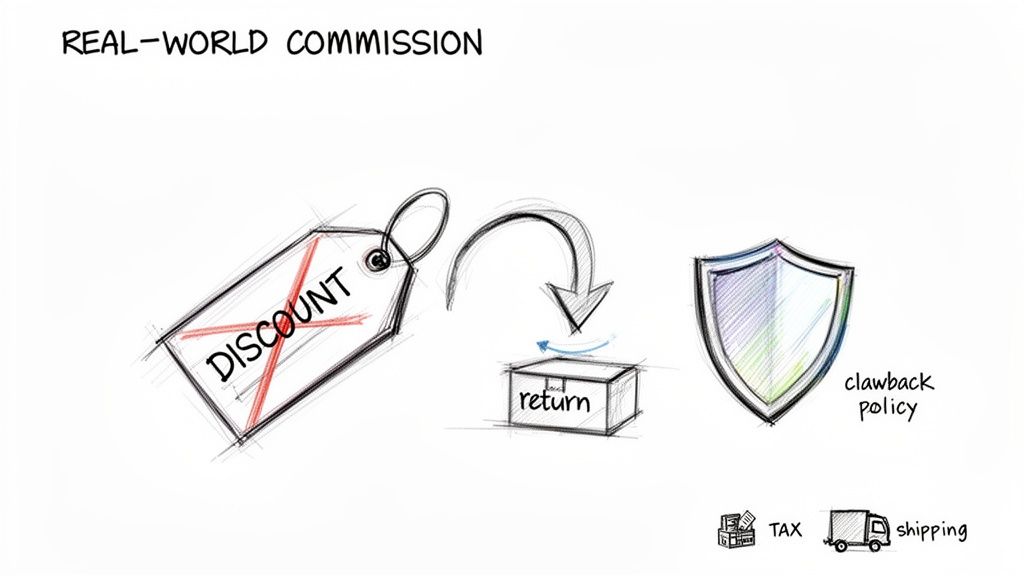
The clean math of a commission formula is a great place to start, but sales rarely happen in a perfect vacuum. In the real world, you're constantly juggling discounts, returns, taxes, and shipping costs. If you ignore these variables, you're setting yourself up for confusion, disputes, and an unhealthy bottom line.
A rock-solid commission policy anticipates this stuff from day one. By defining exactly how to handle these situations, you build a transparent and fair system that protects your business while keeping your sales team or partners fired up. This clarity is everything when it's time to build lasting trust.
Factoring in Discounts and Promotions
One of the first questions that always comes up is whether to pay commission on the original price or the final, discounted price. The answer should always, always be the same: commission is calculated on the net sale amount after discounts have been applied.
Let's say a product has a list price of $200. Your salesperson offers a 20% discount to seal the deal, bringing the final sale price down to $160. If your commission rate is 10%, the calculation has to be based on the actual cash you collected.
Commissionable Revenue: $160
Commission Earned: $160 × 10% = $16.00
Paying commission on the original $200 means you're paying on revenue you never actually received. That eats directly into your profit margins and, frankly, incentivizes deep discounting that can devalue your brand over time. Your commission agreement needs to spell this out in plain English to avoid any arguments.
Your sales commission plan isn't just a payment schedule; it's a legal agreement. Commissions are considered wages in many jurisdictions, so clear, documented policies are non-negotiable for compliance.
Managing Returns and Chargebacks
Just like you pay on revenue collected, you have to account for revenue that gets sent back. When a customer returns a product or initiates a chargeback, the commission you paid on that sale needs to be addressed. This is where a clawback policy is mission-critical.
A clawback is simply the process of reclaiming a commission that was already paid out for a sale that later got reversed. Without one, you could easily end up paying commissions on sales that ultimately generated zero revenue.
Your policy should define a specific time window for these clawbacks, usually 30 to 90 days to align with your return policy. For example, if a $50 commission was paid for a sale in January and the customer returns the item in February, that $50 gets deducted from the salesperson's next commission check.
Transparency is key here. Your reps need to know the rules of the game upfront so a clawback doesn't feel like an unfair penalty. It's just an adjustment to make sure their earnings line up with the company's actual revenue.
Excluding Taxes and Shipping Fees
The final piece of the puzzle is getting crystal clear on what "revenue" actually means. When you're calculating sales commission, you should only ever consider the core product or service revenue. All those other fees need to be stripped out.
Here's what to remove before you apply the commission rate:
Sales Tax: This is money you collect for the government. It's not your revenue.
Shipping and Handling Fees: These fees are there to cover logistics costs, not as part of the product's value.
Let's walk through a complete example. A customer buys a product for $100, pays $10 for shipping, and is charged $7 in sales tax. The total payment collected is $117. But the commissionable amount is only $100. With a 10% commission rate, the payout is $10, not $11.70.
Defining these rules in your official commission agreement is the single most important step you can take. It eliminates ambiguity, prevents disputes, and ensures everyone knows exactly how their hard work translates into their paycheck.
Calculating Commission for Recurring Revenue Models
For any business built on subscriptions, like a SaaS platform or a membership site, commissions aren't a one-and-done deal. They're a living reflection of an ongoing customer relationship. Calculating commissions on recurring revenue forces you to think about long-term value and customer loyalty, not just the initial sale.
The real challenge here is figuring out how to fairly reward a partner for a customer who might pay you every single month for years. This isn't just about a single transaction; it's about giving partners a powerful incentive to bring in high-quality, loyal customers who actually stick around. Your approach will directly shape your partners' behavior and, ultimately, your bottom line.
Choosing Your Recurring Commission Model
When it comes to recurring revenue, you've really got two main paths to choose from. Each one sends a completely different message to your partners about what you value most.
Upfront One-Time Commission: This model pays a larger, single commission based on the initial sale. You might, for example, pay a 30% commission on the first month's payment or a slice of the total first-year contract value.
Ongoing Recurring Commission: This model pays a smaller commission percentage, but it pays out every single time the referred customer renews. A common rate is 10-20% of each monthly payment, often for the entire lifetime of the customer.
Let's see how this actually plays out.
A Real-World SaaS Example
Imagine a SaaS business with a $100/month subscription plan. They could offer a partner one of two deals:
The Upfront Model: A 50% commission on the first month's payment. The partner gets an immediate $50 payout.
The Recurring Model: A 15% commission for as long as the customer stays subscribed. The partner earns $15 every single month.
After just four months, the recurring model already pulls ahead for the partner ($60 vs. $50). This structure is brilliant because it encourages partners to promote your service to audiences that are a genuinely good long-term fit, which naturally helps reduce churn.
Handling Subscription Changes and Churn
Recurring revenue is never static. Customers upgrade, downgrade, and sometimes, they leave. Your commission plan needs crystal-clear rules for these events to keep things fair and transparent for everyone involved.
Upgrades: When a customer moves to a more expensive plan, the partner's commission should absolutely increase with it. If that $100/month customer upgrades to a $250/month plan, a partner earning 15% should see their monthly payout jump from $15 to $37.50. This is how you reward partners for bringing in customers who grow with your business.
Downgrades: By the same token, if a customer moves to a cheaper plan, the commission has to adjust downward. This is just common sense—it ensures you're only paying a commission on the revenue you're actually bringing in.
Churn: This one is simple. When a customer cancels their subscription, the commissions stop. This is the fundamental rule of recurring commissions, and it directly aligns your partner's success with your customer retention.
Key Takeaway: A well-designed recurring commission structure transforms partners from one-time deal-closers into long-term growth allies. Their incentive isn't just to make the sale but to ensure the customer succeeds and stays with your business.
This philosophy is a cornerstone of many successful revenue share agreements, where both the company and the partner share in the ongoing success of a customer. By building a plan that rewards longevity, you create a powerful, predictable engine for sustainable growth. Your partners are now motivated to find not just any customer, but the right customer.
Why You Should Automate Commission Calculations
Spreadsheets are the go-to tool for a reason—they're flexible, familiar, and get the job done when you're just starting out. But as your business grows, that trusty spreadsheet can quickly become your biggest bottleneck. Manually calculating commissions is tedious, dangerously prone to human error, and simply doesn't scale.
When you spend the first few days of every month buried in VLOOKUPs and pivot tables, it's a clear sign your process is broken. That time spent on manual reconciliation, cross-referencing sales data, and fielding endless questions from partners about their payouts is time you're not spending on growing the business.
The Tipping Point for Automation
There's a moment in every growing company's journey where the pain of manual calculations outweighs the perceived simplicity of a spreadsheet. This tipping point often shows up as a series of recurring problems.
Recognizing these signs early can save you from costly mistakes and strained partner relationships.
Error-Driven Payouts: A single misplaced decimal or a copy-paste error can lead to overpaying or underpaying a partner, immediately eroding trust.
Time Sink: What used to take an hour now takes a full day or more. This is a direct operational cost that only gets worse as you add more partners and sales.
Lack of Transparency: Partners are left in the dark about their earnings until you send them a report. This uncertainty kills motivation and leads to constant back-and-forth communication.
Scalability Ceiling: You start to dread success. The thought of onboarding ten new partners is overwhelming because you know the administrative workload will explode.
This visual shows the ideal flow where automation handles the heavy lifting, from a sale being made to the partner seeing their earnings in a dashboard.
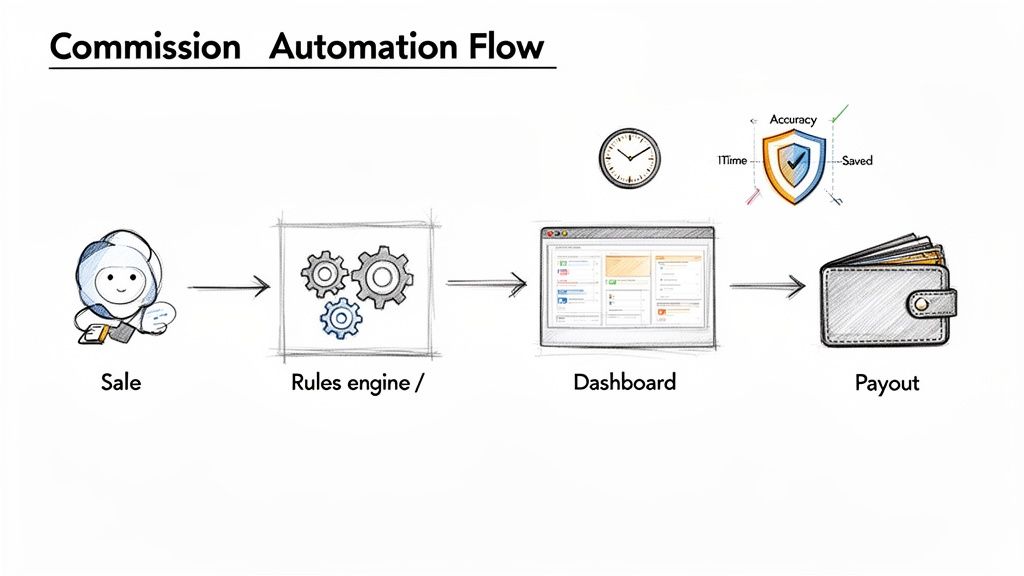
This streamlined process removes manual data entry and calculation, making the entire system more reliable and efficient.
How Automation Platforms Solve These Problems
This is where dedicated commission management platforms come in. Modern tools are built to handle the entire lifecycle of a commission, from tracking the initial sale to processing the final payout, all without manual intervention.
Platforms like Blossu integrate directly with your existing payment systems, such as Stripe. This connection is the key to true automation. When a sale occurs, the platform automatically captures the transaction data, applies your specific commission rules in real-time, and attributes the earning to the correct partner.
The sales compensation landscape has shifted dramatically, with 71% of organizations now tying compensation directly to measurable performance goals. This move away from flat structures is fueled by automation. The global incentive compensation management (ICM) software market, valued at $2.22 billion in 2024, is projected to soar to $8.97 billion by 2033. This growth shows just how central automated commission calculation has become for companies aiming to boost revenue.
The Tangible Benefits of a Hands-Off System
Moving to an automated system delivers immediate and measurable returns. It's not just about saving a few hours; it's a strategic upgrade that impacts your operations, partner relationships, and bottom line.
By automating commission calculations, you're not just buying software; you're buying back time, accuracy, and trust. You turn a reactive, error-prone administrative task into a proactive, reliable growth driver.
The primary benefits are clear:
Massive Time Savings: You reclaim dozens of hours every month previously lost to manual data entry, reconciliation, and troubleshooting. This frees up your team to focus on strategic initiatives.
Elimination of Costly Errors: Automation removes human error from the equation, ensuring payouts are always accurate. This prevents overpayments that hurt your margin and underpayments that damage partner morale.
Real-Time Transparency and Trust: Partners get access to their own dashboard where they can see their referrals, conversions, and commissions update in real-time. This transparency builds immense trust and keeps them motivated.
Effortless Scalability: Onboarding new partners is as simple as sending an invite link. The system handles the increased volume without adding to your workload, allowing you to scale your program confidently.
For a truly hands-off approach, implementing Straight Through Processing (STP) ensures full automation from data input to payout. Integrating directly with your payment processor is a critical first step. You can learn more about how to get started with this in our guide on setting up Stripe revenue tracking at https://blossu.com/help/setup/stripe-revenue-tracking. This direct link is what makes real-time, accurate commission attribution possible, forming the backbone of a modern, scalable partner program.
Got Questions About Sales Commissions? We've Got Answers.
Even the most buttoned-up commission plan will spark questions. That's a good thing—it means your team is engaged. But how you handle those tricky "what if" scenarios is what separates a motivating compensation plan from a confusing one.
Think of this as your go-to guide for navigating those gray areas. We're tackling the most common questions we hear, giving you clear, straightforward answers to keep your commission structure fair, transparent, and trusted.
Frequently Asked Questions
Have a question not in here? Contact us
- What Is a Fair Commission Rate to Offer?
There's no magic number here. A "fair" rate for one business could sink another, so it all comes down to your own business model and, most importantly, your profit margins. The goal is to find a sweet spot that fires up your partners without wrecking your bottom line. For high-margin stuff like SaaS or digital products, you'll often see competitive rates floating between 20% and 40%. But if you're selling physical goods with tighter margins, a rate in the 5% to 15% range is far more realistic to stay profitable on each sale. Your best bet is to root your decision in cold, hard data. Figure out your Customer Acquisition Cost (CAC) and Lifetime Value (LTV). A commission rate is "fair" when it fits comfortably inside your CAC, ensuring every new customer is profitable over the long haul.
- Should Commission Be Based on Revenue or Profit?
Ah, the classic debate. The right answer really depends on your cost structure. Calculating commission on gross profit (Revenue - Cost of Goods Sold) is hands-down the safest route for your business, especially if you sell physical products with variable costs. It guarantees you're only paying out from the actual profit you pocket. However, calculating commission on total revenue is way simpler and more transparent for the salesperson, which is a massive motivational plus. For SaaS and digital products where the cost of adding one more customer is practically zero, paying on revenue is the industry standard. Go with a profit-based model if you have varying product margins or you sell physical goods with real production and shipping costs. Go with a revenue-based model if you have high gross margins (think SaaS or digital downloads) and want the simplest, most motivating structure possible.
- How Should I Handle Payouts for International Sales?
Going global is exciting, but it brings currency exchange rates and funky tax rules that can make payouts a headache. The key here is a crystal-clear, written policy. It's non-negotiable for avoiding confusion and disputes with your international partners. First, standardize all your payouts to a single currency, like USD. This move alone will massively simplify your accounting. The best practice is to lock in the exchange rate at the moment of the transaction—not weeks later at payout time. This keeps things fair for everyone, no matter how the market fluctuates. Second, state explicitly in your partner agreement that partners are on the hook for their own local taxes. You're paying them for a service; how they handle their tax obligations is their business. Using an automated platform that works with global payment processors can make this a breeze, handling currency conversions and cross-border payments without you lifting a finger.
- What Is the Difference Between a Commission and a Bonus?
People often use these terms interchangeably, but they serve totally different strategic goals in a compensation plan. Knowing the difference helps you drive the right behaviors. A sales commission is a direct cut of a deal. It's typically a percentage paid to someone who helped close the sale (e.g., 10% of every sale). It's variable and tied directly to the revenue they bring in. Commissions are all about driving overall sales volume and rewarding consistent performance. A referral bonus, on the other hand, is usually a one-time, fixed reward for a specific action, like sending over a qualified lead or a new customer (e.g., $50 for every successful referral). Bonuses are fixed and tied to actions, not revenue. Use them to encourage specific behaviors that feed your sales funnel.
Ready to stop wrestling with spreadsheets and start growing your business? Blossu automates your entire commission process, from tracking sales with one-click Stripe integration to handling payouts, so you can build a powerful referral program that runs on autopilot. Launch your program for free today.