

How to Create an Affiliate Program: Complete Guide for Growth
Building an affiliate program is a fantastic way to drive sales by teaming up with content creators and influencers who already have the ear of your ideal customers. It's all about defining your goals, offering commissions that get people excited, and using the right software to keep everything running smoothly.
When done right, this strategy turns your biggest fans into a predictable, high-ROI revenue stream.
Why an Affiliate Program Is Your Next Growth Channel
As the costs of traditional ads just keep going up, smart businesses are on the hunt for better, more sustainable ways to find new customers. Affiliate marketing isn't just another option anymore; it's become a core growth engine for top brands in SaaS, e-commerce, and digital products.
It's a performance-based model, which is the best part. You only pay for actual results—sales, leads, or sign-ups. This makes it one of the most cost-effective channels you can invest in.
This whole approach is about building real partnerships. You're not just buying ad space; you're empowering creators, bloggers, and industry experts to become a genuine extension of your marketing team. These folks have already built the trust and attention you're trying to get. A recommendation from them feels like a trusted tip from a friend, not a disruptive ad.
The Shift Toward Performance-Based Marketing
The affiliate marketing world is booming. Valued somewhere between $18.5 billion to $27.8 billion in 2024, it's projected to hit a staggering $48 billion by 2027. A huge reason for this is its incredible ROI; brands are consistently seeing returns of $12-15 for every $1 spent.
It's no surprise, then, that 74% of brands are planning to increase their affiliate budgets. The customers you get through affiliates are also more valuable—they have a 21% higher average order value and tend to stick around longer, making the channel both profitable and sustainable.
To give you a clearer picture, this flow chart breaks down the simple but powerful process of building a program, from setting your goals to getting partners on board.
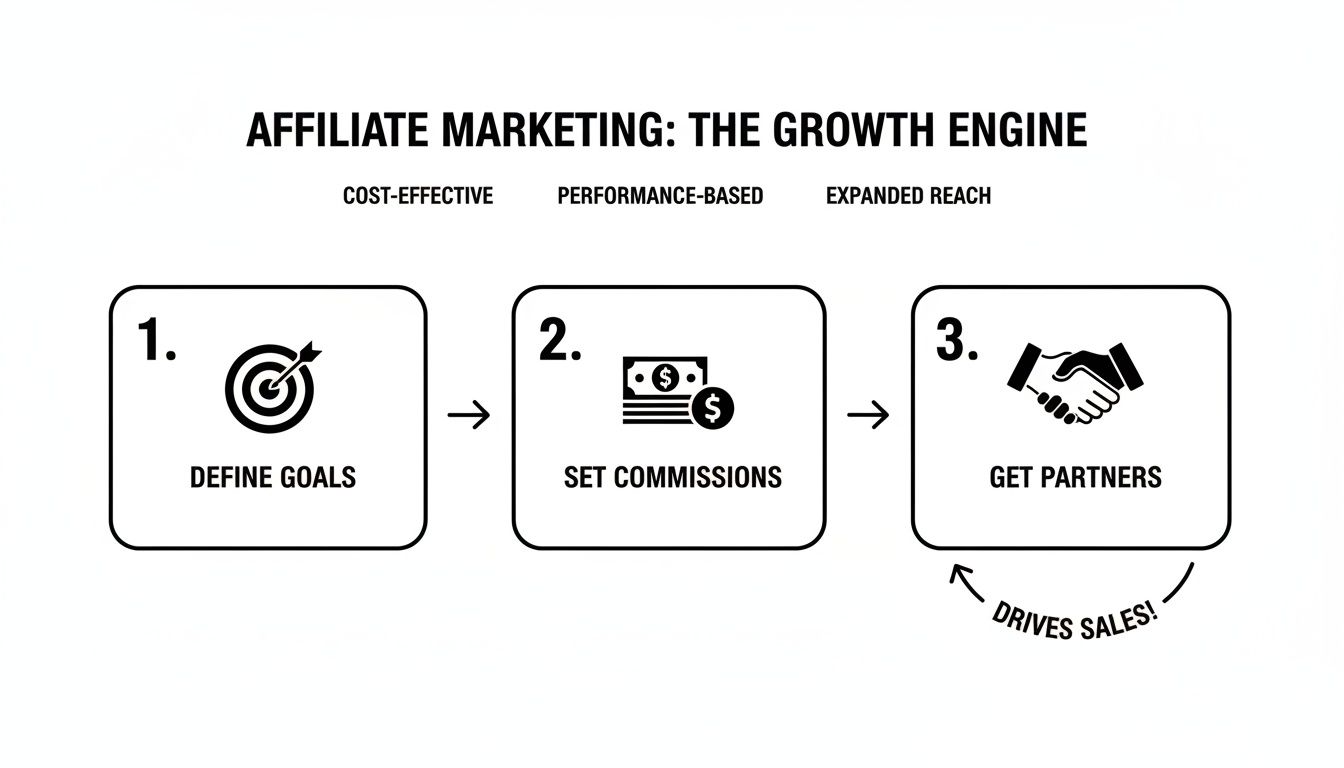
As you can see, a great program is built on a solid foundation of clear goals, compelling incentives, and strong partnerships.
This table gives you a quick, scannable look at how affiliate marketing stacks up against the paid ad channels you're probably already using.
Affiliate Marketing vs Traditional Ad Spend at a Glance
| Metric | Affiliate Marketing | Paid Advertising (Search/Social) |
|---|---|---|
| Cost Model | Pay-for-performance (commission on sales) | Pay-per-click (PPC) or pay-per-impression (CPM) |
| Upfront Risk | Low; you only pay when you make a sale. | High; you pay for clicks/views regardless of sales. |
| ROI | High and predictable (avg. $12-15 per $1 spent). | Variable and can be hard to sustain profitably. |
| Audience Trust | High; comes as a warm referral from a trusted source. | Low; often seen as a disruptive, paid interruption. |
| Scalability | Highly scalable by recruiting more quality partners. | Limited by ad budget and audience saturation. |
The key takeaway is pretty clear: affiliate marketing isn't just about cutting costs. It's about building a more sustainable, trust-based acquisition channel that delivers higher-value customers.
Key Components of a Successful Program
To really appreciate why this is your next big growth channel, it's worth digging into the core benefits of affiliate marketing for growth. A winning program really comes down to a few key ingredients that create a win-win system for both you and your partners. You can also learn more about the benefits of affiliate marketing in our article.
These are the absolute essentials:
Clear Goals and KPIs: You need to know what success looks like. Is it driving trial sign-ups, boosting sales for a specific product, or something else entirely? Define it.
Attractive Commissions: Your reward structure has to be competitive. It needs to be good enough to motivate partners to actively and enthusiastically promote your brand.
Reliable Tracking Software: This is non-negotiable. Using a platform like Blossu ensures every single referral is tracked accurately and commissions get paid on time, which is the foundation of trust with your partners.
Quality Partner Recruitment: Don't just accept anyone. Focus on finding affiliates whose audience and values are a perfect match for your brand. Quality over quantity always wins here.
Designing a Commission Structure Partners Can't Resist
Let's be honest, the heart of any killer affiliate program isn't just your product—it's the deal you offer your partners. A compelling commission structure is what turns a casual fan into a genuinely motivated advocate. This is where we stop talking theory and start designing a system that not only rewards affiliates but also directly fuels your most important business goals.
Your commission structure is way more than just a percentage; it's a strategic tool. It needs to feel like a real partnership, where your affiliates' success is directly tied to yours. Nail this, and you create a win-win that's clear, fair, and just too good to pass up.
Aligning Rewards with Business Goals
Before you even think about percentages or dollar amounts, you have to connect the reward to a specific, measurable business outcome. What's the one action you want your affiliates to drive, above all else?
Is your main goal to get new customers for your subscription box? A one-time, high-payout commission on that first sale makes a ton of sense. But if you're a SaaS company focused on long-term growth, recurring commissions that pay out for the customer's lifetime will attract partners who think the same way.
For instance, a goal to hit 500 new trial sign-ups in a quarter calls for a totally different incentive than a goal to bump up Average Order Value (AOV) by 15%. For the trials, a smaller, fixed bounty per sign-up might be perfect. For the AOV goal, you could roll out a bonus tier for partners whose referrals spend over a certain amount.
Key Takeaway: Don't start with the commission rate. Start with your business objective. Define what success looks like, and then build a reward system that gets partners excited to help you get there.
Popular Commission Models and When to Use Them
There's no single "best" commission model—only the one that's right for your business and your goals. Each model attracts a different type of partner and encourages different behaviors.
Percentage of Sale: This is the classic, especially in e-commerce. You pay out a percentage (say, 10%) of the total sale. It's simple, direct, and super easy for partners to understand.
Fixed-Rate (Pay-Per-Action): Here, you pay a flat fee for a specific action—a lead, a free trial sign-up, or a demo request. It's ideal for SaaS or service-based businesses where the first conversion isn't a direct sale.
Recurring Commissions: This is a game-changer for any subscription business. Partners earn a commission not just on the first sale, but for as long as that referred customer stays subscribed. A 20% recurring commission is incredibly attractive to partners looking to build a predictable income stream.
Tiered Structures: This model rewards your top performers by bumping up their commission rates as they drive more sales. For example, a partner might earn 15% for their first 10 sales, 20% for sales 11-50, and 25% for anything beyond that. It gamifies the process and keeps your best affiliates hungry.
Here's a quick look at how you might visualize tiers to really motivate your partners.
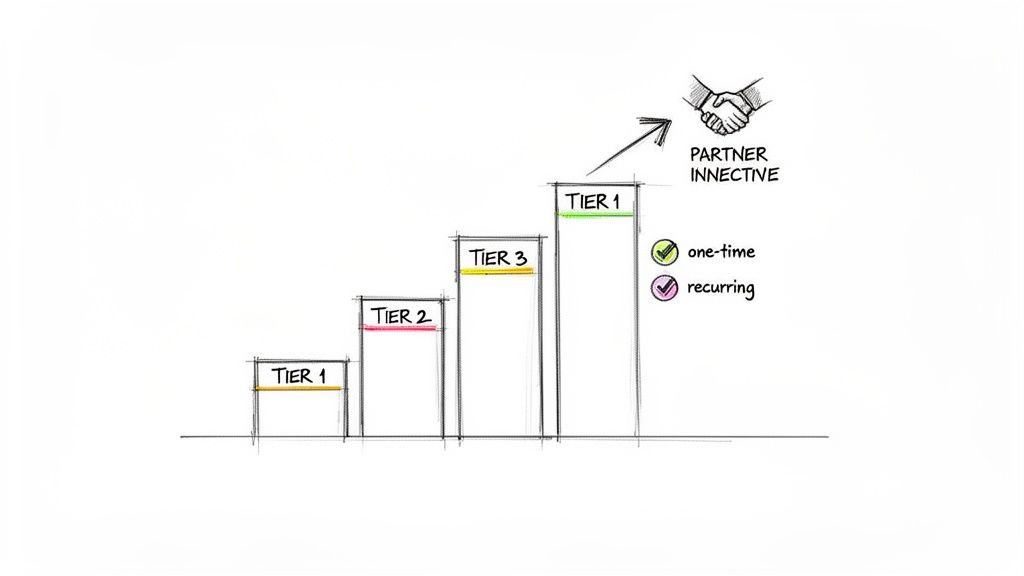
This kind of visual path helps partners see exactly how they can earn more, making the entire program feel more engaging.
Setting Competitive and Sustainable Rates
Once you've picked a model, it's time to land on the actual numbers. This takes a bit of research and a hard look at your own finances.
First, scope out what your competitors are offering. If the standard in your niche is a 20% commission and you're offering 5%, you're going to have a tough time attracting top talent. You don't always have to be the highest, but you absolutely have to be in the ballpark. Our guide on commission rates for sales teams has some great principles that apply here, too.
Next, you have to know your numbers inside and out. Your commission has to be sustainable. Calculate your Customer Acquisition Cost (CAC) and Customer Lifetime Value (CLV). A generous commission only works if the customers it brings in are profitable in the long run.
If your CLV is $1,000 and it costs you $300 to acquire a customer through other channels, you've got a healthy margin to play with. You could offer a substantial commission—maybe $150-$250—and still come out way ahead.
Creating a Clear and Simple Partner Agreement
Finally, get everything down in a partner agreement that people can actually read. Ditch the dense legal jargon. The goal here is to build trust and clarity, not to confuse anyone.
Your agreement should clearly spell out:
Commission Rates: Exactly what partners earn and for what actions. No ambiguity.
Payout Schedule: When and how they get paid (e.g., "Net 30 via PayPal on the 15th of each month").
Cookie Duration: How long the tracking cookie lasts after a click (e.g., 30, 60, or 90 days). A longer window is always more partner-friendly.
Terms and Conditions: Simple rules of the road, like any restrictions on bidding on your brand name in paid ads.
A transparent, fair agreement is the foundation of a strong partnership. It signals to potential affiliates that you're a serious and trustworthy company, making them far more likely to join and start promoting you.
Choosing the Right Tools to Automate and Scale Your Program
Trying to track partners in a spreadsheet and pay them out one by one might feel doable when you're just starting out with a handful of affiliates. But trust me, it's a recipe for disaster. This administrative nightmare quickly spirals into errors, late payments, and shattered trust with the very people driving your growth.
The answer is dedicated software built to automate and scale your entire program. This isn't just about convenience—it's the operational backbone that ensures accuracy, builds partner confidence, and gives you the data you need to make smart decisions.
Core Features of Modern Affiliate Platforms
When you're looking at different tools, think way beyond just tracking clicks. The right platform automates the most soul-crushing parts of running a program, freeing you up to focus on what actually matters: building relationships with your partners.
Your system should be built around these three pillars:
Lightweight and Accurate Tracking: The tracking script should be dead simple to install—usually just a small snippet of JavaScript—and it absolutely cannot slow down your site. Most importantly, it has to be relentlessly accurate, so every single referral gets attributed correctly.
Seamless Payment Integrations: The ability to connect your payment processor, like a one-click Stripe integration, is a total game-changer. It automates all your commission calculations and handles payouts instantly or on a schedule, completely eliminating manual work.
Real-Time, Transparent Dashboards: Both you and your partners need a clear, intuitive dashboard. This transparency is the bedrock of trust. Partners can see their clicks, conversions, and earnings in real time without ever having to chase you for an update.
Here's a glimpse of what a clean, data-rich dashboard looks like. It gives everyone instant clarity on what's working.
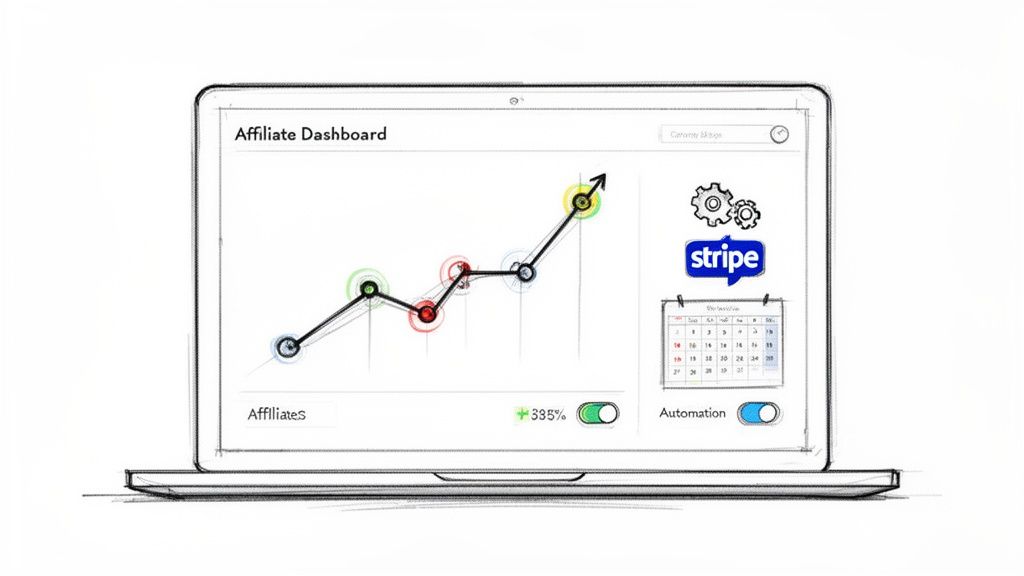
This kind of immediate feedback loop is incredibly motivating for partners. It shows them exactly which of their efforts are paying off, encouraging them to double down on what works.
Why Automation Is Non-Negotiable
Picture a direct-to-consumer brand trying to manage 50 affiliates with nothing but a Google Sheet. Every month, the marketing manager burns days manually matching sales data to coupon codes, calculating different commission tiers, and sending individual PayPal payments. A single copy-paste error could short a top performer, torching that relationship for good.
This is where automation completely changes the game.
By switching to an automated platform, that same manager cuts their admin work from dozens of hours a month down to minutes. The system handles all the tracking, math, and payments, guaranteeing accuracy and freeing up the team to recruit new partners and find ways to make the program better.
Fraud is another massive headache in affiliate marketing, costing businesses over $84 billion globally in 2023. That's a staggering 22% of all digital ad spend gone to waste, polluting the very data you need to optimize. Secure tracking and automated payment systems are your first line of defense against this.
Selecting a Platform That Grows With You
Your needs will look a lot different when you go from 5 partners to 500. The right tool doesn't just solve today's headaches; it's ready to support your growth tomorrow. As you compare your options, pay close attention to the pricing model and feature set.
A platform like Blossu, for instance, is structured for growing brands. With plans that offer unlimited links and tracking without hitting you with per-conversion fees, you can scale your program's reach without your costs blowing up unexpectedly. This is absolutely critical for keeping your profit margins healthy.
As you make your choice, ask yourself these questions:
Scalability: Does the pricing make sense as you grow? Steer clear of tools that penalize your success with fees for every conversion.
Flexibility: Can you easily set up different commission models, like recurring payments for a SaaS product or tiered bonuses for an e-commerce store?
Security: Does the platform offer robust security to protect your data and, just as importantly, your partners' data?
Picking your tech is one of the most foundational decisions you'll make. It's the engine that powers everything, ensuring your program runs like a well-oiled machine, your partners stay happy, and your growth is sustainable. For a deeper look at what to look for, check out our guide on the best affiliate program management software.
How to Recruit and Onboard High-Impact Affiliates
You can have a world-class commission structure and the perfect software, but none of it matters without the right people. The success of your program lives and dies by the quality of your partners. The real secret isn't just finding affiliates; it's finding authentic advocates who genuinely love what you do.
This isn't about blasting generic invites to anyone with a website. It's a targeted hunt for partners whose audience and values are a perfect match for yours. Your goal is to build a high-impact team of evangelists, not just a long list of affiliates who never drive a single click.
Finding Your Ideal Partners
The best affiliates aren't always the ones with the biggest follower counts. They're the ones who have built the most trust and engagement within your specific niche.
So, where do you find these people?
Your Passionate Customers: This is your lowest-hanging fruit. Your happiest customers are already out there talking about you; you just need to invite them to get rewarded for it. Dig through your customer list, check social media mentions, and find your biggest fans. They make the most authentic and effective partners, hands down.
Niche Content Creators: Look for the bloggers, YouTubers, and podcasters who create content for your ideal customer. If you sell high-performance running shoes, you need to connect with creators who review running gear or share marathon training tips. Their audience is already primed to care about your product.
Complementary Brands: Team up with non-competing businesses that serve the same audience. A company selling premium coffee beans could have a fantastic partnership with one that makes high-end espresso machines. Their success is your success.
To help you get started, here's a quick breakdown of the most effective channels for finding top-tier partners.
Top Affiliate Recruitment Channels and Strategies
This table summarizes the best places to look for high-quality affiliates and offers a practical tip for each channel.
| Recruitment Channel | Best For | Actionable Tip |
|---|---|---|
| Existing Customers | Startups and companies with a strong brand community. | Set up an automated email that invites customers to your program 30 days after a positive experience, like a 5-star review or repeat purchase. |
| Niche Influencers/Creators | Brands in visual or lifestyle industries (e.g., e-commerce, fitness, beauty). | Instead of a cold email, engage with their content for a week first. Then, send a personalized DM mentioning something specific you liked. |
| Competitor Research | Any business in a competitive market. | Use SEO tools to see which websites are linking to your competitors. Many of these will be affiliates you can recruit. |
| Complementary Brands | B2B SaaS, specialized e-commerce. | Propose a co-marketing campaign (like a joint webinar) as a first step to build trust before pitching your affiliate program. |
| Affiliate Networks | Companies needing to scale recruitment quickly. | Be highly selective. Filter partners by performance metrics and niche relevance instead of accepting every application. |
Choosing the right mix of these channels will give you a steady pipeline of qualified, motivated partners.
Crafting an Irresistible Outreach Message
Once you've identified potential partners, your outreach has to cut through the noise. Generic, copy-pasted emails get deleted on sight. Your message needs to be personal, concise, and laser-focused on mutual value.
Here's a simple formula for a winning outreach email:
Personalize the Opening: Mention something specific about their work. "I loved your recent video on minimalist desk setups..." proves you've actually done your homework.
State Your Purpose Clearly: Get straight to the point. "I'm launching an affiliate program for my productivity app, and I think your audience would find it incredibly valuable."
Highlight the "What's In It For Them": Briefly mention your commission rate, cookie life, or any unique perks. Frame the partnership around how it benefits them and their audience.
Make it Easy to Say Yes: End with a clear, low-friction call to action. "If you're interested, you can see all the details and sign up here. It takes about two minutes."
Your outreach should feel less like a sales pitch and more like an exclusive invitation to a partnership that just makes sense. Frame it as a collaboration, not a transaction.
Building a Frictionless Onboarding Experience
Getting an affiliate to sign up is only half the battle. A confusing or clunky onboarding process can kill their motivation before they even start. Your job is to get them from "signed up" to "promoting" as quickly and smoothly as possible.
A great onboarding experience is built on clarity and empowerment. Affiliates should never have to guess what to do next.
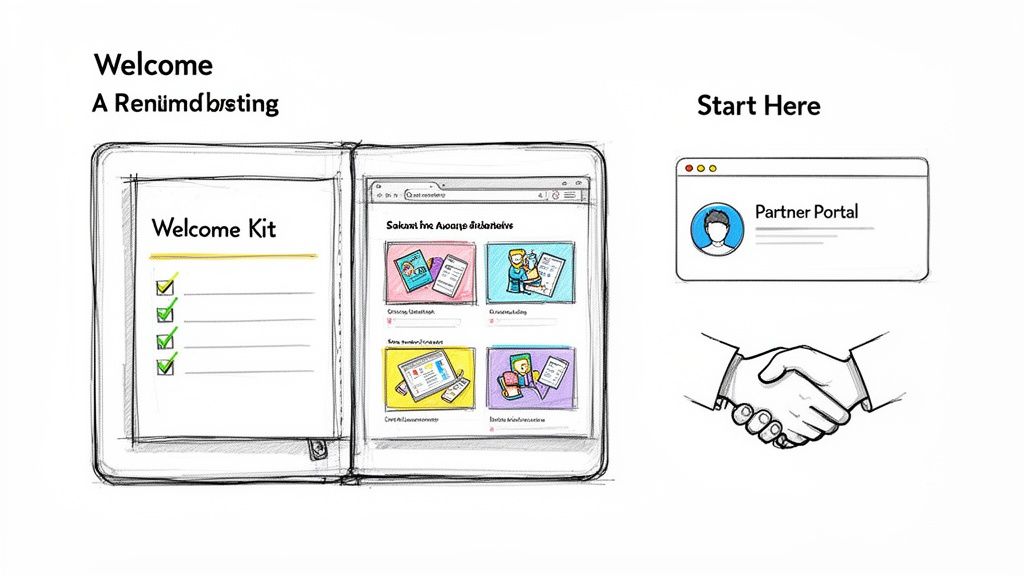
Your "Partner Welcome Kit" is the cornerstone of this process. It doesn't have to be complicated—a well-organized page in your affiliate portal or a detailed welcome email works just fine. It just needs to contain everything they need to succeed from day one.
Here's a checklist for the perfect welcome kit:
Your Unique Affiliate Link: Put this front and center. Make it impossible to miss.
A "Getting Started" Guide: A super-simple, step-by-step walkthrough explaining how to use their link and navigate the dashboard.
Ready-to-Use Creatives: Provide a library of high-quality assets like logos, product images, pre-written social media posts, and banner ads. This removes a huge barrier to entry.
Program Rules and Guidelines: Clearly lay out the commission structure, payout schedule, and any important terms so everyone is on the same page.
Contact Information: Let them know who to reach out to if they have questions. A dedicated contact makes affiliates feel valued and supported.
By arming your new partners with everything they need from the get-go, you empower them to start driving traffic and sales immediately. This proactive support sets the foundation for a long-lasting, profitable relationship.
Okay, you've done the hard work. Your commission structure is solid, the software is ready to go, and you've got a game plan for recruiting killer partners. But here's the thing: great affiliate programs don't just quietly appear. They launch.
Think of it less like flipping a switch and more like rolling out the red carpet. Making a coordinated, exciting splash right out of the gate is how you build momentum and attract that first wave of high-quality affiliates. Before you announce a single thing, you need to be positive every moving part is working perfectly. A clunky start can kill enthusiasm before it even has a chance to build.
Your Essential Pre-Launch Checklist
Confidence comes from preparation. Run through this list to iron out any potential wrinkles before you invite a single partner. This is your final systems check—your chance to make sure every touchpoint is polished and professional.
Test Your Tracking Links: This is non-negotiable. Create a test affiliate account for yourself. Click your own link, make a real test purchase on your site with a real payment method, and confirm the conversion shows up in your admin dashboard and the test partner's dashboard.
Review the Partner Dashboard: Log in as your test affiliate. Is it intuitive? Can you easily find your unique link, see your performance stats, and grab creative assets? A confusing experience is an immediate turn-off for a new partner.
Verify Automated Emails: Sign yourself up and trigger the automated welcome email. Read it carefully. Check for typos, broken links, and clarity. Does it give a new partner everything they need to get started right away?
Confirm Payout Systems: If your platform, like Blossu, connects to Stripe, double-check that the integration is active and properly configured. Knowing your payment system is ready to go signals that you're running a professional operation.
Pro Tip: Don't just simulate a purchase. Make a small, real one with a test link and take it through a full payout cycle to yourself. It's the ultimate stress test and the only way to be 100% sure your tracking and payment automation are working flawlessly from end to end.
Crafting a Multi-Channel Launch Promotion
With your systems locked and loaded, it's time to make some noise. A coordinated promotional push across a few key channels ensures your announcement reaches the right people and sparks immediate interest. You're not just looking for sign-ups; you're building excitement.
This strategy is all about leveraging the audience you already have while simultaneously reaching out to new communities.
Email Your Existing Audience
Your customers and email subscribers are your warmest leads. They already know your brand and, hopefully, love your product. Send them a dedicated email announcing the new partner program. Frame it as an opportunity to earn rewards for sharing something they already use. Be sure to highlight the good stuff—your commission rate, cookie window, and how easy it is to get started.
Add a Prominent "Partners" Link
Don't hide your affiliate program. Add a clear, visible "Affiliate Program" or "Partners" link right in your website's footer. This simple move makes your program easily discoverable for any site visitor, blogger, or creator who might be a great fit. It basically acts as a permanent, passive recruitment tool.
Create Compelling Social Media Announcements
Draft announcements for all the social channels where you're active. Use an eye-catching graphic or a quick video to explain what the program is all about. Focus on the core value: "Love our product? Get paid to share it." Make sure you tailor the message for each platform—a professional tone on LinkedIn, something more visual for an Instagram Story, and a conversational thread on X (formerly Twitter).
Conduct Targeted Outreach
Now it's time to go from passive to proactive. You should have already built a wishlist of ideal bloggers, YouTubers, and creators in your niche. This is when you send them a personal invitation. Don't just blast a template. Reference their specific work and explain why you think their audience would genuinely connect with your product. A personal touch here makes all the difference.
Measuring Success and Optimizing for Long-Term Growth
Launching your affiliate program is a huge milestone, but let's be clear: it's the starting line, not the finish. The real work—and where the most rewarding growth happens—comes from paying close attention to what the data is telling you. This isn't a "set it and forget it" channel.
Sustained success is all about continuously measuring, learning, and tweaking to build a program that gets stronger every single month. Think of it as a living ecosystem. Your job is to nurture it, prune what isn't working, and double down on what is. This is how you turn that initial launch momentum into predictable, long-term revenue.
Defining the KPIs That Actually Matter
It's easy to get lost in vanity metrics like total clicks or impressions, but they can be seriously misleading. To really understand your program's health, you need to zero in on the key performance indicators (KPIs) that connect directly to your bottom line. These are the numbers that should live on your dashboard.
Affiliate-Driven Revenue: The ultimate metric. This tells you exactly how much new cash your partners are generating for the business. No ambiguity here.
Partner Activation Rate: What percentage of your approved affiliates are actually driving clicks and sales? A low rate is a big red flag that might point to a problem in your onboarding or communication.
Conversion Rate by Partner: This one is crucial. It shows you which partners aren't just sending traffic, but sending the right traffic that actually converts. A partner with fewer clicks but a much higher conversion rate is often more valuable.
Average Order Value (AOV) from Affiliates: Are the customers your affiliates bring in spending more than your average customer? Tracking this helps prove the quality of the audience your partners are tapping into.
These KPIs give you a clear, actionable snapshot of performance, moving you beyond guesswork and into strategic management.
Using Data to Spot Winners and Opportunities
Your affiliate dashboard is a goldmine of insights. If you get into the habit of digging into the numbers regularly, you'll uncover two critical things: who your top-performing partners are and where your biggest opportunities for improvement lie.
Look for the outliers. Who are the top 5% of partners driving 50% of your sales? These are your superstars. Once you've identified them, your job is to figure out why they're so successful and how you can empower them to do even more.
At the same time, keep an eye out for partners with a ton of clicks but very few conversions. This isn't always a sign of a bad partner. It could mean your landing page isn't resonating with their specific audience, or maybe they just need different creative assets to frame your offer better. This is a perfect optimization opportunity, not a failure.
The most successful affiliate programs aren't just built on a great product and commission rate. They're built on the manager's ability to interpret data and use it to forge stronger, more effective partnerships.
Actionable Strategies for Continuous Optimization
Once you have the data, it's time to act on it. Optimization is an ongoing cycle of testing, learning, and refining your approach. Here are a few proven strategies to keep your program growing and your partners engaged.
Run Exclusive Promotions for Top Segments: Reward your high-performers. Give them a temporary commission bump or an exclusive coupon code for their audience. This not only boosts their earnings but also makes them feel valued, which strengthens the relationship immensely.
Provide Unique Coupon Codes: Giving top partners a unique, memorable coupon code (like "PARTNERNAME15") can significantly lift conversion rates. It's way easier for their audience to remember and feels more personal than a generic link.
Refresh Your Creative Assets: "Banner blindness" is a real thing. If you notice a partner's performance starting to dip, it might just be because their audience has seen the same ads too many times. Give them some fresh banners, new product photos, or updated ad copy to combat that fatigue.
The impact of a well-optimized program is immense. Marketers often see an impressive $12 to $15 in revenue for every $1 invested in affiliates, making it one of the highest-performing channels out there. In fact, for many major brands, 5-25% of their total sales come directly from these partnerships, and the customers they acquire often spend 21% more per order with higher retention.
By treating your affiliate program as a dynamic engine for growth and consistently fine-tuning it with data, you create a powerful and sustainable revenue channel that scales right alongside your business.
Ready to turn your word-of-mouth into a predictable revenue stream without the hassle of spreadsheets? With Blossu, you can launch your affiliate program in minutes, automate tracking and payouts with a one-click Stripe integration, and empower your partners with a real-time dashboard they'll love. Start for free and see how simple scaling can be at Blossu.com.
Frequently Asked Questions
Have a question not in here? Contact us
- How do I set commission rates that attract affiliates but remain profitable?
Calculate your Customer Lifetime Value (CLV) and Customer Acquisition Cost (CAC) first. A good rule of thumb is to offer 20-30% of your typical CAC as commission. For example, if your CLV is $1,000 and CAC is $300, you could offer $150-200 commissions and still maintain healthy margins while staying competitive.
- What's the difference between affiliate marketing and influencer marketing?
Affiliate marketing is performance-based - you only pay when specific actions are completed (sales, signups). Influencer marketing typically involves upfront payments for content creation or promotion, regardless of results. Affiliate programs can include influencers, but the payment model focuses on measurable outcomes.
- How quickly can I launch an affiliate program for my business?
With modern platforms like Blossu, you can launch a fully functional affiliate program in hours or days. The key steps are: set up tracking (30 minutes), define commission structure (1 hour), create partner onboarding materials (2-3 hours), and recruit initial partners. Most businesses can be live within a week.
- What metrics should I track to measure affiliate program success?
Focus on revenue-driving metrics: affiliate-driven revenue, conversion rate by partner, Customer Acquisition Cost (CAC) by affiliate, Average Order Value (AOV) from referrals, and partner activation rate. These show real business impact beyond vanity metrics like clicks or impressions.
- How do I prevent affiliate fraud and ensure program integrity?
Use platforms with built-in fraud detection, monitor for suspicious patterns (click-spamming, duplicate conversions), implement reasonable cookie windows (30-90 days), and set clear program terms. Regularly audit top performers and use tools that provide transparent tracking and real-time monitoring.
🎯 Key Takeaways
Start with clear business goals and align commission structure to drive specific outcomes like trial signups or high-value sales
Choose between percentage-based, fixed-rate, recurring, or tiered commission models based on your business type and partner behavior goals
Invest in dedicated affiliate software to automate tracking, payments, and partner management from day one
Focus on recruiting quality partners: existing customers, niche creators, and complementary brands over mass applications
Create frictionless onboarding with welcome kits, clear guidelines, and ready-to-use creative assets
Launch with coordinated multi-channel promotion: email existing audience, add website links, and conduct targeted outreach
Track revenue-focused KPIs: affiliate-driven revenue, conversion rates by partner, and customer quality metrics
Optimize continuously by rewarding top performers, providing unique assets, and refreshing creative materials
Expect 12:1 to 15:1 ROI when properly managed, with affiliate customers showing 21% higher average order values
Plan for long-term growth by treating your program as a dynamic ecosystem requiring ongoing nurturing and optimization
🚀 Launch Your Affiliate Program with Blossu
Ready to transform your biggest fans into a predictable revenue stream? With Blossu, you can set up a complete affiliate tracking system in minutes. Our platform handles everything from commission structures to automated payouts, with seamless Stripe integration and real-time partner dashboards. Start building your affiliate program today and turn word-of-mouth into measurable revenue growth.