
How to Find Partners for a Business That Drive Real Growth
Finding the right business partners isn't about luck or just making random connections. It requires a deliberate, systematic approach. The entire process boils down to three core stages: defining who your ideal partner is, finding and recruiting them, and then managing that relationship with solid systems. This is the modern playbook for building a predictable growth engine.
Your Modern Playbook for Finding Business Partners
Forget cold calls and old-school handshake deals. The real secret to scaling your business today is building strategic partnerships that act as a powerful, self-sustaining marketing channel.
Whether you're a SaaS founder, an e-commerce brand, or a digital creator, learning how to find the right partners is a critical skill for unlocking consistent, predictable revenue. This guide is your complete roadmap, moving beyond theory to give you the exact frameworks you need to get it done.
This visual breaks down the simple, three-step process we'll cover to help you find, recruit, and manage partners effectively.
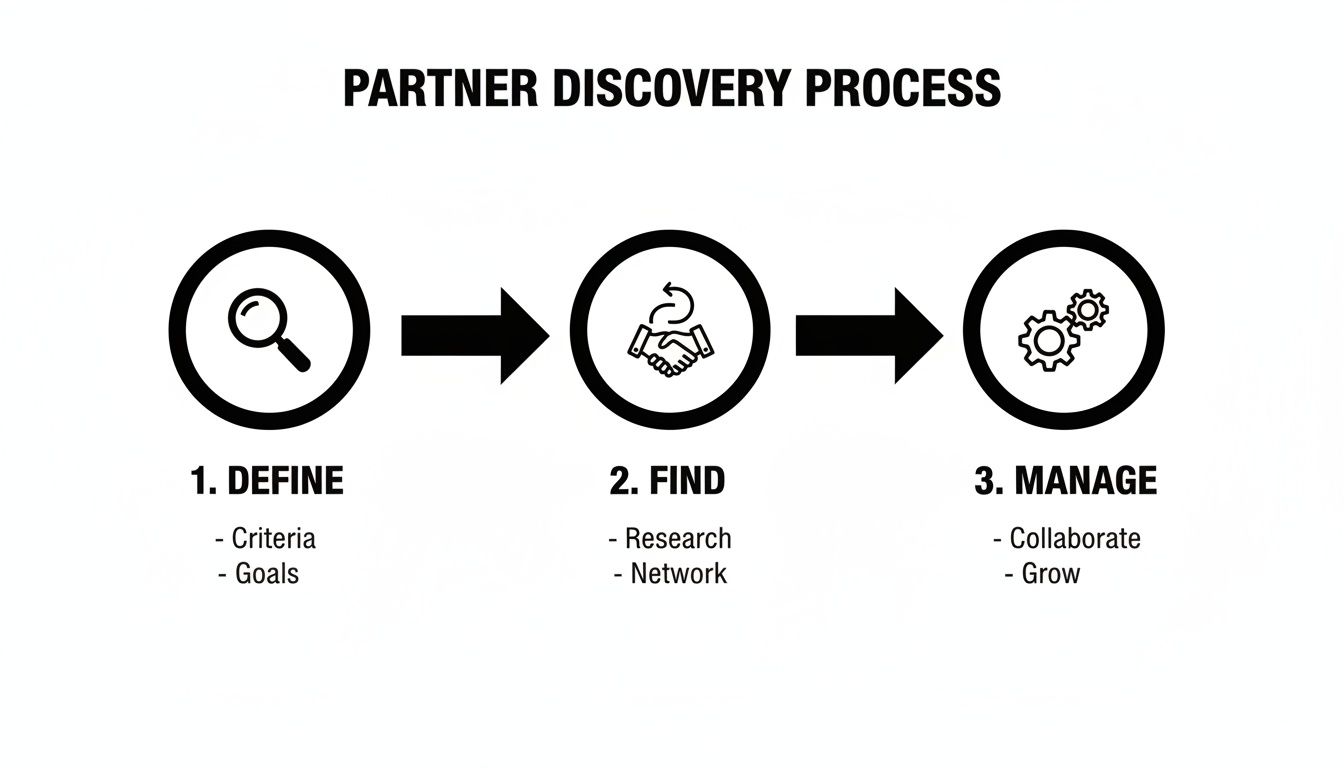
This simple flow turns a complex goal into clear, actionable stages. It's all about building a foundation of strategy, not just hoping for the best.
What to Expect in This Guide
This isn't just a list of ideas; it's a practical playbook. We'll dive deep into the specific tactics used by fast-growing brands to build affiliate, referral, and channel partner programs that actually deliver results.
You're going to learn how to:
Define Your Ideal Partner: Go way beyond surface-level metrics to pinpoint partners whose audience and values are a perfect match for your brand.
Craft Outreach That Gets Replies: Get your hands on outreach scripts and strategies that feel personal and focus on what's in it for them.
Set Up Motivating Compensation: Understand the different compensation models so you can create a structure that attracts top performers and keeps them engaged.
Manage Relationships for the Long Haul: Discover why using the right systems from day one is the key to avoiding messy spreadsheets and scaling your program efficiently.
The goal here is to build a true partnership ecosystem—a network of advocates who are genuinely invested in your success because it's tied to their own. This shift from transactional relationships to strategic alliances is what separates struggling programs from thriving ones.
Ultimately, building a successful partnership program is all about creating a win-win scenario. By the end of this guide, you'll have the tools and the confidence to find the right people, build the right infrastructure, and turn your partners into your most valuable growth asset.
Defining Your Ideal Partner Profile
Before you can even think about finding business partners, you need to know exactly who you're looking for. Firing off mass, untargeted outreach is a surefire way to waste time and fill up spam folders. The first, most critical step is building a detailed Ideal Partner Profile (IPP)—this document becomes your north star for recruitment.
This isn't about surface-level metrics like website traffic or follower counts. Real, powerful partnerships are built on a much deeper alignment of audience, values, and content. Your goal isn't just to find someone with an audience; it's to find someone with the right audience. You need people who trust their recommendations and will see the immediate value in what you offer.
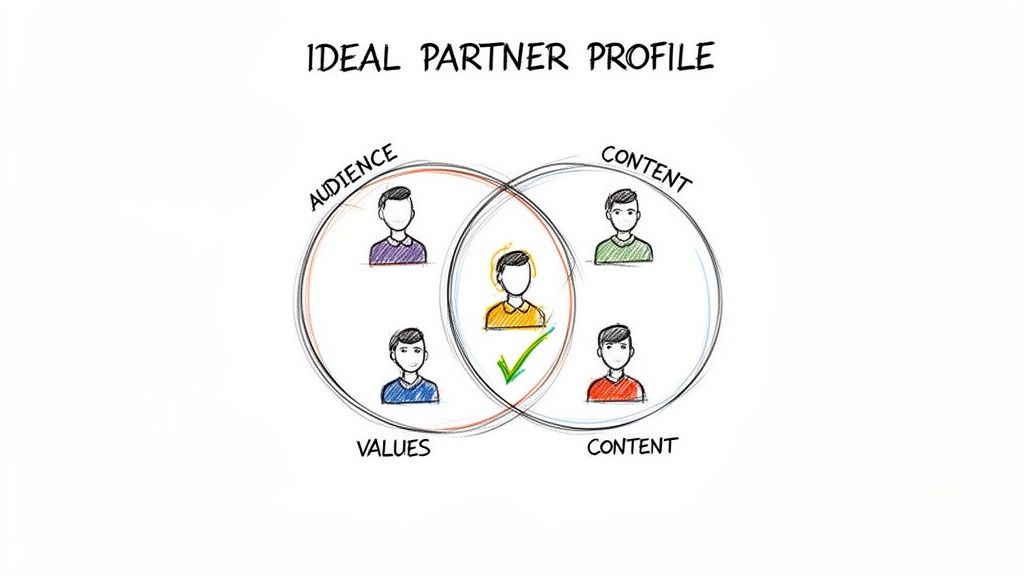
Think of your IPP as a buyer persona, but for your partners. It's what separates the true brand advocates from the opportunistic affiliates who are just in it for a quick commission.
Core Components of Your IPP
To build a profile that actually works, you need to zero in on three key areas of alignment. Answering these questions will give you a concrete framework to evaluate every single partner you come across.
Audience Alignment: Who do they actually serve? Does their audience—their readers, followers, or customers—match your ideal customer profile? Look for shared pain points, goals, and needs. A partner with a smaller, hyper-relevant audience is always more valuable than one with a huge, generic following.
Brand & Value Alignment: Does their brand's voice, style, and mission feel like a natural extension of yours? A partnership is a direct reflection of your own brand, so this has to feel authentic. If your brand is professional and data-driven, teaming up with a casual, humor-focused creator might create a jarring disconnect for everyone involved.
Content & Product Alignment: Does your product solve a problem their audience actually has? The best partnerships feel like a genuinely helpful recommendation, not a forced ad. Dig into their existing content. Are they already talking about the exact challenges your product was built to solve?
Moving from Theory to a Practical Framework
Once you've defined these qualitative elements, you can build a simple scoring system to make your evaluation process objective and scalable. This is what stops you from getting swayed by vanity metrics and keeps your outreach disciplined.
We use a straightforward scorecard to rank potential partners, assigning a weight to each attribute based on what matters most to our business.
Here's how you can use an IPP scoring matrix to objectively score and prioritize potential business partners based on your key criteria.
Ideal Partner Profile (IPP) Scoring Matrix
| Attribute | Description | Weight (1-5) | Score (1-10) | Total |
|---|---|---|---|---|
| Audience Relevance | Does their audience match our Ideal Customer Profile? | 5 | 9 | 45 |
| Content Quality | Is their content well-researched and engaging? | 4 | 8 | 32 |
| Brand Fit | Do their brand values and tone align with ours? | 4 | 7 | 28 |
| Engagement Rate | Do they have an active, trusting community? | 3 | 9 | 27 |
This data-driven approach means you spend your valuable time recruiting partners who have the highest probability of driving real results. It transforms your search from a guessing game into a strategic process. This becomes especially important when you start looking at different types of partners. You can get a better handle on this by exploring the fundamentals of channel marketing meaning and strategy.
Your IPP should be a living document. As you learn what makes a partner successful, go back and refine it. The goal is to create a feedback loop where your real-world results continuously sharpen your future recruitment efforts.
The partner landscape is incredibly diverse. Research shows partners can range from Managed Service Providers ( 44%) and Value Added Resellers ( 30%) to consultants (10%), each with different models and motivations. Knowing which type fits your IPP is critical for effective collaboration. This clarity will sharpen your focus and dramatically improve the quality of your outreach.
Sourcing and Recruiting Partners
Alright, you've got your Ideal Partner Profile dialed in. You know exactly who you're looking for. Now comes the fun part: moving from the blueprint to the hunt. Sourcing and recruiting is where you actively find those high-impact partners and show them why working with you is a no-brainer for their business.
This isn't about spraying a generic email blast and hoping for the best. Smart recruitment is a mix of clever detective work, genuine outreach, and creating an inbound engine that brings perfect-fit partners straight to your door. Think of it as running two plays at once: proactive hunting and inbound attraction.
Uncovering Partners in Unexpected Places
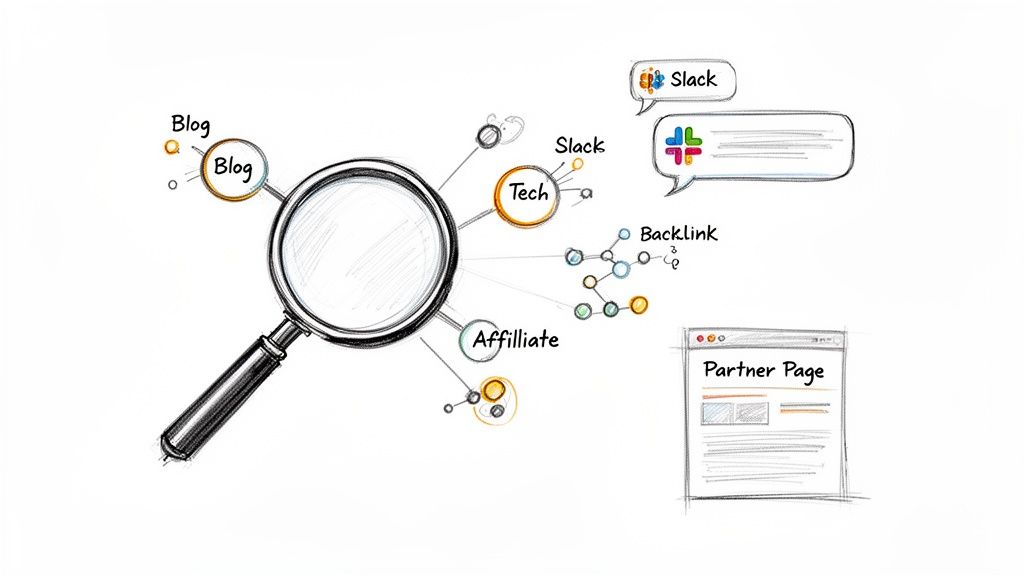
Your best potential partners are often hiding in plain sight—you just need to know where to look. Getting beyond a simple Google search is the key to finding the real gems.
Here are a few of the most effective, yet often overlooked, sourcing channels:
Competitor Backlink Analysis: This is an absolute goldmine. Fire up an SEO tool and see who's linking to your direct competitors. These are often review sites, bloggers, and content creators who are already sold on your product category and have a proven audience that converts.
"Best Of" & Comparison Articles: Search for things like "best [your category] software" or "[competitor A] vs [competitor B]." The people writing these articles are prime partner material. They're authorities in your space and have already built trust with an audience looking for a solution just like yours.
Niche Online Communities: Don't sleep on platforms like Slack, Discord, or niche forums. Find the digital watercoolers where your ideal customers hang out. The most active and helpful members are often influential voices who could become incredible advocates.
These tactics shift your search from broad and generic to laser-focused, making sure you're finding people who are already a great match based on your IPP.
Crafting Outreach That Actually Gets a Response
Once you have a solid list of prospects, the outreach begins. The single biggest mistake I see brands make is sending a cold, "me-first" email. Your message needs to be personal, punchy, and focused entirely on the mutual win.
Understanding how to recruit affiliates is a core skill here, because the principles apply to any partner type. It's all about demonstrating value clearly and respectfully.
Your outreach has to answer their silent question: "What's in it for me and my audience?"
Here's a simple framework that just works:
The Personalized Hook: Reference something specific they've created. Show them you've actually done your homework. "Hi [Name], I just read your breakdown of [topic], and your point about [specific detail] really hit home."
The Bridge: Briefly explain why you're reaching out and how your product is a genuine solution for their audience. "The challenges you described are exactly why we built [Your Product], which helps [their audience] achieve [specific outcome]."
The Value Prop: Get straight to the point about the benefit for them. This could be a solid commission, exclusive perks for their audience, or co-marketing opportunities. "We offer a 30% recurring commission for partners, and I think your audience would get a ton of value from it."
The Easy Ask: Make the next step frictionless. Don't ask for a 30-minute call right away. Instead, offer to send over more info or a quick demo link. "If you're open to it, I'd be happy to send over a one-page overview of our program."
This approach respects their time and frames the partnership as a collaborative opportunity, not just another sales pitch.
Pro-Tip: Never, ever lead with your commission rate in the subject line. Focus your initial outreach on building a real relationship and showing authentic alignment. The money is important, but it should support a partnership that already makes perfect sense strategically.
Building an Inbound Recruitment Engine
While you're out there actively hunting for partners, you should also be building a system that brings them directly to you. A well-designed, dedicated partner page on your website is your most powerful inbound tool. It works for you 24/7, qualifying and converting potential partners while you sleep.
Your partner page should be easy to find and clearly lay out the essentials:
Who you're looking for: Briefly describe your ideal partner.
What's in it for them: Highlight commission rates, rewards, and other perks.
How it works: Break down the process in a few simple steps.
Social proof: Add testimonials from your current, happy partners.
A clear signup form: Make applying ridiculously simple.
This page turns your sourcing efforts into a scalable system. When managed correctly, this becomes the foundation of your entire program. After all, great strategic partnership management starts with clear communication and easy-to-access resources from day one.
Onboarding Partners for Long-Term Success
You did it. You found the perfect partner, pitched them, and they said "yes." The contract is signed. It's easy to feel like you've crossed the finish line, but the truth is, you're just getting started. This is the most fragile moment in the entire relationship.
A clunky, confusing, or slow onboarding process can kill a promising partnership before it generates a single dollar. Your goal now is to erase friction and build momentum. Fast.
The first 30 days are everything. A smooth, supportive experience makes your new partner feel welcomed, equipped, and confident they made the right call. This early investment is what builds the trust you need for a long-term, revenue-generating relationship.
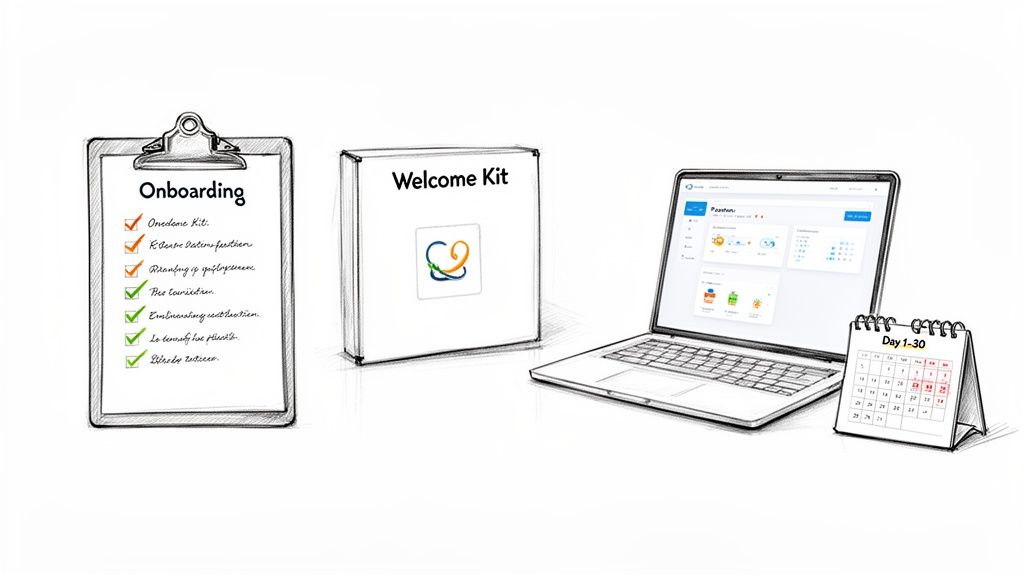
This isn't just a nice-to-have; it's a core business strategy. The broader trend shows immense confidence in partnerships as a primary growth driver. PwC's Global Investor Survey found that seven in ten investors expect companies to ramp up strategic alliances over the next three years, tying it directly to economic growth. This tells you just how critical it is to not only find partners but to onboard them effectively to reduce risk and kickstart expansion. You can explore the full investor survey from PwC for more on these market-shaping trends.
Creating a Frictionless Welcome Experience
The second a partner signs up, the clock starts ticking. Your very first communication should be an automated—but still personal—welcome email that gives them everything they need to get started instantly. Don't make them hunt for information or wait for you to get back to them.
This initial touchpoint should nail three key things right away:
A Warm, Personal Welcome: A quick note from a real human (like their partner manager) that says you're genuinely excited to work with them.
Dashboard Login: Instant access to their partner portal where they can grab tracking links, see performance, and find resources.
A "Getting Started" Guide: One clear link to a resource that walks them through what to do next.
Delivering this value immediately sets a professional and supportive tone from the very first interaction.
The Essential Partner Welcome Kit
Your "Getting Started" guide or welcome kit is the foundation of your onboarding. Think of it as a centralized hub designed to answer every question a new partner might have, empowering them to start promoting you without having to ask for help.
It's a self-service resource center. It stops you from becoming a bottleneck and gives them the autonomy to move at their own pace.
Your partner welcome kit should be so clear and comprehensive that a new partner could successfully generate their first referral without ever having to speak to you directly. This is the true test of a scalable onboarding process.
Keep your welcome kit simple, digital, and easy to get through. It should include these core components:
Brand Assets: Make it dead simple to access logos, product screenshots, and any pre-approved marketing graphics. Put them in a shared folder for easy downloading.
Program Guidelines: Lay out the rules of engagement in plain English. Detail the commission structure, payout schedule, and any promotional dos and don'ts.
Swipe Copy & Content Ideas: Give them a running start with pre-written email copy, social media post templates, and talking points about your product's key benefits.
Product Cheat Sheet: A one-pager that sums up your ideal customer, the problems you solve, and what makes you different.
By handing them these tools upfront, you dramatically shrink the time it takes for a partner to become active and effective. You're not just telling them what to do; you're giving them the exact assets they need to do it right. This proactive support is what separates thriving programs from the ones that just fizzle out.
Designing a Partner Comp Plan That Actually Motivates
Let's be honest: your compensation plan is the engine of your entire partnership program. Get it right, and you'll attract top-tier partners who are fired up to promote your product. Get it wrong, and you'll be stuck wondering why you can't get any traction.
Every potential partner is asking themselves one simple question: "What's in it for me?" Your comp plan is the direct answer.
This isn't about just slapping a generic percentage on a sale. The best structures are carefully crafted to fit your business model. What works for a recurring revenue SaaS company is going to look completely different from an e-commerce brand driving one-time purchases. Your plan needs to be generous enough to be exciting, but sustainable enough that it doesn't sink your margins.
Matching Compensation Models to Your Business
The secret to a great comp plan is picking a model that incentivizes the right kind of behavior. If you need partners to bring in customers who will stick around for years, your commissions need to reflect that value. If you just need a massive volume of initial sales, you'll want a structure that rewards that instead.
Here's a breakdown of the most common models and where they shine:
Recurring Percentage Commission: This is the gold standard for any SaaS or subscription business. Partners earn a percentage (usually 20-30%) of every single payment a customer makes, either for a set time or for the life of the customer. It's a powerful way to motivate partners to find high-quality, long-term users, not just quick signups.
One-Time Percentage Commission: Perfect for e-commerce stores or anyone selling a digital product with a single price point. It's clean and simple: a partner gets a cut of the initial sale. This is great for driving volume, but it does little to reward customer loyalty.
Tiered Rewards: This is how you get your best partners to perform even better. As a partner hits specific revenue or referral milestones, their commission rate actually increases. For example, they might start at 20% for their first 10 sales, but then jump to 25% once they cross that threshold.
Fixed-Rate or Bounty Payouts: Instead of a percentage, you offer a flat dollar amount for a specific action—like a qualified lead, a booked demo, or even just a new trial signup. This is fantastic for lead-gen partnerships where a direct sale isn't the immediate goal.
When you're mapping out your own plan, it helps to see what successful programs are already doing. A great example like DocsBot's Partner Program can give you some fantastic ideas for creating incentives that are both clear and compelling.
Structuring a Plan That Drives Performance
Once you've landed on your core commission model, don't stop there. Layering in extra incentives can keep your program competitive and exciting. In fact, a hybrid approach is often the most effective, combining a solid base commission with performance-based bonuses that reward specific achievements.
Try mixing these elements into your compensation structure:
Launch Bonuses: Kick things off with a bang. Offer a higher commission rate for a partner's first 30-60 days to create a sense of urgency and build immediate momentum.
Performance Bonuses: Set clear, achievable targets that give your partners something to shoot for. You could offer a $500 bonus for any partner who drives $5,000 in new revenue in a single quarter.
Milestone Rewards: Don't forget to celebrate the wins. When a partner brings in their 100th customer, reward them with a cash bonus, a special gift, or a public shout-out. It goes a long way.
Key Takeaway: Your compensation plan is a direct signal of what your business values. If you want long-term customer relationships, a recurring commission is non-negotiable. If you need to drive rapid adoption, front-loaded bonuses and tiered rewards are your best friends.
To help you decide, here's a quick breakdown of the different partner reward structures.
Comparing Partner Compensation Models
This table breaks down the most common reward structures to help you choose the best fit for your business and your partners.
| Model Type | Best For | Pros | Cons |
|---|---|---|---|
| Recurring % | SaaS, Subscriptions | Aligns partner and business goals for long-term value; attracts high-quality partners. | Can be more complex to track; higher long-term payout. |
| One-Time % | E-commerce, Digital Products | Simple to calculate and understand; predictable cost per acquisition. | Doesn't incentivize customer retention; may attract lower-quality traffic. |
| Tiered Rewards | All Models | Strongly motivates top performers; encourages continuous growth. | Can be complex to manage; lower tiers may feel unmotivated. |
| Fixed-Rate | Lead Generation | Easy to budget for; rewards specific actions beyond just a sale. | Harder to attribute final revenue impact; risk of low-quality leads. |
Ultimately, finding the sweet spot is all about balancing generosity with sustainability. Check out what your competitors are offering to make sure you're in the ballpark, but always ground your numbers in your own customer lifetime value (LTV) and customer acquisition cost (CAC).
A plan that looks great on paper but destroys your profit margins is a recipe for disaster. Finally, make sure you use modern tools to automate payouts. Nothing builds trust like paying your partners accurately and on time, every single time. It's a critical piece for scaling your program successfully.
Scaling Your Program with the Right Technology
When you're just starting out, managing your first handful of partners on a spreadsheet seems smart and simple. But trust me, it's a trap. As soon as you start to get traction, that manual approach breaks down. It becomes a bottleneck choked with tracking errors, late payouts, and genuinely frustrated partners.
To grow a partnership program that doesn't fall apart, technology isn't just a nice-to-have—it's a necessity. The right platform automates all the tedious, time-sucking parts of the job. It becomes your single source of truth for everything from link tracking to performance analytics, freeing you up to focus on what actually moves the needle: strategy and building real relationships.
Must-Have Platform Features
When you start looking at software, it's easy to get mesmerized by flashy features you'll likely never use. My advice? Ignore the noise and focus on the core functions that will directly improve your program's efficiency and your partners' experience.
Your platform absolutely needs these four things:
Automated Link Tracking: This is non-negotiable. The system has to reliably track clicks, conversions, and commissions without you lifting a finger. If it can't do this flawlessly, nothing else matters.
Real-Time Dashboards: Transparency builds trust. Both you and your partners need instant, easy access to performance data so they can see what's working and double down on their efforts.
Effortless Payouts: Look for a solution with integrated payment systems that automate commissions. Paying your partners accurately and on time is the single best way to keep your top performers happy and motivated.
Centralized Communication: A built-in portal for sharing updates, new creative assets, and important announcements keeps everyone on the same page and out of your inbox.
The partnership economy has absolutely exploded. To give you a sense of the scale, a platform like impact.com now supports nearly 350,000 active partnerships that have driven close to $120 billion in value. Tapping into this massive ecosystem with the right tech is how you compete and win. You can dig into more stats about the momentum in the partnership economy on impact.com.
Tracking KPIs That Actually Matter
A dashboard packed with data is completely useless if you don't know what to look for. While total revenue is the ultimate prize, it's a lagging indicator. The real magic is in the leading indicators—the metrics that tell you if your program is healthy long before the sales pour in.
Don't just track sales; track the behaviors that lead to sales. A high partner activation rate is often a much better early signal of future success than a few initial conversions.
To get a clear picture of what's really going on, zero in on a handful of key performance indicators (KPIs):
Partner Activation Rate: What percentage of your approved partners are actually driving their first click or conversion within 30 days? This tells you if your onboarding is effective.
Click-to-Conversion Rate: This metric helps you pinpoint which partners are sending high-intent traffic that converts, not just empty clicks.
Average Commission Per Partner: By tracking this, you can quickly identify your MVPs—the valuable players who deserve more of your time and attention.
Monitoring these numbers allows you to spot your top performers, give targeted help to those who are struggling, and make data-driven decisions to build a predictable revenue engine. Choosing the right platform is a big decision, so you might be interested in our guide on the best affiliate program management software to compare your options.
Frequently Asked Questions
Have a question not in here? Contact us
- How Long Until I See Real Results?
This is the big one, isn't it? While you can definitely get your first few partners signed within weeks of launching your program, seeing significant, predictable revenue usually takes about three to six months. Patience is a virtue here. Think of it this way: the first phase is all about recruiting, onboarding, and giving your partners the tools they need to succeed. The real momentum builds as they start creating content, weaving your product into their workflow, and sending you qualified traffic. My advice? Focus on early indicators like partner activation rates before judging the program solely on revenue.
- What's the Biggest Partner Recruiting Mistake?
The most common—and most costly—mistake is chasing partners with huge audiences while completely ignoring relevance. It's a classic trap. You see a massive follower count and think 'jackpot,' but those vanity metrics rarely translate into actual sales. A micro-influencer with a small but fiercely loyal niche audience will almost always run circles around a mega-influencer with a broad, disengaged following. The real key is to prioritize genuine audience trust and authentic alignment over raw numbers. A partner who is a true expert in their niche is infinitely more valuable than one who is simply famous.
- How Much Should I Pay My Partners?
There's no single 'right' answer here, as commission rates vary a ton by industry. But there are some solid benchmarks to get you started. For SaaS & Subscription Models: A recurring commission of 20-30% on each subscription payment is pretty standard. This is a huge motivator for partners. For E-commerce & One-Time Sales: A one-time commission of 10-25% on the initial purchase is more common. Your best bet is to do a little digging to see what your direct competitors are offering. That'll make sure your program is competitive right out of the gate. From there, just calculate a rate that's both exciting for your partners and sustainable for your own profit margins.
Key Takeaways
Define your Ideal Partner Profile (IPP) before starting outreach to focus on quality over quantity
Use competitor backlink analysis and "best of" articles to find high-quality partner prospects
Craft personalized outreach that focuses on mutual value rather than just commission rates
Create a frictionless onboarding experience with instant access to dashboards and marketing assets
Choose compensation models that align with your business goals: recurring commissions for SaaS, one-time for e-commerce
Invest in partnership management technology early to avoid manual tracking nightmares
Turn Your Partners into a Predictable Revenue Stream
Ready to turn your partners into a predictable revenue stream? With Blossu, you can launch and automate your affiliate and referral program in minutes, not months. Eliminate spreadsheets, automate payouts, and give your partners the real-time data they need to succeed. Start scaling your partnerships with Blossu today.
✅ Ideal partner recruitment tools - Find the right partners faster
✅ Automated tracking & payouts - No more manual spreadsheets
✅ Real-time partner dashboards - Keep partners engaged and motivated
✅ Customizable compensation models - Match rewards to your business goals
✅ Partner welcome kits & onboarding - Reduce time to first sale
✅ Performance analytics & KPI tracking - Make data-driven decisions