
A Modern Product Launch Strategy for SaaS Brands
A powerful product launch strategy isn't just a marketing blitz. It's a carefully choreographed sequence of events designed to bring a new product to market and hit specific business goals. This is a cross-functional effort, pulling your product, marketing, and sales teams together under one unified vision. The real purpose is to build momentum, spark demand, and turn all that initial excitement into predictable, long-term revenue.
Building Your Pre-Launch Foundation
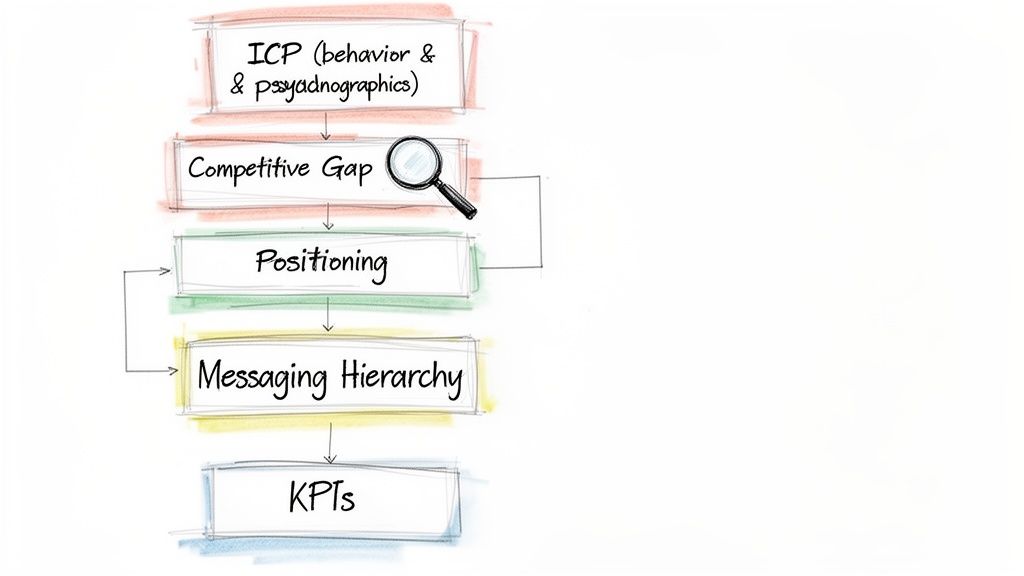
Honestly, your launch is often won or lost long before you send that big announcement email. The pre-launch phase is where the real work happens. It's where you trade assumptions for hard data and build the strategic bedrock for your entire campaign. This isn't the flashy part, but it's the work that makes every ad, email, and blog post that follows actually effective.
This stage is all about setting the direction. It defines your messaging, pinpoints your most valuable customer segments, and cements the "why" behind your product. Skipping this is like building a house on sand—it might look good for a minute, but it's going to crumble the second the pressure is on.
Define Your Ideal Customer Profile with Precision
Let's be real: generic customer personas lead to bland, forgettable marketing. To make any real noise with your launch, you need a razor-sharp Ideal Customer Profile (ICP) that goes way beyond basic demographics. For a SaaS or digital product, that means getting deep into their mindset and behaviors.
It's not enough to know your customer is a "marketing manager." You need to know their day-to-day frustrations, the software they already tolerate, and what they're actually trying to get done.
Job-to-be-Done (JTBD): What specific task are they trying to accomplish when they start looking for a product like yours?
Pain Points: What are the exact headaches and roadblocks they run into with their current setup? Get specific.
Watering Holes: Where do they actually hang out online? Forget "LinkedIn." Think specific Slack communities, niche subreddits, or industry newsletters they genuinely read.
Behavioral Triggers: What event pushes them over the edge and finally gets them to search for a new solution?
This level of detail is a game-changer. It lets you craft messaging that feels like you're reading their minds, ensuring your product launch speaks directly to the people who are most likely to open their wallets.
Conduct Competitive Analysis to Find Your Edge
A proper competitive analysis isn't about filling a spreadsheet with your competitors' features. It's a hunt for the gaps in the market—the weaknesses you can exploit. Look for what your competitors aren't doing well or, even better, the audiences they are completely ignoring.
Your goal isn't to be better; it's to be different. Pinpoint a unique angle—whether it's superior user experience, a focus on a niche vertical, or a disruptive pricing model—and make that the cornerstone of your positioning.
Dig into their marketing language, their customer reviews (especially the bad ones), and their social media feeds. What are their customers complaining about? Those complaints are pure gold—they're your opportunities. This deep dive will shape your positioning and help you explain why your product isn't just another option, but the only smart choice for your target audience.
Craft a Powerful Positioning Statement
Once you have a crystal-clear ICP and you know where you fit in the market, you can nail down your positioning statement. Think of this as your internal North Star for every single marketing decision you make. It's not a public tagline; it's a simple statement that concisely answers four critical questions:
Who is your target customer? (Your hyper-specific ICP)
What is the product category? (The market you're playing in)
What is your unique benefit? (The primary value you deliver that no one else does)
Why should they believe you? (Your proof or key differentiator)
This statement is the source of truth that ensures every email subject line, every paid ad, and every piece of content reinforces the same core message. It's how you build consistency across all the different places you'll show up, which is a key part of any good marketing channels strategy.
Creating Unstoppable Pre-Launch Momentum
Let's be honest: launch day success isn't really about launch day. It's almost entirely decided by the work you do in the weeks and months leading up to it. A great product launch doesn't start with a bang; it starts with a slow, deliberate build-up of anticipation.
This pre-launch phase is your chance to turn a cold audience into a group of genuine fans who are refreshing their browser, waiting for you to go live. It's not about just slapping an email form on a landing page. It's about creating a narrative, making potential customers feel like insiders, and building a groundswell of real excitement. When you nail this part, launch day feels less like a push and more like opening the floodgates to existing demand.
Grow an Engaged and Eager Waitlist
Your waitlist is the single most valuable asset in your pre-launch toolkit. It's a direct line to your hottest prospects. But just having a "Notify Me" button on your site is lazy marketing. You need to give people a seriously compelling reason to sign up right now.
Think of it as a value exchange. What can you offer that solves a small piece of their problem today while teasing the much bigger solution your product will provide?
High-Value Lead Magnets: Don't just offer a checklist. Create a detailed guide, a free mini-course, or a specialized template that your ideal customer would happily pay for. This move immediately establishes your authority.
Early Access Offers: Frame the waitlist as an exclusive club. Promise members first access, a special launch-day discount, or bonus features that the general public won't get. Scarcity and exclusivity work.
Referral Incentives: Turn your waitlist members into a volunteer marketing army. Offer tiered rewards—like moving up the waitlist or unlocking more bonuses—for each successful referral they bring in.
This approach transforms a passive email list into an active community of advocates before your product is even out the door.
Execute a Strategic Content Marketing Blitz
While you're building that waitlist, you need to be out there educating the market. A pre-launch content blitz isn't about shouting "coming soon!" from the rooftops. It's about teaching your audience, digging into their pain points, and subtly positioning your upcoming product as the inevitable solution.
This is your moment to build trust and prove you know your stuff. Share behind-the-scenes glimpses of your product development on social media. Write deep-dive blog posts that explore the problems your product solves—often without even mentioning the product itself. Host a webinar or a live Q&A session with industry experts to build your credibility.
The goal here is to become the go-to resource on the topic your product addresses. By the time you launch, your audience should already see you as a trusted authority, which makes the purchase decision a whole lot easier.
This content becomes the fuel for all your social media and email newsletters, keeping your brand top-of-mind and warming up leads as you get closer to launch day. Every piece should tell a consistent story, creating a cohesive narrative across every channel you use.
Nurture Key Influencer and Partner Relationships
Third-party validation is pure gold. Getting influential voices in your niche to talk about your product before it even launches can be a complete game-changer. But this process starts long before you ever ask for a shoutout. It starts with building genuine relationships.
First, identify a small, curated list of micro-influencers, bloggers, or complementary brands whose audiences are a perfect match for your ideal customer. Then, start engaging with their content. Offer value with zero strings attached and build real rapport. Once you've established that connection, offer them exclusive, early access to your product.
Let them kick the tires, give you feedback, and form their own opinions. A real, honest endorsement from a trusted source is infinitely more powerful than any ad you could ever buy. These early advocates provide the critical social proof that gives a wider audience the confidence to jump on board.
The playbook for launches is always evolving. Today, community-first approaches have exploded 45% year-over-year, and interactive demos are now used in 56% of SaaS launches. Video is king, with video-first content present in 67% of rollouts, while the use of micro-influencers has grown by an incredible 78%. These aren't just trends; they're proven tactics for building momentum.
Executing a Flawless Launch Day
After all the planning, the building, and the waiting, launch day is showtime. This is the moment where all that pre-launch momentum you've carefully built up gets converted into real, tangible results. It's not a day for winging it; it's about executing a plan that's been rehearsed down to the minute.
Think of it like a coordinated performance. Every email, every social post, every partner announcement needs to hit its mark at just the right time. The goal is to create a wave of activity that feels massive and exciting, drawing everyone's attention to what you've built.
The Final Pre-Flight Checks
Before you push the big red button, a final technical audit is absolutely critical. The last thing you want is for your site to buckle under the first wave of excited visitors or for your checkout process to fail. Go through everything one last time.
And I don't just mean loading the homepage. Click through the entire customer journey yourself. Sign up, buy the product, test every link, and make sure your analytics are tracking properly. Your support team should be briefed and ready to go. A smooth technical experience is the invisible foundation of a great launch.
Orchestrating Your Multi-Channel Push
On launch day, your communication shouldn't be a single cannonball splash—it should be a series of perfectly timed waves. How you sequence your announcements across different channels is what builds momentum and keeps it going all day long.
The groundwork you laid in the pre-launch phase is what makes this possible.
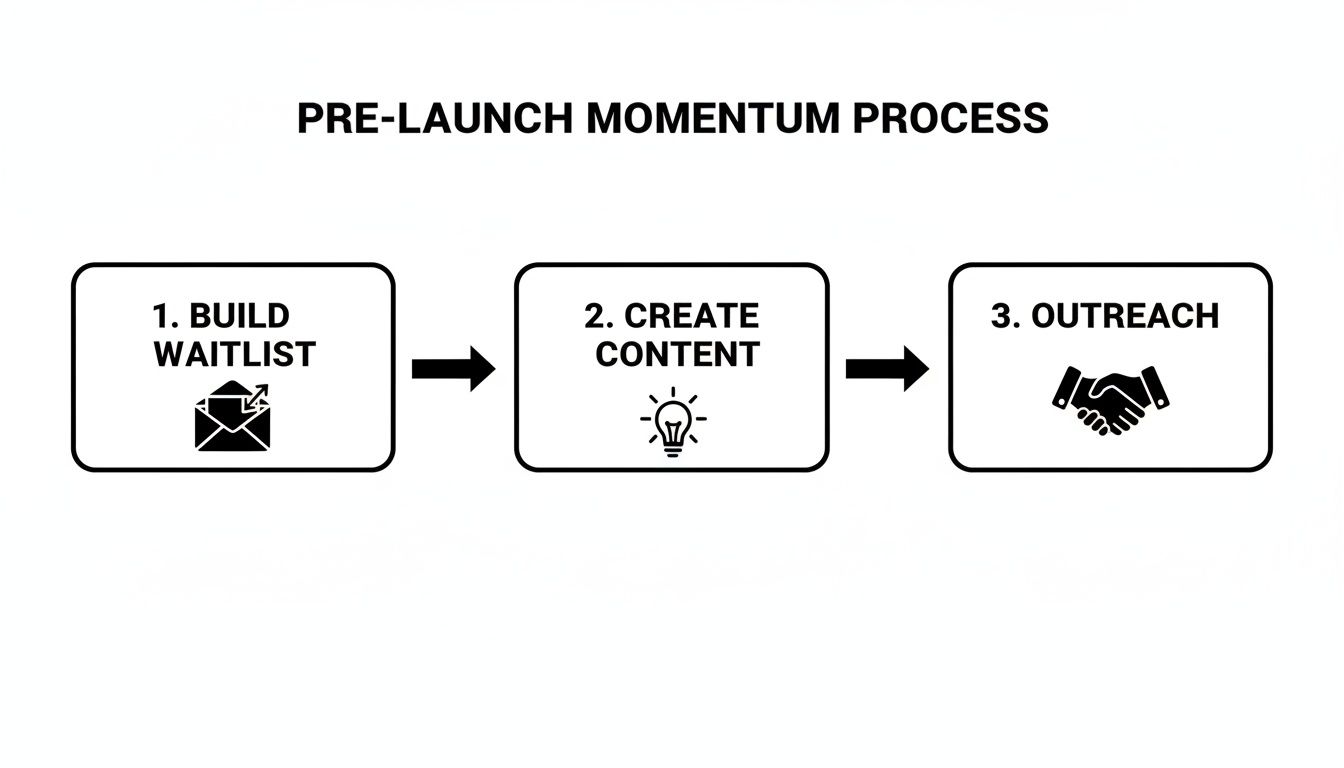
That waitlist, the content you created, and the outreach you did—it all culminates in the energy you're about to unleash.
Here's a sequence that I've seen work wonders:
Morning (Email First): Your waitlist and email subscribers get the news first. No exceptions. They've been with you from the start, and giving them first dibs makes them feel like true insiders. Send them a direct link to buy before you breathe a word about it anywhere else.
Mid-Morning (Social Media & Content): After the email has landed, it's time to go public. Hit all your social channels with the announcement and publish that launch-day blog post you've been sitting on. This is where you start pulling in a wider audience.
Afternoon (Paid Ads & Partners): Once you've got some organic buzz, flip the switch on your paid ad campaigns. This is also the perfect time for your affiliates and partners to start sharing. Their reach amplifies your message and brings in waves of new, high-trust traffic.
To keep everything on track during a notoriously chaotic day, a simple checklist can be a lifesaver. It keeps the team aligned and ensures no critical step is missed when the pressure is on.
Launch Day Execution Checklist
| Time Block (Launch Day) | Marketing & Comms Task | Technical & Ops Task |
|---|---|---|
| 8:00 AM | Final review of all launch assets (email copy, social posts, blog). | Run final systems check on website, servers, and payment gateways. |
| 9:00 AM | Send "We're Live!" email to waitlist and subscribers. | Monitor server load and site performance in real-time. |
| 10:00 AM | Publish launch blog post. Announce launch on all organic social media channels. | Support team goes live, actively monitoring all help channels. |
| 11:00 AM | Begin real-time social media engagement (replying to comments, sharing mentions). | Check analytics to ensure conversion events are firing correctly. |
| 12:00 PM | Activate paid ad campaigns (Google Ads, Facebook/Instagram, LinkedIn). | Technical lead on standby for any immediate bug fixes or performance issues. |
| 1:00 PM | Partners and affiliates begin their promotional pushes. | Review initial sales data and customer sign-up flow for any friction points. |
| 3:00 PM | Host live launch event (Webinar, Q&A, AMA). | Actively monitor social media for technical complaints or user confusion. |
| 5:00 PM | Send a "recap" or "last chance for launch offer" email to non-openers. | Prepare for end-of-day performance reporting and analysis. |
This schedule ensures that both the promotional and the operational sides of the launch are in lock-step, creating a seamless experience for your new customers.
Engaging Your First Customers in Real Time
Don't just broadcast on launch day—connect. It's a golden opportunity to engage directly with your very first customers and turn a simple transaction into a memorable moment.
Consider hosting a live event, like a product demo webinar or an "Ask Me Anything" session with the founders. It puts a human face to the brand, builds instant trust, and gives you a chance to answer questions and handle objections as they come up. This shows your new customers that you're there for them from day one.
Plan for things to go wrong. Have a small, dedicated team monitoring social media for feedback, a technical lead on standby for server issues, and pre-written responses for common questions or potential negative comments. Control the narrative by being prepared and responsive.
Building a Word-of-Mouth Growth Engine
A powerful product launch isn't a single event; it's the first domino to fall in a long chain of sustainable growth. The real magic happens when your initial wave of happy customers starts telling their friends. This is about turning that organic word-of-mouth from a hopeful byproduct into a predictable, automated revenue channel.
The key is to systematically motivate your biggest fans to spread the word. By creating a formal affiliate and referral program, you build an engine that runs on its own, constantly bringing in new, high-trust customers long after the launch-day buzz has faded.
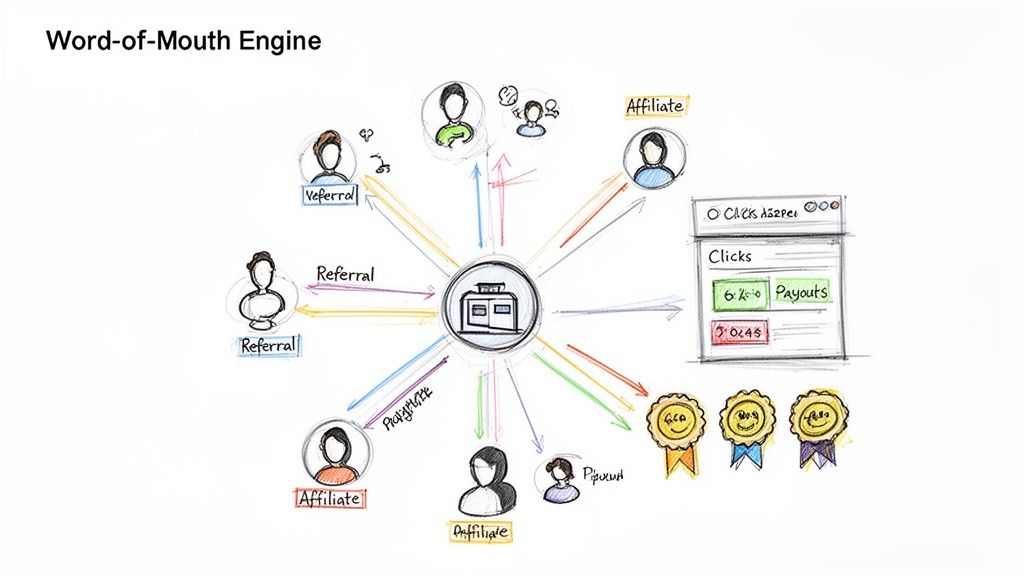
This is how you systemize what is often a chaotic process, transforming casual recommendations into a measurable part of your product launch strategy.
Designing a Program That Actually Motivates
Let's be clear: a weak incentive structure will get you nowhere. Simply offering a 5% discount isn't enough to get someone to actively champion your product. Your reward structure needs to feel substantial and genuinely worth their effort.
For SaaS and digital products, you have several compelling options. The right choice depends entirely on your business model, price point, and customer lifetime value.
Percentage Commissions: This is the classic model. You offer partners a recurring percentage of the subscription fee for every customer they refer. It's a powerful motivator for subscription businesses because it creates a passive income stream for your affiliates.
Fixed Bonuses: A flat-rate reward for each new sign-up (e.g., $50 per new customer) works well for products with a clear, one-time purchase price. It's simple, predictable, and easy for partners to understand.
Tiered Rewards: This structure incentivizes your top performers. An affiliate might earn 20% for their first 10 referrals, but that jumps to 30% after they hit that milestone. It adds a layer of gamification that encourages your best partners to keep promoting.
Your goal is to make the reward so appealing that your best customers feel like they'd be foolish not to participate. The incentive should match the value they're bringing to your business.
Remember, this isn't just about rewarding customers; it's about creating a true partnership. This philosophy is central to many successful word-of-mouth marketing strategies that build long-term brand loyalty.
Automating the Entire Referral Workflow
The biggest barrier to running a successful affiliate program is often the administrative headache. Manually tracking clicks, attributing sales to the right partner, and processing monthly payouts is a nightmare that drains time and invites errors. This is where automation becomes a non-negotiable part of your product launch strategy.
Modern platforms are built to handle this entire process for you. For instance, a tool like Blossu can be integrated with a lightweight piece of code that starts tracking every referral click and conversion automatically.
Connecting your payment processor, like Stripe, can be done in a single click. This link allows the system to automatically calculate commissions as payments come in and handle partner payouts without you ever touching a spreadsheet. This frees you up to focus on building relationships with your partners, not on managing their payments.
Recruiting and Equipping Your First Partners
Your first affiliates are hiding in plain sight. They are your most engaged beta testers, the customers who leave positive reviews without being asked, and the people who are already recommending you for free on social media.
Your first step is to personally invite them. Send a direct, personal email explaining the program and why you think they'd be a great fit. Make them feel like founding members of an exclusive club.
Once they're on board, your job is to make it incredibly easy for them to succeed. Don't just send them a link and wish them luck. Arm them with the resources they need to be effective advocates for your brand.
A Simple Onboarding Process: Give them a quick tour of their partner dashboard so they know where to find their unique tracking link and monitor their performance.
Ready-to-Use Creative Assets: Provide them with a swipe file of email copy, social media posts, and high-quality graphics. This removes friction and ensures their messaging is on-brand.
Product Knowledge & Talking Points: Give them a one-pager that clearly outlines the key benefits and talking points of your product. This helps them answer questions and promote you with confidence.
By turning your happiest customers into an empowered sales force, you create a growth loop that feeds on itself. Each new, happy customer becomes a potential new affiliate, making your word-of-mouth engine a core, scalable pillar of your post-launch success.
Scaling for Long-Term Success After Launch
You popped the champagne, the launch-day adrenaline is wearing off, but let's be clear: the real work is just starting. The few weeks right after your launch are a massive opportunity to turn that initial buzz into lasting momentum. This is your window to prove your product's value, build real relationships with your first users, and lay the foundation for a growth flywheel that actually sustains itself.
Success from here on out isn't about making more marketing noise. It's about retention, feedback, and smart optimization. It means shifting from a "launch" mindset to a "growth" mindset, focusing on the people you just acquired. You need to make sure they don't just stick around, but become your next wave of evangelists. Skipping this part is the fastest way to watch a great launch just fizzle out.
Solidify Relationships with Flawless Onboarding
A new user's first experience inside your product is everything. A clunky or confusing onboarding process can kill the relationship before it even begins, sending your churn rates through the roof.
A great onboarding sequence doesn't just show people how to use features; it guides them to their first "aha!" moment as quickly as humanly possible. This is where your product's promise becomes their reality.
Welcome Email Series: Don't just send one "thanks for signing up" email. Set up a short, automated sequence that reinforces the core value prop and points them to the key actions that deliver immediate value.
In-App Guided Tours: Use tooltips or quick walkthroughs to steer new users through the most critical first steps. Focus on the one or two actions that will give them an early win.
Proactive Support: Offer help before they even realize they need it. A simple in-app message checking in or pointing them to a help doc can make a world of difference.
A user who feels the core value of your product in their very first session is exponentially more likely to become a long-term, paying customer.
Systematize Your Customer Feedback Loop
Your first cohort of users is a goldmine of raw, unfiltered feedback. They will show you exactly what's great about your product and—more importantly—what's confusing, broken, or flat-out missing. You need a system to capture, analyze, and act on this intelligence.
Don't just sit back and wait for them to come to you. You have to actively solicit their opinions.
By systematically gathering feedback, you move from making assumptions about your users' needs to building a product roadmap based on real-world data. This is how you build a product people actually love, not just one you think they need.
For true long-term growth, you have to understand how to leverage your customer service as a growth engine. This means creating feedback channels that are dead simple to use. Mix it up with surveys, one-on-one calls with your most active users, and in-app feedback widgets to make sharing their thoughts completely frictionless.
Analyze Launch KPIs and Document Lessons Learned
Now it's time to get brutally honest with yourself about performance. The data from your launch campaign holds critical lessons for every single marketing effort you'll run in the future. Dive into your analytics and stack your results against the KPIs you set before the launch.
But please, look beyond the vanity metrics. What really moved the needle?
Channel Performance: Which marketing channels delivered the highest-quality signups? Was it your partner outreach, paid ads, or organic content? Knowing this is how you allocate your next budget effectively.
Messaging Resonance: Which email subject lines crushed it on open rates? What ad copy had the highest click-through rate? This tells you which parts of your messaging actually connected with your audience.
Conversion Funnel Drop-offs: Where did you lose people in the sign-up process? Identifying friction points on your landing page or in your checkout flow gives you a clear, prioritized optimization list.
This analysis isn't about creating a report that gets buried in a folder. It's about pulling out actionable insights.
The timing of your launch can be a huge factor here. Enterprise software, for example, sees 35% of its successful launches in Q1 when budgets are fresh, while Q4 lags at 15% because of holiday freezes. Understanding patterns like this—and knowing that North America has a 43% success rate for launches—is critical for planning your next move.
Finally, don't forget to celebrate the wins, no matter how small they seem. Share the positive results with your entire team and your launch partners. Acknowledging all the hard work keeps morale high and everyone motivated for the long road of scaling ahead. Digging into marketing attribution software can help you track these wins with much greater clarity.
Your Top Product Launch Questions, Answered
Even the most detailed playbook can leave you with a few nagging questions. When you're in the trenches of planning a launch, getting straight answers to these common hurdles can be the difference between a smooth execution and a last-minute scramble. Let's tackle the questions that come up most often for SaaS and digital brands.
How Far Out Should I Start Planning My Launch?
For any serious digital product or SaaS platform, you need to give yourself at least three to six months. Anything less is a recipe for a rushed, disjointed launch that fizzles out before it ever gets going.
That timeline isn't just a random number; it's built around the critical phases that you simply can't skip. You have to give each stage room to breathe:
Months 1-2: This is all about foundational work. You'll be doing deep market research, nailing down your ideal customer profile (ICP), and locking in your core messaging and positioning. Everything else is built on this.
Months 2-4: Time to start building your pre-launch assets. This means creating lead magnets, designing landing pages, writing out your email sequences, and producing the content that will educate your early audience.
Months 4-6: Now it's time to build real buzz. You'll be doing influencer outreach, running teaser campaigns, and pouring energy into growing an engaged, high-quality waitlist.
Trying to cram this into a few weeks is the single most common mistake I see founders make. A six-month runway feels like a long time, but it's what gives you the space to build genuine anticipation instead of just shouting about a new product into the void.
What Are the Most Important Launch KPIs to Track?
Your Key Performance Indicators (KPIs) need to tell the whole story, not just what happened on launch day. A smart set of metrics will give you a complete picture of your launch strategy's health, from the first whisper to its long-term impact on the business.
I like to think about it in three distinct phases:
Pre-Launch: Here, your entire world revolves around building an audience and getting them excited. The metrics that matter are waitlist sign-ups, your social media engagement rate, and the referral traffic you're getting from early partners or advocates.
Launch Week: This is when all eyes are on conversion and customer acquisition. You'll be obsessively tracking your website conversion rate, the total number of new customers or trials, and your customer acquisition cost (CAC).
Post-Launch: The focus immediately shifts to retention and customer happiness. Start monitoring your user activation rate, customer lifetime value (LTV), churn rate, and your Net Promoter Score (NPS).
This phased approach ensures you're measuring the right things at the right time, from generating initial buzz all the way to building a sustainable business.
How Do I Recruit My First 10 Affiliates?
Your first affiliates are your most powerful, and they're almost always hiding in plain sight. Forget sending cold emails to massive influencers. You need to start with your warmest audience—the people who are already believers.
Kick things off with your most enthusiastic early adopters or beta testers. These are the people who already get your product's value, which makes them the perfect first advocates. Reach out to them personally and invite them to join your new affiliate program. Make them feel like founding partners, because that's exactly what they are.
At the same time, start identifying micro-influencers and niche content creators whose audience is a dead ringer for your ICP. Offer them exclusive early access and a competitive commission rate to get them on board. Using a platform designed for this, like Blossu, takes the headache out of the process. It can give them unique tracking links and automate all the partner management and payouts right from the start.
Ready to turn your happy customers into a predictable revenue stream? Blossu makes it easy to launch and automate your affiliate and referral program. Get started for free and see how simple word-of-mouth growth can be.
Frequently Asked Questions
Have a question not in here? Contact us
- How Far Out Should I Start Planning My Launch?
For any serious digital product or SaaS platform, you need to give yourself at least three to six months. Months 1-2 should focus on foundational work like market research and messaging. Months 2-4 involve building pre-launch assets like lead magnets and content. Months 4-6 are for building buzz through influencer outreach and waitlist growth. Trying to cram this into a few weeks leads to rushed, disjointed launches.
- What Are the Most Important Launch KPIs to Track?
Your KPIs should tell the whole story across three phases: Pre-Launch (waitlist sign-ups, social media engagement rate, referral traffic), Launch Week (website conversion rate, new customers/trials, customer acquisition cost), and Post-Launch (user activation rate, customer lifetime value, churn rate, Net Promoter Score). This phased approach ensures you're measuring the right things at the right time.
- How Do I Recruit My First 10 Affiliates?
Start with your warmest audience—your most enthusiastic early adopters or beta testers who already understand your product's value. Reach out personally and make them feel like founding partners. Simultaneously, identify micro-influencers whose audiences match your ideal customer profile and offer them exclusive early access with competitive commission rates. Platforms like Blossu can automate the tracking and payouts from day one.
- What's the difference between a product launch strategy and a marketing campaign?
A product launch strategy is a comprehensive, cross-functional effort involving product, marketing, and sales teams to bring a new product to market and achieve specific business goals. It includes pre-launch preparation, launch execution, and post-launch optimization. A marketing campaign is typically a single, time-bound promotional effort focused on specific messaging or channels. Launch strategies are broader and more strategic, while campaigns are tactical components within the larger strategy.
🎯 Key Takeaways
A modern product launch strategy requires 3-6 months of planning across three phases: foundational research, asset creation, and buzz building
Pre-launch momentum is built through precise ICP definition, competitive analysis, waitlist growth, and strategic content marketing
Launch day execution requires technical audits, multi-channel coordination, and real-time customer engagement with proper contingency planning
Post-launch success depends on word-of-mouth engines, flawless onboarding, systematic feedback loops, and data-driven optimization
Automated referral and affiliate programs transform satisfied customers into scalable acquisition channels for long-term growth
🚀 Ready to Build Your Product Launch Strategy?
Turn your product launch into a predictable growth engine with Blossu. Build automated referral and affiliate programs that scale your word-of-mouth marketing from day one. Track everything, automate payouts, and turn your happiest customers into your most powerful growth channel. Start building your launch strategy with Blossu today.