
7 High-Impact Referral Program Examples to Model in 2026
Referral marketing remains one of the most powerful and cost-effective growth channels, turning your existing customer base into a scalable acquisition engine. But what separates a program that fizzles out from one that delivers exponential growth? It often comes down to the underlying strategy, the psychological triggers, and the quality of execution. A successful referral program isn't just about offering a reward; it's about creating a seamless, motivating experience that encourages sharing.
This guide moves beyond generic advice to provide a deep, strategic breakdown of high-impact referral program examples. We'll dissect the reward structures, messaging, and rollout tactics used by leading SaaS, DTC, and B2B brands that have mastered word-of-mouth marketing. Instead of just showing you who did it well, we'll explain why it worked and how you can replicate their success.
For each example, you will find a comprehensive analysis, including:
Reward Model Breakdown: A clear explanation of the incentive structure.
Strategic Insights: The core reasons behind the program's effectiveness.
Actionable Takeaways: Replicable strategies for your own business.
Performance Metrics: The key data points to track for success.
We provide screenshots for visual context and direct links to explore each platform further. This resource is designed to be your blueprint for building a referral program that drives predictable, word-of-mouth revenue. Let's explore the models that work.
1. ReferralCandy
ReferralCandy is a powerful yet user-friendly platform designed to help e-commerce and subscription businesses launch and manage referral marketing programs. It stands out by simplifying the entire process, allowing brands to set up a fully functional campaign quickly, often in under 30 minutes. Its core strength lies in its turnkey nature, offering automated reward payouts, customizable email templates, and seamless integrations with major platforms like Shopify, Klaviyo, and ReCharge.
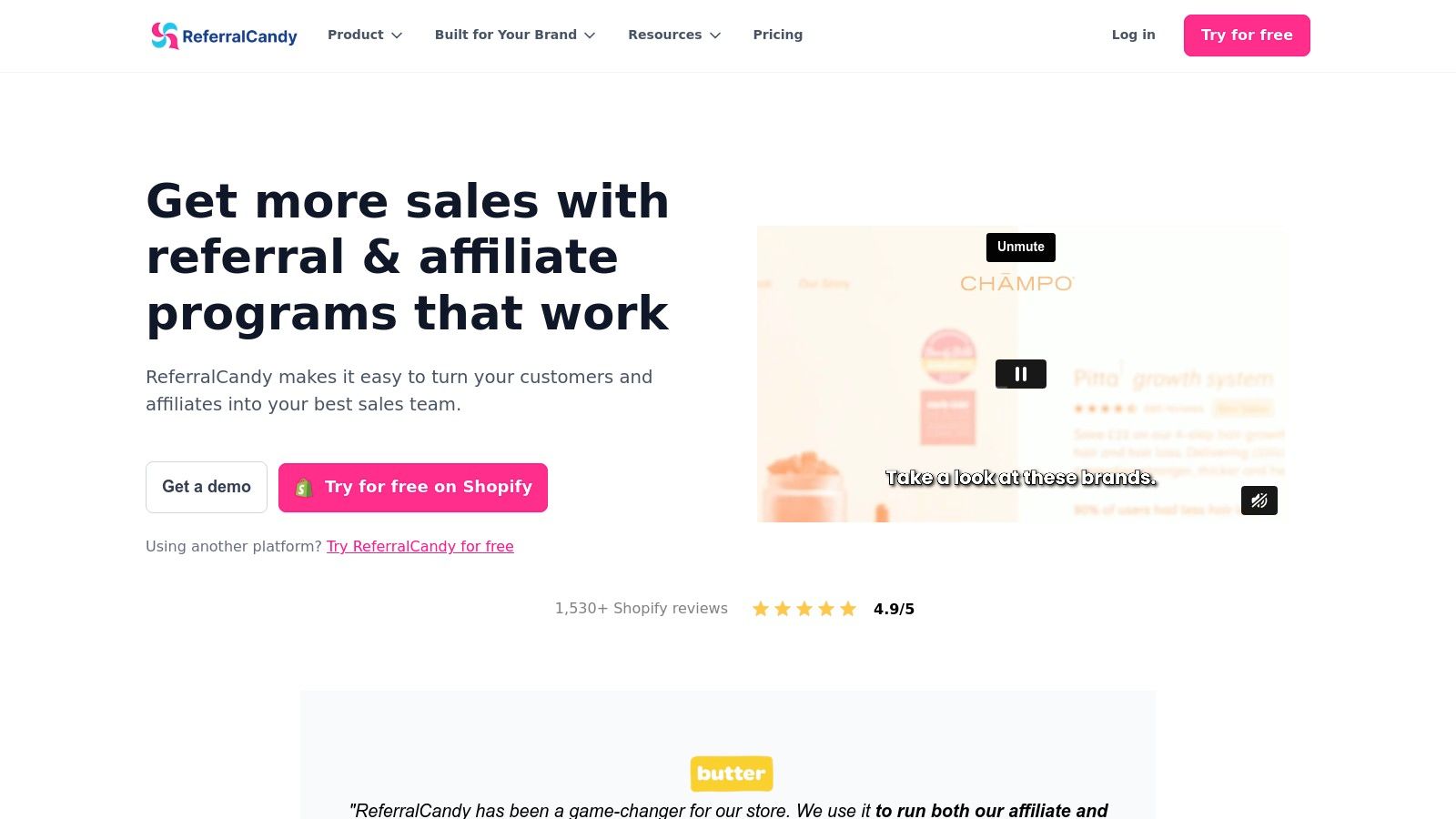
What makes ReferralCandy a top choice, especially for growing brands, is its extensive public library of real-world referral program examples. This curated collection allows marketers to study successful campaigns across various industries, gaining inspiration for their own reward structures and messaging. This resource is invaluable for anyone looking to understand the practical application of referral marketing before committing to a strategy.
Strategic Breakdown & Key Features
Reward Flexibility: Supports cash, store credit, and coupon codes, giving businesses the flexibility to choose the incentive that best aligns with their profit margins and customer motivations.
Automation: The platform automates everything from advocate invitations to reward fulfillment, freeing up valuable time for marketing teams.
Integration Ecosystem: Connects with essential tools like Shopify, WooCommerce, BigCommerce, Klaviyo, and ReCharge to create a unified marketing stack.
Transparent Pricing: Offers a 7-day free trial and a success-fee pricing model on its Premium plan ($59/month + commission), making it accessible for startups. As businesses scale, the Plus plan ($299/month) provides more advanced features.
Actionable Insights: The dashboard provides clear analytics on key performance indicators like referral traffic, conversion rates, and revenue generated, helping you prove the value of your program.
Actionable Takeaways & Tips
For businesses just starting with referral marketing, ReferralCandy is an excellent entry point. Before launching, use their library of referral program examples to model your reward. A common best practice is to offer a two-sided incentive, such as "Give $10, Get $10," which motivates both the advocate and the new customer.
To maximize your program's success, actively promote it across multiple channels. Use ReferralCandy's post-purchase popups and automated emails, but also share referral links on social media and in your email newsletters. This multi-channel promotion ensures your program gets the visibility it needs to drive consistent growth.
Website: https://www.referralcandy.com
2. Friendbuy
Friendbuy is a premium referral and loyalty platform engineered for high-growth direct-to-consumer (DTC) brands, subscription services, and marketplaces. It empowers marketing teams to build sophisticated, on-brand programs focused on continuous testing and optimization. The platform's primary advantage is its deep emphasis on data-driven growth, providing the tools needed to run A/B tests across every touchpoint of the referral funnel, from widgets to post-purchase sharing prompts.
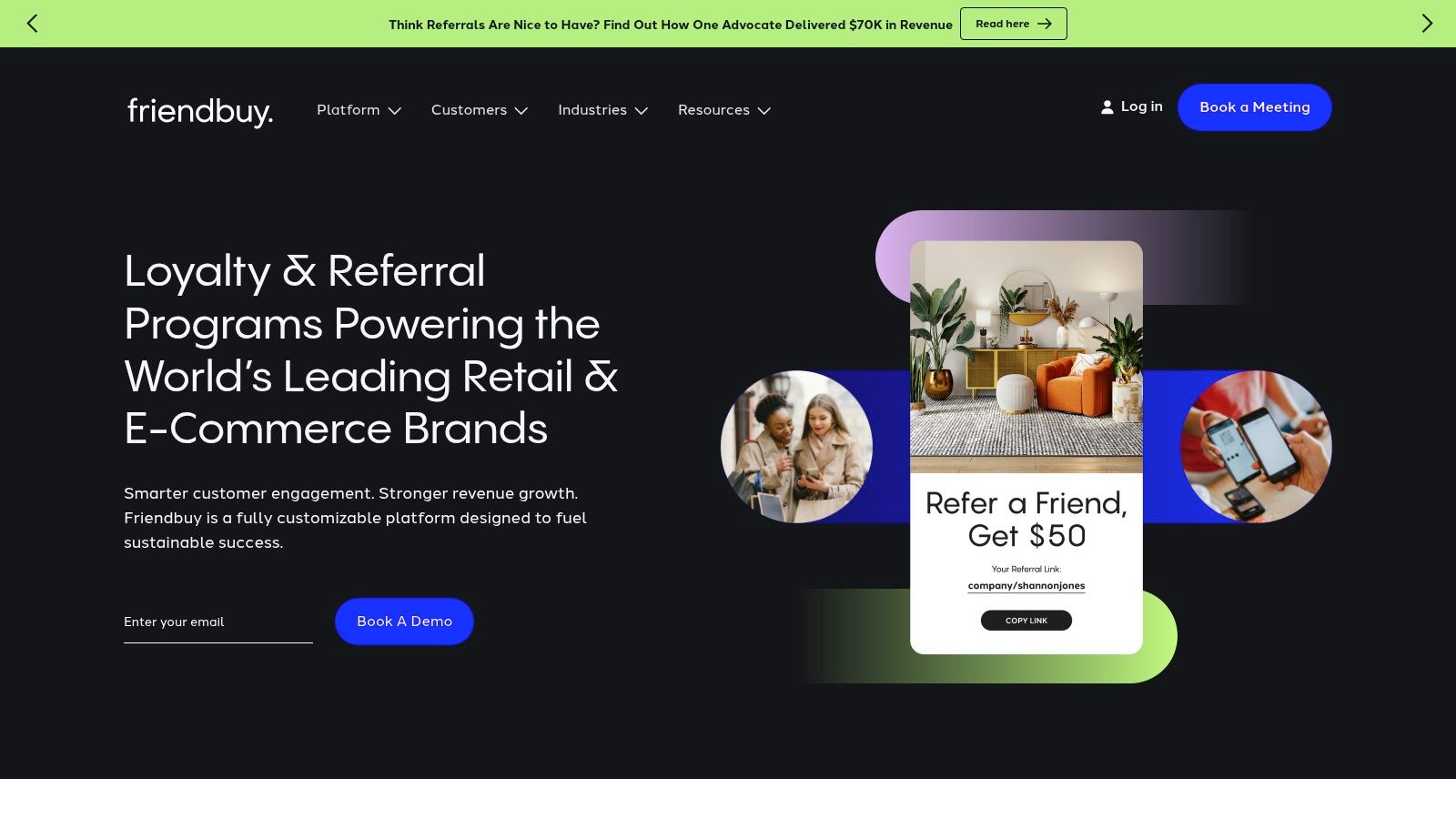
What truly sets Friendbuy apart is its resource center, which offers detailed teardowns and tactic-rich articles analyzing high-performing programs. These guides provide concrete examples with real numbers, incentive math, and conversion optimization advice. This makes it an essential tool for experienced marketers who want to move beyond basic setups and into advanced, scalable referral strategies. For teams looking to understand the mechanics of top-tier campaigns, these referral program examples are an invaluable source of inspiration.
Strategic Breakdown & Key Features
Advanced A/B Testing: Enables marketers to experiment with different offers, copy, and creative across the entire referral funnel to identify what drives the highest conversion rates.
Deep Integration: Offers robust enterprise-level integrations and services designed to connect seamlessly with complex tech stacks, ensuring a cohesive customer experience.
On-Brand Customization: Provides extensive control over the design of widgets, emails, and in-app placements, allowing brands to maintain a consistent look and feel.
Performance Reporting: Delivers clear, actionable reporting on crucial metrics like cost per acquisition (CPA), conversion lift, and overall revenue impact, helping prove ROI.
Sales-Led Approach: Pricing is not publicly listed and is customized through a sales-led process, which is ideal for larger businesses needing a tailored package and dedicated support.
Actionable Takeaways & Tips
Friendbuy is best suited for established brands with the resources and bandwidth to dedicate to ongoing program optimization. Before committing, leverage their public case studies to understand the potential revenue lift and to model your own incentive structure. A key takeaway from their resources is the power of post-purchase sharing, which captures customers when they are most excited about your brand.
To get the most out of the platform, plan to run A/B tests from day one. Start by testing the core offer (e.g., "$20 vs. 20% off") and the primary headline on your referral widget. Even small improvements in these areas can lead to significant gains in participation and revenue over time. Continuously monitor your CPA and conversion data to refine your strategy and scale your most successful experiments.
Website: https://www.friendbuy.com
3. ReferralRock
ReferralRock is a versatile referral marketing platform designed for a broad range of businesses, including B2C, B2B, and service-based companies. It excels at managing referral programs that go beyond typical e-commerce transactions, accommodating more complex, sales-led, or non-checkout flows. This makes it an ideal solution for SaaS companies, agencies, and professional services that need a system to track leads through a longer sales cycle.
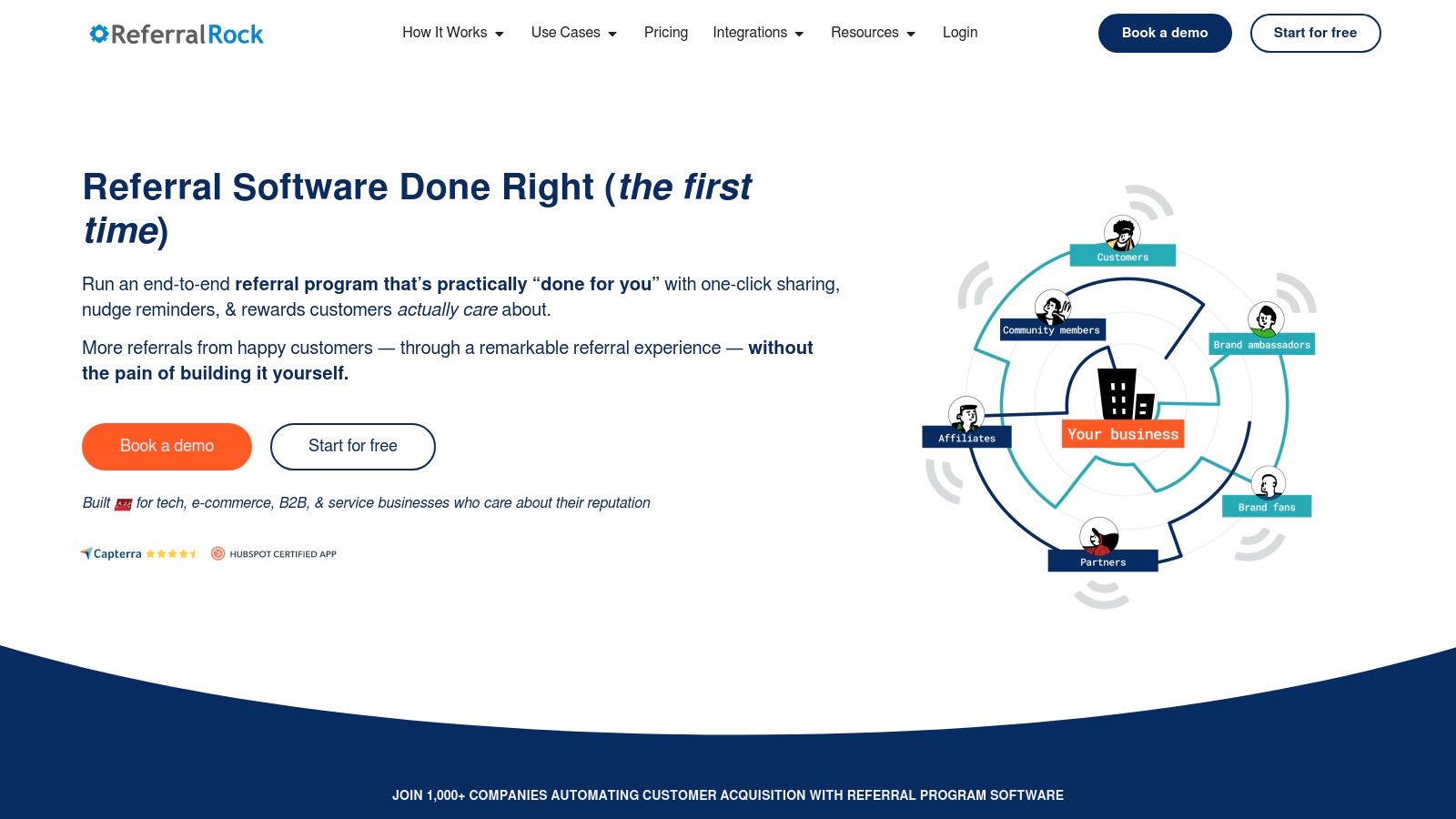
What truly distinguishes ReferralRock is its extensive public directory of referral program examples and case studies specifically tailored to these non-standard funnels. While many platforms focus on direct-to-consumer models, ReferralRock provides detailed guides on reward design and funnel optimization for scenarios where a direct online checkout isn't the final conversion point. This educational focus helps businesses build effective programs from the ground up, regardless of their go-to-market motion.
Strategic Breakdown & Key Features
Diverse Reward Structures: The platform supports a wide array of reward models, including give-get, milestone-based, multi-step, and stacked incentives, allowing for highly customized campaigns.
Hosted Member Experience: Provides hosted member portals, shareable widgets, and unique landing pages, creating a seamless and branded experience for advocates and their referrals.
Robust Integrations: Connects with essential CRMs like HubSpot and Salesforce, as well as e-commerce platforms, enabling detailed tracking and analytics across the entire customer journey.
Tailored Plan Families: Offers distinct plans (Professional vs. Engage) designed for different business models, with add-ons for scaling and automated payouts to fit growing needs.
Advanced Controls: Includes built-in fraud detection and management tools to ensure program integrity and protect against self-referrals or system abuse.
Actionable Takeaways & Tips
ReferralRock is a strong choice for businesses with a considered purchase process. When setting up your program, map out your entire sales funnel and use their multi-step reward feature to incentivize advocates at key stages, such as when a referral books a demo and when they become a paying customer. This approach keeps advocates engaged throughout a longer conversion timeline.
Promote the program directly through your sales and customer success teams, equipping them with easy-to-share links and talking points to enroll happy clients as advocates.
Website: https://referralrock.com
4. Viral Loops
Viral Loops is a referral marketing platform that specializes in template-based campaigns, allowing brands to replicate the success of famous viral programs like those from Dropbox, Harry's, and Robinhood. It stands out by providing a gallery of proven referral structures that are pre-configured and ready to launch. This approach is ideal for businesses that want to quickly implement a campaign based on a well-known and effective referral pattern without starting from scratch.
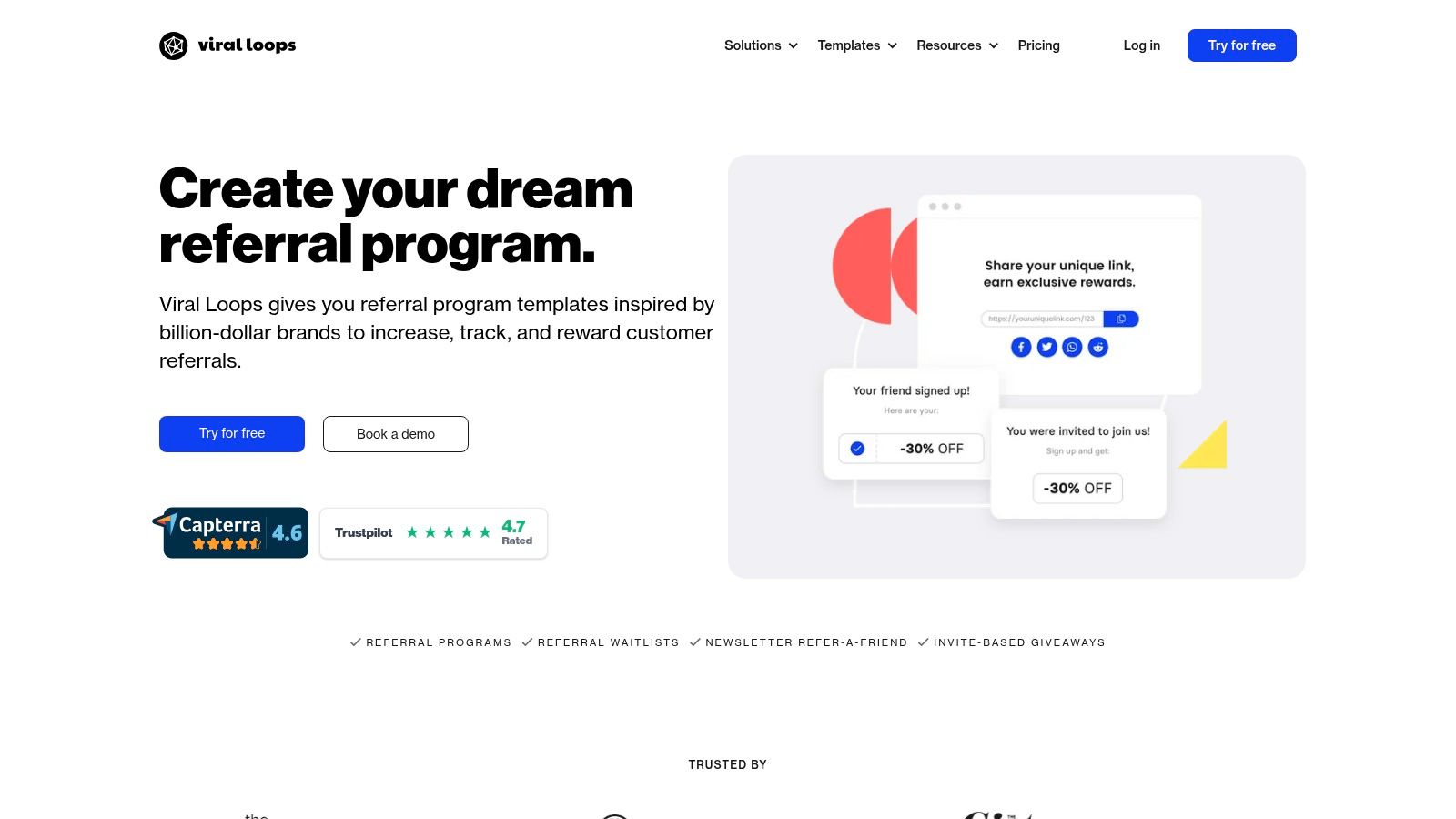
What makes Viral Loops particularly compelling is its direct mapping of strategic concepts to actionable templates. Instead of just giving you the tools, it guides you toward a specific campaign type, such as a Milestone, Refer-a-Friend, or Leaderboard contest. This is perfect for marketers who know the type of viral loop they want to create but need a fast and reliable way to build and deploy it, whether for a pre-launch waitlist, a newsletter, or an e-commerce store.
Strategic Breakdown & Key Features
Template-Based Campaigns: Offers pre-built templates for various goals, including Milestone referrals (like Dropbox), e-commerce Refer-a-Friend (like Harry's), Leaderboard Contests, and Pre-launch waitlists. This is a key resource for studying different referral program examples and then immediately implementing them.
Fast Implementation: Provides hosted landing pages, customizable widgets, and a dedicated Shopify app, enabling a very quick time-to-launch with minimal coding.
Broad Applicability: The platform is versatile, serving pre-launch startups, newsletters, and established e-commerce businesses with equal effectiveness.
Automated Rewards & Fraud Detection: Integrates with Stripe and Tremendous for automated reward payouts and includes built-in fraud detection to ensure the integrity of your campaign.
Participant-Based Pricing: Pricing starts with a 14-day free trial. Paid plans like the "Start-up" plan ($49/month) are based on the number of participants (up to 1,000), which can be a constraint for larger communities but is cost-effective for smaller ones.
Actionable Takeaways & Tips
Viral Loops is the perfect choice when you have a specific, proven referral model in mind. If you want to build pre-launch hype, use its "Prelaunch" template to create a waitlist where users can climb the ranks by referring others. This creates a powerful sense of anticipation and social proof before you even go live.
For e-commerce stores, the classic two-sided "Refer-a-Friend" template is a solid starting point. To enhance its performance, use the platform's no-code widgets to embed the referral call-to-action directly on post-purchase pages and within customer account dashboards. This ensures advocates see the referral offer when they are most engaged with your brand, increasing the likelihood they will share.
Website: https://viral-loops.com
5. Mention Me
Mention Me is a sophisticated customer advocacy and referral marketing platform trusted by global consumer brands to turn their existing customer base into a powerful acquisition channel. It differentiates itself by focusing heavily on data-driven optimization, particularly through robust A/B testing and cohort segmentation. This allows brands to move beyond a "set it and forget it" approach and continuously refine their programs for maximum performance.
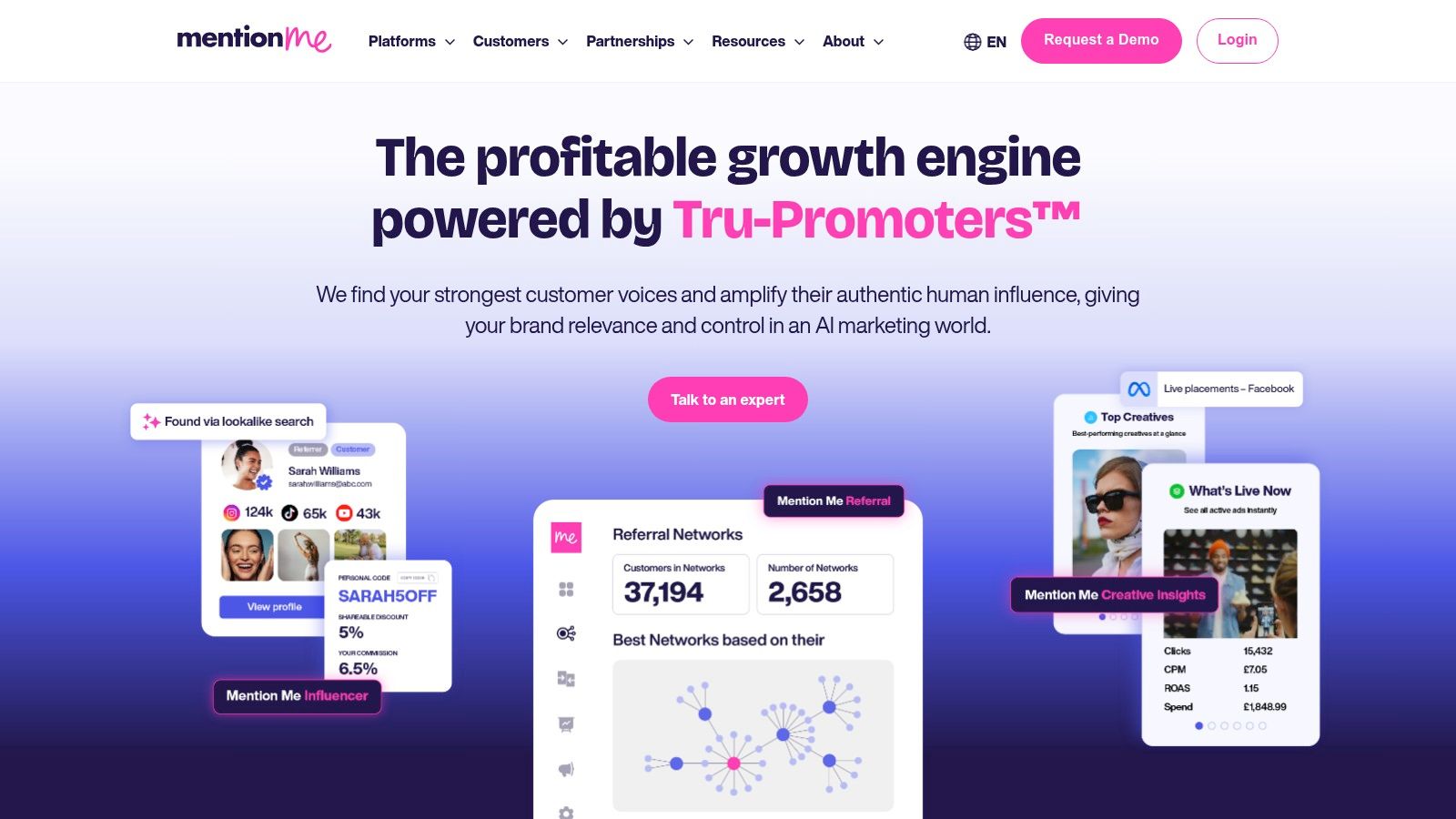
What makes Mention Me particularly valuable as a resource is its library of detailed case studies. Unlike generic success stories, these examples often include specific metrics like CPA, share rates, and conversion lifts, providing a transparent look into what makes a referral program successful. This emphasis on quantified impact and experimentation methodology makes it an excellent choice for data-centric marketing teams looking to prove ROI.
Strategic Breakdown & Key Features
Advanced A/B Testing: Enables brands to test every element of the referral journey, from headlines and CTAs to reward structures and sharing options, across different customer segments.
On-site and In-App Journeys: Provides light-touch integration using tags and div containers, making it easy to deploy referral touchpoints within checkout flows, post-purchase pages, and native mobile apps.
Transparent Case Studies: Publishes quantified results from its clients, offering real-world referral program examples with concrete data on share rates, conversion lifts, and cost-per-acquisition.
Customer Segmentation: Allows for tailored referral offers based on customer cohorts, such as new vs. repeat buyers or high-LTV customers, ensuring the right incentive is presented to the right audience.
Custom Pricing: Pricing is quote-based and tailored to business needs, which is common for enterprise-focused platforms. This model is best suited for established brands with significant customer volume.
Actionable Takeaways & Tips
For brands with an established customer base, Mention Me provides the tools to take referral marketing to the next level. Before launching, dive into their case studies to benchmark potential share and conversion rates for your industry. This data can help you set realistic goals and secure buy-in from stakeholders.
Leverage the A/B testing functionality from day one. Don't just test rewards; experiment with the core proposition. Test a "Give $20, Get $20" offer against a "Give 20% off, Get a free gift" offer to see what truly motivates your specific audience. The key is to build a culture of continuous optimization around your program rather than treating it as a static channel.
Website: https://www.mention-me.com
6. G2 (Referral Software category)
G2 is a leading peer-to-peer review site and software marketplace where businesses can discover, compare, and manage the technology they need. Its referral marketing category serves as a comprehensive, vendor-neutral directory, allowing users to evaluate a wide range of referral software based on real user reviews, feature sets, and market presence. Instead of showcasing a single tool, G2 provides a meta-level view of the entire landscape, making it an essential research hub.
The platform's power lies in its structured data and authentic user feedback. It helps businesses move beyond marketing claims by providing a transparent look at what it's like to actually use a specific tool. Users can filter options by company size, industry, and specific features, ensuring they can create a shortlist of platforms that genuinely meet their operational needs and budget constraints before ever speaking to a sales representative.
Strategic Breakdown & Key Features
Side-by-Side Comparisons: G2's comparison feature allows you to select multiple referral software platforms and view their ratings, features, and user satisfaction scores in a head-to-head format.
Verified User Reviews: The platform aggregates detailed reviews from verified users, who often share specific pros, cons, and implementation experiences. This provides invaluable insight into a tool's real-world performance, customer support quality, and stability.
Advanced Filtering: Users can narrow down the extensive list of referral tools by specifying their business size (small, mid-market, enterprise), industry, and must-have features like gamification, multi-step rewards, or specific integrations.
Category Rankings: G2 uses a proprietary algorithm to rank software based on user satisfaction and market presence, creating its Grid® Reports. This helps quickly identify market leaders and high-momentum products.
Actionable Takeaways & Tips
For any business serious about selecting the right referral software, G2 should be the first stop for research. Start by exploring the main category to get a broad overview of the available options. Use the filters to narrow the list to platforms that cater to your company size and industry, as a tool built for enterprise B2B SaaS will have different features than one designed for a small DTC brand.
Pay close attention to recent reviews (posted within the last six to twelve months) as they often reflect the current state of the product and its customer support. When you've created a shortlist, use the compare feature to analyze your top three to five choices side-by-side. This methodical approach, leveraging thousands of referral program examples and software reviews, ensures you make an informed decision rather than being swayed by a single vendor's marketing pitch.
7. Shopify App Store – Referral apps collection
The Shopify App Store serves as a central marketplace where merchants can discover, compare, and install a wide range of applications to extend their store's functionality. For those looking to implement referral marketing, the store features a curated collection of referral apps, including well-known names like ReferralCandy, Smile.io, and Growave. This makes it an incredibly practical starting point for any Shopify-based business wanting to quickly test and launch a program.
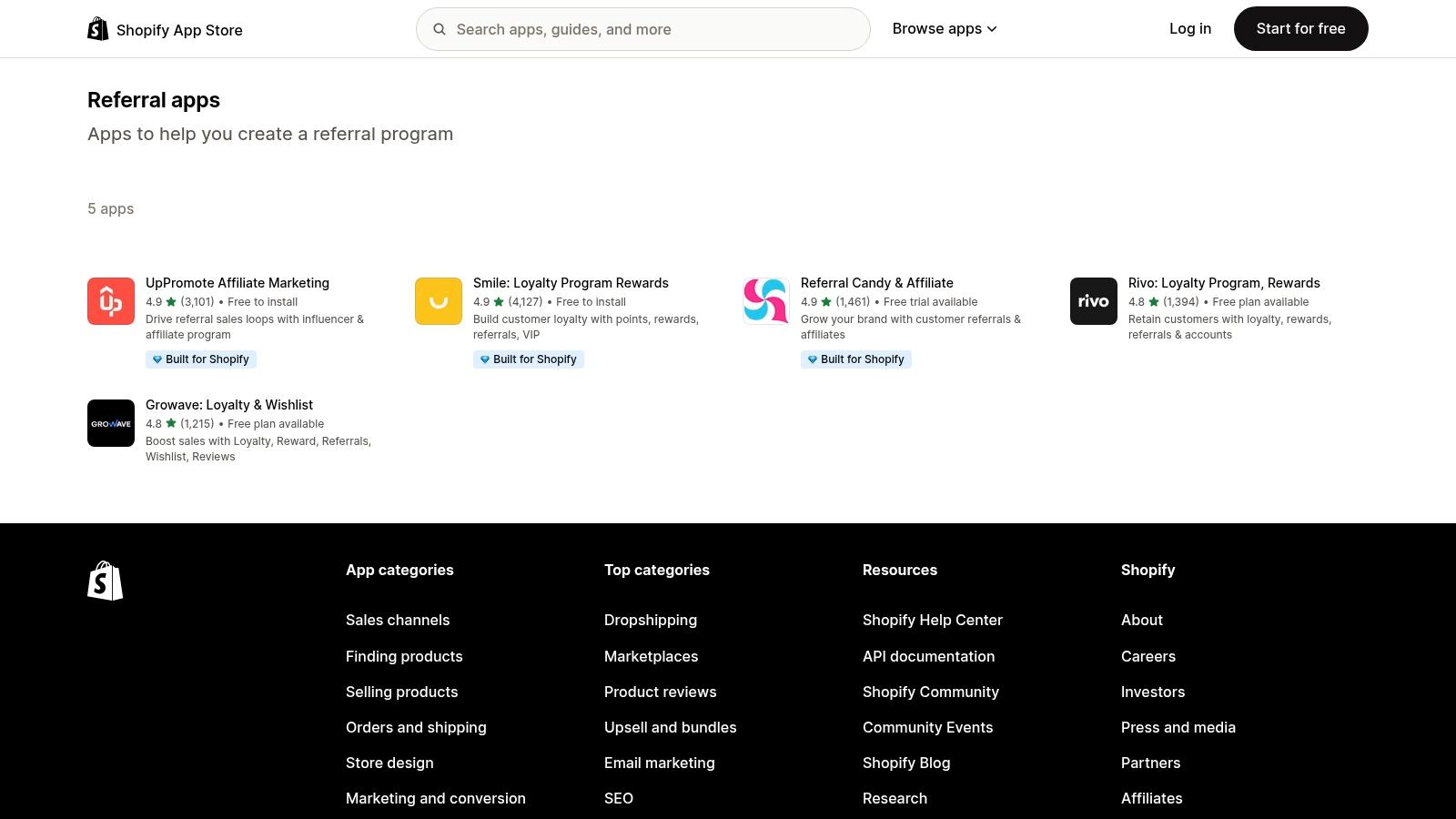
What makes the App Store an essential resource is the combination of low-friction installation and transparent social proof. Merchants can often install an app with a single click and take advantage of free plans or trial periods to evaluate its suitability. The rich, unfiltered merchant reviews provide invaluable real-world insights into an app's pros, cons, and customer support quality, helping business owners make informed decisions without a significant upfront commitment.
Strategic Breakdown & Key Features
One-Click Installation: Most apps integrate directly into the Shopify ecosystem, allowing for immediate setup and testing without complex coding.
Merchant Reviews & Ratings: Real-world feedback from other store owners helps you vet apps for reliability, feature depth, and customer service quality.
Live Demo Stores: Many app listings include links to live demo stores, so you can see the referral program in action from a customer's perspective before installing.
Category & Feature Comparison: The App Store allows you to filter and compare apps based on pricing, features, and ratings, helping you find the perfect fit for your business size and goals.
Varied Pricing Models: You can find apps with free plans, flat monthly fees, or commission-based pricing, offering a solution for nearly any budget.
Actionable Takeaways & Tips
For Shopify merchants, the App Store is the most efficient place to start your search. Instead of just picking the most popular app, use the filters to narrow down options that fit your specific needs, such as reward type (cash vs. store credit) or key integrations (like Klaviyo or ReCharge). Read both the positive and negative reviews to get a balanced view of an app's performance.
Before committing to a paid plan, leverage the free trials offered by most apps. Set up a basic campaign and invite a small group of loyal customers to test the experience. This allows you to check the user interface, automation reliability, and dashboard analytics firsthand. This hands-on approach ensures the software aligns with your operational workflow before a full-scale rollout.
Top 7 Referral Program Platforms Comparison
| Solution | Implementation complexity 🔄 | Resource requirements ⚡ | Expected outcomes ⭐📊 | Ideal use cases 📊 | Key advantages 💡 |
|---|---|---|---|---|---|
| ReferralCandy | Low — turnkey setup, Shopify plug‑and‑play 🔄 | Low — success‑fee pricing, minimal dev effort ⚡ | Quick referral lifts; reliable for ecommerce ⭐⭐📊 | Early‑stage ecommerce & subscription brands; fast launches | Large public example library; fast setup; transparent pricing 💡 |
| Friendbuy | Medium — custom widgets and A/B testing setup 🔄 | Medium‑High — needs analytics and ops to run experiments ⚡ | High conversion uplift when optimized ⭐⭐⭐📊 | High‑growth DTC, subscriptions focused on optimization | Tactic‑rich teardowns; strong testing & conversion guidance 💡 |
| ReferralRock | Medium — feature‑rich configuration, onboarding advised 🔄 | Medium — CRM/ecommerce integrations and ops support ⚡ | Versatile outcomes across B2B/B2C; scalable ⭐⭐📊 | B2B, professional services, sales‑led or non‑checkout flows | Multiple reward structures; hosted portals and fraud controls 💡 |
| Viral Loops | Low — template‑based, no‑code install options 🔄 | Low — participant‑based pricing; may need upgrades for scale ⚡ | Fast launches using proven patterns; moderate ROI ⭐⭐📊 | Prelaunch waitlists, newsletters, fast ecommerce pilots | Prebuilt templates modeled on famous programs; quick time‑to‑launch 💡 |
| Mention Me | Medium — cohort A/B testing and tag integrations 🔄 | Medium‑High — experimentation resources; custom pricing ⚡ | Strong measured lifts in share & conversion when tested ⭐⭐⭐📊 | Global consumer brands prioritizing measured experimentation | Transparent case studies; rigorous experimentation methodology 💡 |
| G2 (Referral Software category) | Low — research and shortlist tool, no implementation 🔄 | Low — time investment to read reviews and compare ⚡ | Better vendor selection; reduced vendor risk ⭐⭐📊 | Shortlisting vendors; comparing real‑user feedback across categories | Vendor‑neutral reviews; side‑by‑side comparisons and filters 💡 |
| Shopify App Store – Referral apps collection | Low — install apps directly; complexity varies by app 🔄 | Low — immediate install; some apps charge fees or tiers ⚡ | Quick testing in live stores; impact varies by app ⭐⭐📊 | Shopify merchants wanting low‑friction trials and demos | Immediate installs, demo stores, merchant reviews for practical vetting 💡 |
From Examples to Execution: Building Your Growth Engine
We've journeyed through a comprehensive showcase of high-impact referral program examples, dissecting the strategies that power industry leaders from SaaS to DTC. From ReferralCandy's turnkey setup to Mention Me's advanced A/B testing capabilities, a clear pattern emerges. The most successful referral programs are not happy accidents; they are meticulously engineered growth engines built on a deep understanding of customer motivation and product value.
The core lesson from these examples is that authenticity and alignment are paramount. A program that feels like a natural extension of your brand experience will always outperform one that feels like a tacked-on marketing gimmick. Your customers are your most credible advocates, and your program must honor that relationship by being generous, transparent, and incredibly simple to use.
Synthesizing the Winning Formula
Across the diverse examples we analyzed, several strategic pillars consistently appeared. As you move from inspiration to implementation, keep these foundational principles at the forefront of your planning.
Motivation is Everything: The reward must resonate deeply with your audience. For a SaaS tool, this might be a product upgrade or account credit. For a DTC brand, it could be store credit, an exclusive product, or early access. Don't just guess; survey your best customers to understand what they truly value.
Simplicity Scales: Complexity is the enemy of participation. The ideal referral program can be explained in a single sentence. If advocates or their friends need a flowchart to understand the rules, the friction is too high. Prioritize clarity and ease of sharing above all else.
Two-Sided Incentives Win: The most powerful referral program examples offer value to both the referrer and the referred friend. This dual-sided structure transforms a purely transactional request into a genuine, mutually beneficial recommendation. It changes the psychology from "Help me get a reward" to "I've got a great deal for you."
Promotion is Not an Afterthought: You cannot simply launch a program and expect it to succeed. The best companies integrate their referral program into the entire customer lifecycle. It's mentioned in onboarding emails, celebrated in newsletters, and made easily accessible within the product dashboard or customer account portal.
Your Actionable Roadmap to a High-Performance Referral Program
Translating these insights into a tangible program is your next critical step. Avoid analysis paralysis by following a structured approach to design and launch.
Define Your Core Objective: What is the primary goal? Is it acquiring new paying customers, increasing free user sign-ups, or boosting a specific product's adoption? A clear objective will dictate your reward structure and the key performance metrics you track.
Model Your Reward Structure: Based on your objective and customer research, design the incentive. Calculate your Customer Acquisition Cost (CAC) and Customer Lifetime Value (LTV) to ensure the rewards are both compelling and financially sustainable.
Choose the Right Technology: As our analysis of tools like ReferralCandy, Friendbuy, and Viral Loops shows, manual tracking is not a scalable option. The right software is essential for automating reward fulfillment, preventing fraud, and providing the analytics needed to optimize performance. When evaluating tools, look for flexibility in reward types, robust tracking, and easy integration with your existing tech stack.
Craft a Multi-Channel Launch Plan: Don't just add a link to your website footer. Plan a dedicated launch campaign. Announce the program to your email list, promote it on social media, and train your customer support team to mention it in relevant conversations.
Track, Test, and Iterate: Your initial launch is just the beginning. Continuously monitor your key metrics: Share Rate, Invitation Click-Through Rate, and Conversion Rate. Use this data to A/B test headlines, offer values, and promotional channels to constantly improve your program's efficiency.
The powerful referral program examples we've explored prove that word-of-mouth can be your most predictable and profitable growth channel. By combining a customer-centric strategy with the right technology, you can move from admiring these examples to becoming one yourself.
Ready to turn these examples into your own success story? Blossu provides the flexible, powerful platform you need to launch, manage, and scale a world-class referral program without the technical overhead. See how our automated tracking, versatile reward options, and insightful analytics can transform your best customers into your most effective growth engine. Learn more about Blossu.
Frequently Asked Questions
Have a question not in here? Contact us
- What makes a referral program example effective for my business?
The most effective referral program examples align closely with your business model and customer behavior. SaaS companies often succeed with recurring commission structures, while DTC brands see better results with dual-sided incentives like 'Give $10, Get $10' offers. Key success factors include understanding your customer lifetime value, offering meaningful rewards that motivate sharing, creating a frictionless experience for both referrers and new customers, and strategically promoting the program at moments of peak customer satisfaction.
- How do I choose the right referral program model from these examples?
Start by analyzing your customer acquisition cost (CAC) and lifetime value (LTV). If you have high LTV customers, consider recurring commission models like HubSpot's partner program. For viral growth potential, dual-sided incentives like Dropbox's storage rewards work well. B2B companies often benefit from strategic partner programs and case study advocacy, while content-driven businesses should explore influencer and creator partnerships. The key is matching the program structure to your growth goals and customer motivations.
- What metrics should I track when implementing these referral program examples?
Focus on participation rate (percentage of customers who refer), conversion rate of referred leads, average reward cost per acquisition, and the lifetime value of referred customers. Additionally, track program ROI, time to first referral, viral coefficient, and partner retention rates. Advanced metrics include share rate by channel, attribution accuracy, and fraud detection rates. These metrics help you optimize the program structure and identify which examples work best for your specific business model.
- How can I prevent fraud in referral programs based on these examples?
Implement multi-layered fraud prevention including email verification, IP tracking, purchase validation, and cooling-off periods. Use platforms with built-in fraud detection that can identify suspicious patterns automatically. Set clear terms of service, monitor for unusual referral patterns like multiple sign-ups from the same IP, establish minimum thresholds for reward payouts, and implement attribution windows to prevent gaming. Consider requiring verified purchases before rewards are issued, similar to how successful programs handle validation.
- How long does it typically take to see results from referral program examples like these?
Most successful referral programs see initial traction within 30-90 days, with meaningful results appearing in 3-6 months. Dropbox-style viral loops can show faster adoption, while B2B partner programs may take longer to mature. Key factors affecting timeline include program visibility, reward attractiveness, ease of sharing, and how well you promote the program to existing customers. Sprint campaigns and gamified elements can accelerate adoption, while community-driven advocacy builds more slowly but creates lasting engagement.
🎯 Key Takeaways
Study multiple referral program examples to understand diverse approaches across different industries and business models
Automation is critical for scale - manual tracking and payouts will limit your program's growth potential
Data-driven optimization beats guesswork - focus on metrics like participation rate, conversion rate, and program ROI
Two-sided rewards consistently outperform single-sided offers across all successful referral program examples
Platform selection should prioritize integration ease, feature flexibility, and transparent pricing models
The best referral programs align incentives with customer value and create frictionless sharing experiences
🚀 Transform Inspiration into Action with Blossu
Ready to move beyond studying examples and start building your own high-converting referral program? With Blossu, you can implement the strategies and best practices from these top referral program examples in minutes, not months. Our platform handles the complex tracking, attribution, and payout automation while integrating seamlessly with your Stripe setup. Start your referral program today and turn your customers into your most powerful growth channel.