

What Is Affiliate Marketing? what is affiliate marketing explained
Here's the honest truth: Affiliate marketing is just a modern, scalable version of word-of-mouth. It's a performance-based partnership where you earn a commission for promoting another company's products. Think of yourself as a digital salesperson who gets paid only when a referral leads to an actual sale, turning your content into a genuine revenue stream.
What Is Affiliate Marketing in Simple Terms?
Let's ditch the textbook definitions and try a real-world analogy.
Imagine you find a fantastic local coffee shop and tell a friend all about it. They go, they love it, and the owner is so thrilled with the new customer that they give you a free coffee as a thank-you. That's it. Affiliate marketing is the same simple idea, just scaled up for the internet.
This performance-first model has become a massive engine for growth. As of 2024, the global affiliate marketing market is valued at a staggering $27.8 billion and is on track to hit $48 billion by 2027. It's no wonder over 80% of brands now have affiliate programs to find new customers and drive sales. You can dive deeper into these affiliate marketing trends to see just how fast the industry is moving.
The Three Key Players
To really get what affiliate marketing is all about, you need to know who's involved. The entire system is built on a simple, symbiotic relationship between three core parties. Each plays a specific part, and the magic only happens when everyone gets something out of the deal.
Let's quickly break down the cast of characters in this ecosystem.
| Player | Role in the Ecosystem | Primary Goal |
|---|---|---|
| The Merchant (or Brand) | The company that creates and sells the product or service. They provide the products and pay partners. | Increase sales and acquire new customers without the upfront cost of traditional advertising. |
| The Affiliate (or Partner) | An individual or company that promotes the merchant's products to their own audience. | Earn commissions by driving qualified traffic and sales to the merchant. |
| The Customer | The end-user who sees the affiliate's promotion and makes a purchase through their unique link. | Discover and purchase a product that solves a problem, often with a trusted recommendation. |
Each player has a clear goal, and the system is designed to align their incentives perfectly.
The beauty of affiliate marketing is its pure simplicity: The merchant gets a new customer, the affiliate earns a commission, and the customer finds a great product they might have missed. It's a transparent, results-based partnership.
Essentially, the affiliate acts as a trusted bridge between the brand and potential buyers. They use the credibility they've built with their audience to introduce products in a natural, authentic way. This creates a powerful and efficient sales channel that feels far more personal than a typical ad, leading to higher trust and better conversion rates.
How Affiliate Marketing Really Works
Affiliate marketing can look complicated from the outside, but when you pull back the curtain, the mechanics are surprisingly simple. The whole system is built on tracking technology that connects a partner's promotional effort directly to a customer's action. It all starts with a single, unique link.
This tracking is powered by affiliate links. When a partner joins your program, they get a custom URL that acts like a digital fingerprint. Every time a potential customer clicks that link, that unique ID is passed along, telling your system exactly which affiliate sent them. To get deeper into the nuts and bolts, check out our guide on what are affiliate links and how they work.
Behind the scenes, when someone clicks that link, a small file called a browser cookie gets stored on their device. This cookie is like a short-term memory, holding onto the affiliate's ID for a set period—usually 30 to 90 days. If the customer browses, leaves, and comes back later to buy, the cookie ensures the original partner still gets credit for the sale.
This simple flowchart shows the whole journey, from the affiliate's promotion right through to the customer's purchase.
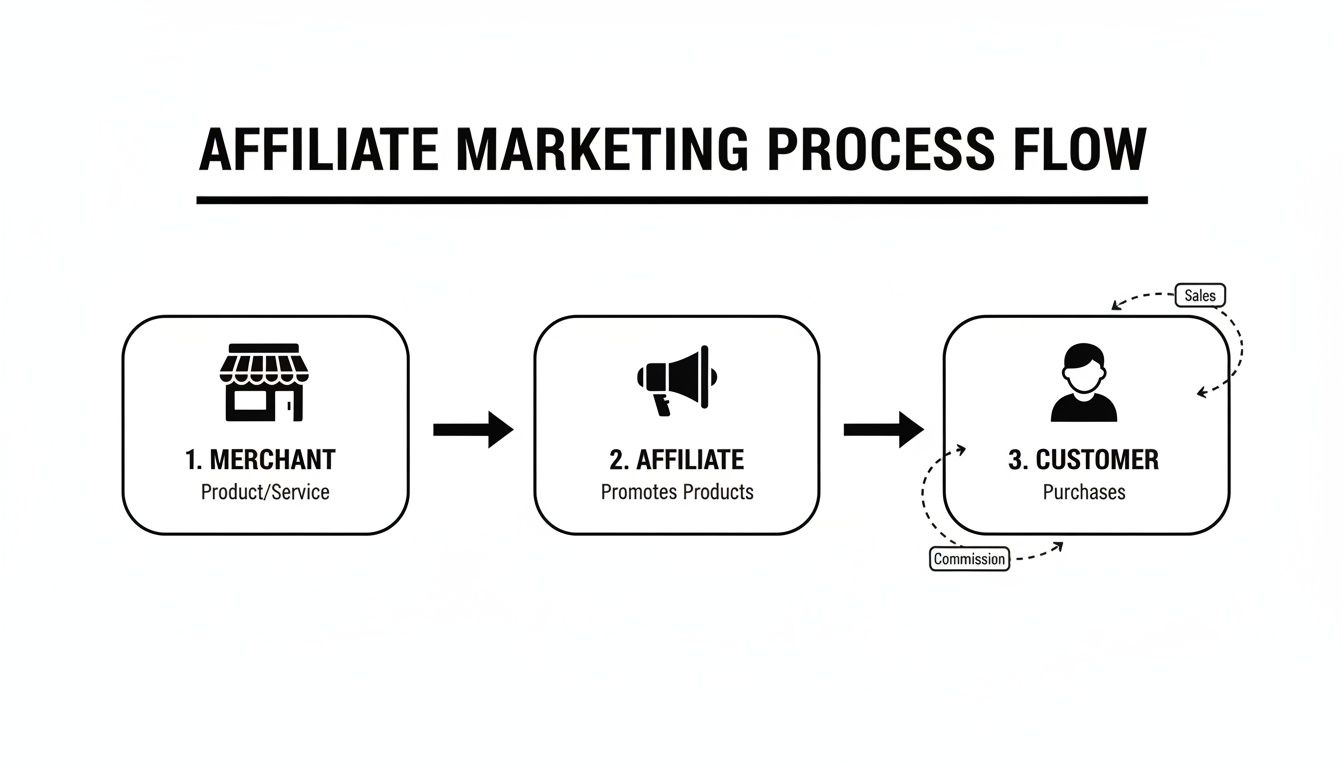
As you can see, the affiliate acts as the bridge, guiding an interested customer straight to your product.
The Most Common Commission Models
Once a conversion is tracked, it's time to pay the affiliate. But not all programs reward partners in the same way. The payment structure, or commission model, is built to match the merchant's business goals.
There are three main models you'll run into, each rewarding a different kind of customer action.
Pay-Per-Sale (PPS): This is the bread and butter of affiliate marketing. The partner earns a commission only when their referral leads to an actual sale. It's a pure performance model, which is why over 80% of affiliate programs rely on it.
Pay-Per-Lead (PPL): With this model, the affiliate gets paid when their referral completes a specific action that isn't a purchase. Think signing up for a free trial, filling out a form, or joining a newsletter. It rewards partners for generating potential customers.
Pay-Per-Click (PPC): Here, partners earn a small fee for every single click their unique link generates, whether it leads to a sale or not. This is less common for most businesses and is typically used by massive publishers to monetize their high traffic.
Getting these models right is key to building a program that makes sense for your business and motivates your partners to drive the actions you actually want.
Commission Models in Action
To make this crystal clear, let's look at how different businesses put these models to work. The model a company picks is tied directly to what they count as a valuable conversion.
The right commission model isn't just about paying partners—it's about defining what "success" looks like for your business. A sale, a qualified lead, or initial engagement can all be valid goals.
Check out these real-world scenarios:
A SaaS Company Using PPS: A project management software company needs more paying subscribers. They offer affiliates a 20% recurring commission on every monthly payment from a referred customer. Their goal is long-term revenue, so the PPS model directly rewards partners for bringing in loyal, paying users.
A Digital Course Creator Using PPL: An expert selling a high-ticket online course knows that people who watch their free webinar are very likely to buy. They use a PPL model, paying affiliates $5 for every person who signs up for that webinar. This fills their pipeline with warm, qualified leads.
A News Aggregator Using PPC: A huge media website makes its money from ads on its pages. Their goal is simple: maximize eyeballs. They might pay partners a few cents for every click (PPC) sent to their articles, because more traffic directly translates to more ad revenue.
Each example shows how the commission structure is tailored to the business's goals, creating a true partnership where everyone wins. This flexibility is a huge reason why affiliate marketing is such a powerful tool for modern businesses.
The Different Types of Affiliate Partners You Can Recruit
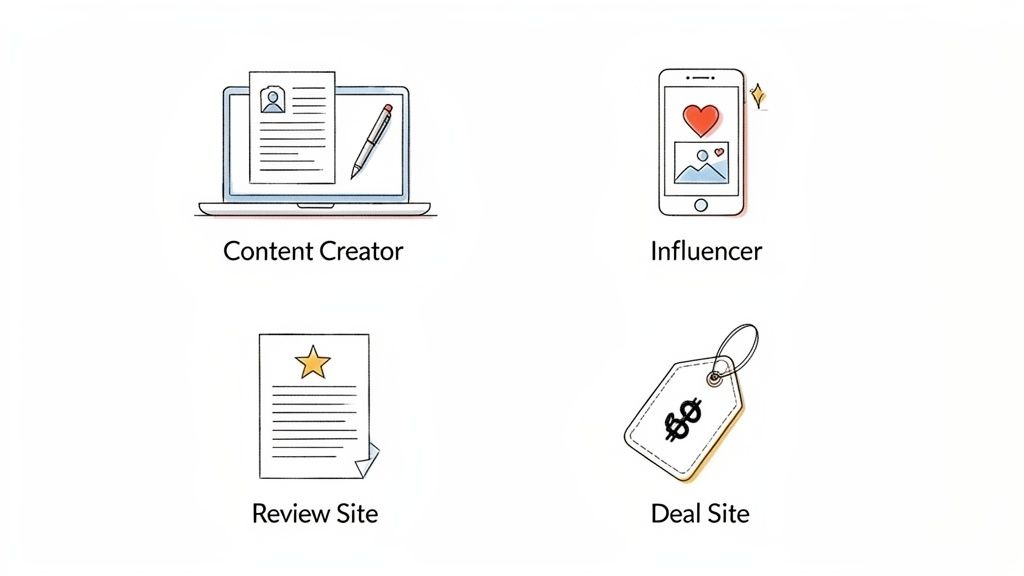
When you're building an affiliate program, it's tempting to lump all "affiliates" into one big bucket. But that's a mistake. The reality is that your potential partners are a diverse ecosystem of creators, publishers, and specialists, each with their own audience and unique strengths.
Just like you wouldn't use the same marketing message for every customer, you shouldn't approach every affiliate with the same pitch. Some partners build deep trust with detailed, educational content, while others are masters at grabbing attention with massive social reach. Recruiting a healthy mix is the key to diversifying your program and driving growth from all angles.
Let's break down the main types of partners you'll meet and what they can bring to the table.
Content Creators and Niche Bloggers
These partners are the bedrock of authentic, trust-based marketing. We're talking about the bloggers, YouTubers, and podcasters who have spent years building loyal audiences by creating genuinely helpful content. They're the experts in their corner of the world, whether that's WordPress speed optimization, vegan cooking, or financial planning for freelancers.
Their real power comes from credibility. When a trusted blogger recommends a product in an in-depth tutorial or a detailed review, it doesn't feel like an ad. It feels like a genuine tip from a knowledgeable friend, which is why this approach works so well for higher-ticket items or complex SaaS products.
Think of a software company that sells project management tools. A partnership with a blogger who writes about small business productivity is a perfect match. The blogger can weave the software into their content naturally, showing readers exactly how it solves their real-world problems.
Social Media Influencers
While content creators build authority over time, social media influencers capture attention in the blink of an eye. They live on platforms like Instagram, TikTok, and Twitter, where they have a direct, personal line to their followers. Their promotions are visual, engaging, and built to spark immediate interest.
Influencers are a fantastic fit for direct-to-consumer (DTC) brands with products that look great on camera—fashion, beauty, home goods, you name it. An Instagram influencer showing off a new dress in a stylish post can drive a ton of traffic and sales in just a few hours. Their strength lies in creating desire and social proof.
The key difference is focus: Content creators often drive sales through in-depth education and problem-solving, while influencers drive sales through inspiration, aspiration, and immediate social validation.
Review and Comparison Sites
For many shoppers, these websites are the last stop before they pull out their credit card. Review and comparison sites specialize in creating detailed, side-by-side analyses of products in a specific category, like web hosting, mattresses, or antivirus software. They attract buyers who are already at the bottom of the funnel, actively trying to make a final decision.
Imagine a customer weighing two different software solutions. A well-researched comparison article can be the final nudge that solidifies their choice. Getting your product featured favorably on these sites can deliver a steady stream of high-intent traffic, full of people ready to buy. These affiliates run on data, so giving them clear feature lists, performance specs, and competitive advantages is how you build a winning partnership.
Coupon and Deal Sites
Coupon and deal sites speak to the most price-sensitive shoppers out there. Partners like RetailMeNot or Honey attract massive audiences of bargain hunters by collecting discounts and promo codes in one place. While they might not be the right channel for a luxury brand, they can be incredibly powerful for driving volume or clearing out inventory.
These sites are a go-to strategy during major sales events like Black Friday. By offering an exclusive coupon code, you can tap into their enormous user base and generate a huge spike in sales. The trick is to manage these partnerships carefully to avoid devaluing your brand or accidentally stealing sales from your other marketing channels.
Why Affiliate Marketing Is a Game Changer for Businesses
Let's be honest: traditional advertising often feels like a gamble. You pour money into social media ads or billboards, cross your fingers, and just hope something good happens. There's no guarantee you'll see a return.
Affiliate marketing completely flips that script. It turns your marketing budget from a hopeful expense into a predictable, performance-based investment.
Instead of paying for clicks or impressions, you only pay when you get a real result—a completed sale, a new subscriber, or a qualified lead. This pay-for-performance model guts your upfront financial risk. Your marketing spend is tied directly to revenue, making it one of the most cost-effective ways to get new customers.
This simple shift changes marketing from a cost center into a direct engine for growth, giving you the confidence to scale.
Low-Cost Customer Acquisition
The real magic of affiliate marketing is its raw efficiency. You're tapping into the built-in audiences and credibility of your partners, essentially outsourcing customer acquisition to a network of trusted voices. This lets you reach highly targeted customers without the massive ad spend you'd normally need.
Your partners do the heavy lifting—creating content, engaging their communities, and building trust. The only time you spend a dime is on the commission you pay after a sale is already in the bank. This creates a powerful, low-risk machine for bringing in new customers at a cost you can count on.
Affiliate marketing is a true win-win: partners are motivated to promote your product effectively because their income depends on it, and your business acquires new customers at a fixed, profitable cost.
Expanding Your Brand Reach and Authority
Imagine an army of advocates telling your brand's story across countless blogs, social media channels, and niche communities. That's the kind of reach an affiliate program unlocks. Every single partner introduces your product to a fresh, unique audience, multiplying your brand's visibility.
But the benefits go way beyond direct sales:
Improved SEO: When authoritative websites link back to your product pages, search engines pay close attention. These backlinks are a powerful signal to Google, helping to boost your search rankings and pull in more organic traffic over the long haul.
Enhanced Social Proof: A recommendation from a trusted affiliate works like a powerful testimonial. This third-party validation builds instant credibility and trust with potential customers who might be skeptical of a direct ad from a brand they don't know yet.
This expanded footprint doesn't just drive sales today; it builds a long-term marketing asset that cements your brand's authority in the market.
Creating a Predictable Revenue Stream
With affiliate marketing, you can build a scalable and predictable sales channel. Once you've built a healthy program with a diverse mix of partners, you create a steady flow of traffic and conversions that isn't at the mercy of volatile ad platforms.
For example, a SaaS startup can partner with tech bloggers to break into new international markets without ever hiring a local sales team. Their partners already have the audience and trust needed to generate that crucial initial traction.
Likewise, a creator selling digital courses can scale their sales by recruiting affiliates who already serve their target students. Instead of dumping more money into ads with diminishing returns, they can grow revenue predictably just by adding more high-performing partners to their program.
This transforms growth from a series of expensive, one-off campaigns into a sustainable, relationship-driven engine.
Launching Your First Affiliate Program
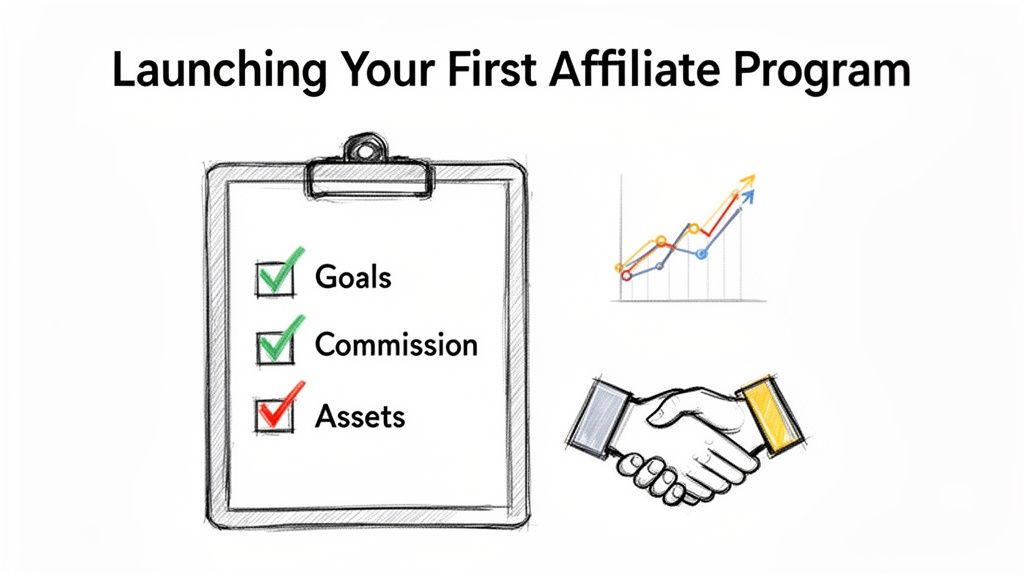
Moving from understanding affiliate marketing to actually building a program can feel like a huge leap. But it's really a series of deliberate, strategic steps that lay the groundwork for a powerful new sales channel.
This isn't about just flipping a switch and hoping for the best. It's about methodically putting the right pieces in place—clear goals, attractive incentives, and solid partner support—to build an engine for real, sustainable growth. Let's walk through the fundamentals of getting your program off the ground and running.
Define Your Goals And KPIs
Before you do anything else, you have to define what a "win" looks like for your business. Are you trying to boost overall sales volume, break into a new customer segment, or drive more free trial sign-ups? This one decision will shape every other choice you make.
Once your primary goal is locked in, it's time to get specific with Key Performance Indicators (KPIs). Vague targets won't cut it; you need to get granular.
Conversion Rate: What percentage of clicks from your partners' links actually turn into sales or leads?
Average Order Value (AOV): Are your affiliates bringing in high-value customers who spend more?
Active Affiliates: How many of your partners are actually driving traffic versus just sitting idle?
Revenue Growth: What's the month-over-month sales lift coming directly from this channel?
These KPIs create a real-time dashboard for your program's health. They tell you exactly what's working and what needs fixing. For a deeper look at this process, check out our complete guide on how to start an affiliate program.
Set A Competitive Commission Structure
Your commission structure is the single most important lever you have for attracting and motivating great partners. If your rates are too low, the best affiliates won't even give you a second look. If they're too high, you'll torch your profit margins. The key is finding that sweet spot that's both competitive and sustainable.
Start by doing some homework. See what similar companies in your space are offering. A SaaS company, for instance, might offer a 20-30% recurring commission on subscriptions, while a DTC brand might offer a 10-15% one-time commission on a sale.
Your commission isn't just a payment; it's a message to your partners about how much you value their contribution. A competitive rate signals a serious, long-term commitment to the partnership.
You can also get creative with tiered structures that reward your top performers. Maybe you offer a base rate of 15%, but bump it to 20% for any affiliate who drives more than 50 sales a month. This lights a fire under your best partners and helps you build incredibly strong relationships with them.
Create Essential Marketing Assets
To really succeed, your partners need the right tools for the job. Giving them a ready-to-go library of high-quality marketing assets makes it dead simple for them to promote you effectively and keep your brand message consistent.
Your partner asset kit should be packed with useful stuff like:
Banner Ads: A variety of polished designs in all the standard sizes for blogs and websites.
Email Templates: Pre-written copy they can easily adapt for their newsletters.
Social Media Content: Ready-to-post images, videos, and captions for platforms like Instagram, X, and LinkedIn.
Product Shots and Demos: High-resolution visuals they can drop right into their content.
By equipping your partners with these resources from day one, you remove all the friction and empower them to start driving sales right away. Think of it as giving them a promotional head start—a win for you both.
Common Affiliate Marketing Mistakes to Avoid
Getting an affiliate program off the ground is a great first step, but the real work is making sure it actually grows. I've seen so many promising programs stall out, not because the product was bad, but because of simple, avoidable mistakes. Getting past these common hurdles is what turns a little bit of early momentum into a serious, long-term revenue channel.
These slip-ups usually happen when founders take a "set it and forget it" approach. But a great affiliate program is a living, breathing thing. It needs a solid strategy, constant attention, and real relationships.
Let's break down the biggest mistakes I see people make and how you can steer clear of them.
Setting Uncompetitive Commission Rates
Want to kill an affiliate's motivation instantly? Offer them a commission that doesn't measure up. Your best partners have options—a lot of them. They're naturally going to put their effort behind programs that give them the best return. If your rates are too low, you're basically telling them you don't value their work.
Before you lock in your commission structure, you have to do your homework and see what your direct competitors are offering.
Do some digging: Look at companies in your space. Are they offering a 10% flat fee? A 25% recurring commission for the life of the customer? Know the landscape.
Run the numbers: Figure out your Customer Lifetime Value (LTV) and Customer Acquisition Cost (CAC). This will help you land on a rate that's both generous enough to attract top talent and sustainable for your business.
Add some incentives: Think about creating performance-based tiers. You could offer a base rate and then bump it up for partners who blow past a certain number of sales each month. This is a powerful way to reward your top performers and motivate everyone else.
Providing Poor Partner Support
Your affiliates aren't just another line item in your marketing budget; they are extensions of your team. If you treat them like they're disposable, your program is doomed. When a partner has a question, needs a custom graphic, or hits a technical snag, they need to know someone has their back. A lack of support just creates friction and frustration, and frustrated partners stop promoting.
An affiliate program is built on relationships, not just transactions. Investing in partner support is investing in your own growth. The more successful your partners are, the more successful you will be.
You don't need a massive support team to do this well. A simple, effective system will do. Set up a dedicated email for partner questions, build out a detailed FAQ page, and maybe send out a monthly newsletter with program updates, new creative assets, and tips to help them sell better. Consistent, proactive communication shows you're in it together.
Using Unreliable Tracking Technology
Nothing erodes trust faster than sketchy tracking. If a partner sends you a dozen sales but your system only credits them for eight, you've got a huge problem on your hands. Bad tracking completely undermines the performance-based promise of affiliate marketing, and word gets around fast.
This is exactly why trying to manage a program with spreadsheets is a recipe for disaster—it's full of human error and just doesn't scale. A dedicated affiliate management platform is non-negotiable.
A solid platform will give you:
Rock-Solid Attribution: It ensures every single click and conversion gets assigned to the right partner using dependable cookie tracking and other modern methods.
Real-Time Dashboards: This gives both you and your partners a transparent, up-to-the-minute look at clicks, conversions, and commissions. No more guessing games.
Automated Payouts: It takes the pain out of manual commission calculations and payments, ensuring your partners get paid accurately and on time, every time.
Investing in good technology is what provides the trustworthy foundation you need to build and maintain strong partner relationships for the long haul.
Frequently Asked Questions About Affiliate Marketing
It's one thing to understand the high-level concept of affiliate marketing, but it's another to get into the nitty-gritty of running a program. When you start to actually implement it, the real questions bubble up.
Let's clear the air on some of the most common questions we hear from founders and marketers dipping their toes into the affiliate world for the first time. Getting these basics straight will help you set realistic expectations from day one.
Ready to turn your word-of-mouth into a predictable revenue channel? Blossu makes it easy to launch, manage, and scale your affiliate program without the complexity of spreadsheets or per-transaction fees. Start for free on blossu.com and put your partner marketing on autopilot.
Frequently Asked Questions
Have a question not in here? Contact us
- How Much Does It Cost To Start an Affiliate Program?
Surprisingly little, especially when you stack it up against traditional ad spend. Your main costs boil down to two things: the commissions you pay your partners and the subscription for an affiliate management platform. The best part? You only pay commissions after a sale is made. There's almost zero upfront financial risk. The real investment is your time—finding the right partners, creating killer assets for them to use, and nurturing those relationships.
- How Long Does It Take to See Results?
Affiliate marketing is a long game, not a get-rich-quick scheme. While you might see a trickle of sales in the first few months, building a program that drives consistent, predictable revenue usually takes anywhere from 6 to 12 months. This initial ramp-up period is critical for recruiting quality partners and building momentum.
- Are There Legal Rules to Follow?
Yes, and this is non-negotiable. Transparency isn't just a nice-to-have; it's a legal requirement. In the US, the Federal Trade Commission (FTC) has clear guidelines stating that affiliates must disclose their financial relationship with a brand when promoting its products. This means your partners have to make it crystal clear that they might earn a commission if someone buys through their link.
- What makes affiliate marketing different from referral programs?
While both involve people recommending products for rewards, affiliate marketing typically focuses on content creators, bloggers, and influencers who promote to broader audiences. Referral programs usually target existing customers who refer friends and family. Affiliate programs often have more complex commission structures and tracking systems, while referral programs tend to be simpler with fixed rewards.
🎯 Key Takeaways
Affiliate marketing is a performance-based partnership where you earn commissions by promoting other companies' products through unique tracking links
The system involves three key players: merchants (who create products), affiliates (who promote them), and customers (who make purchases)
Common commission models include Pay-Per-Sale (most popular), Pay-Per-Lead, and Pay-Per-Click, each suited to different business goals
Different types of affiliates include content creators, social media influencers, review sites, and coupon platforms, each with unique strengths
Affiliate marketing offers low-cost customer acquisition, expanded brand reach, and predictable revenue streams through performance-based partnerships
Success requires competitive commissions, strong partner support, reliable tracking technology, and clear legal compliance with FTC disclosure requirements
🚀 Launch Your Affiliate Program with Blossu
Ready to harness the power of affiliate marketing for your business? With Blossu, you can set up a complete affiliate tracking system in minutes. Our platform handles everything from link generation to commission payouts, integrating seamlessly with your existing Stripe setup. Start building your affiliate program today and transform word-of-mouth into measurable revenue growth.