
Indirect Distribution Channels: The Ultimate Guide to Scaling Your Business
Indirect distribution channels are simply pathways to market where someone else sells your product for you. Think of these third-party intermediaries—retailers, wholesalers, or affiliates—as a skilled sales army you recruit to expand your reach far beyond what you could ever manage alone.
They don't just sell your product; they bring their own audiences, credibility, and existing customer relationships to the table.
Understanding the Indirect Distribution Model
Imagine your business is a river and your product is the water. A direct-to-consumer (DTC) model is like that river flowing straight to the ocean. It's powerful, for sure, but it follows a single, limited path.
Indirect distribution channels are like that same river branching out into countless smaller streams and tributaries. Each stream is an intermediary, carrying your product into new landscapes and reaching customers you could never access on your own.
This model isn't just for physical goods stacked on store shelves. It's an absolute game-changer for digital products, SaaS companies, and e-commerce brands. A software company might partner with value-added resellers who bundle their product with other services, while an online course creator could use affiliates to promote their content to hyper-specific audiences. The principle is always the same: you empower others to sell on your behalf, tapping into their networks to fuel your growth.
The True Scale of Indirect Sales
While the DTC model gets all the headlines, the sheer scale of indirect commerce is staggering. Consider this: a massive 75% of world trade flows through indirect sales channels like distributors and partners. And it's not some relic of the past—from 2020 to 2022, indirect channel revenues actually grew faster than direct channels. This model isn't just huge; it's accelerating. You can dig into the numbers yourself in Horváth's research on the topic.
This isn't just an old-school strategy; it's a modern engine for scalability. It lets you break into new markets, drive down customer acquisition costs, and focus on what you do best—building a killer product—while your partners handle the front-line selling. But all that power comes with trade-offs, especially when it comes to control and profit margins.
The fundamental choice isn't just about how you sell, but where you meet your customers. Indirect channels meet them on platforms and in communities they already trust, making the sale nearly frictionless.
To really get the strategic implications here, it helps to see how the two models stack up against each other. Each path offers unique advantages and demands a totally different approach to your operations, branding, and customer relationships.
Direct vs Indirect Distribution: A Head-to-Head Comparison
Choosing between direct and indirect distribution is one of the most fundamental strategic decisions a business can make. It dictates everything from your profit margins to your brand's perception in the market. The table below breaks down the core differences to help you see the trade-offs at a glance.
| Characteristic | Direct Channels (e.g., Your Website) | Indirect Channels (e.g., Affiliates, Resellers) |
|---|---|---|
| Customer Reach | Limited to your own marketing efforts and brand recognition. | Greatly expanded through partners' established networks. |
| Profit Margins | Higher, as you keep 100% of the revenue. | Lower, due to commissions or wholesale discounts for partners. |
| Brand Control | Complete control over messaging, pricing, and customer experience. | Shared control; brand messaging is interpreted by partners. |
| Upfront Costs | High investment in marketing, sales teams, and infrastructure. | Lower upfront costs; you pay for performance (sales). |
| Customer Data | Direct access to rich first-party customer data and feedback. | Limited or no direct access to end-customer data. |
| Speed to Market | Slower, as you must build your audience and presence from scratch. | Faster, allowing rapid entry into new markets or demographics. |
Ultimately, neither model is inherently "better"—they simply serve different business goals. The right choice depends entirely on your product, your target market, and how quickly you need to scale. For many businesses, the ideal strategy isn't a choice between one or the other but a hybrid approach that blends the best of both worlds.
Exploring the Six Types of Indirect Channels
Indirect distribution isn't a single, rigid path. It's a rich ecosystem of partnerships, each with its own strengths and strategic sweet spots. Figuring out which ones fit your business is the first step toward building a scalable growth engine.
From old-school bulk movers to modern digital advocates, each channel gives you a different way to get your product in front of the right customers.
The visual below maps out the fundamental split: do you sell directly to your customers, or do you empower a network of intermediaries to do it for you?
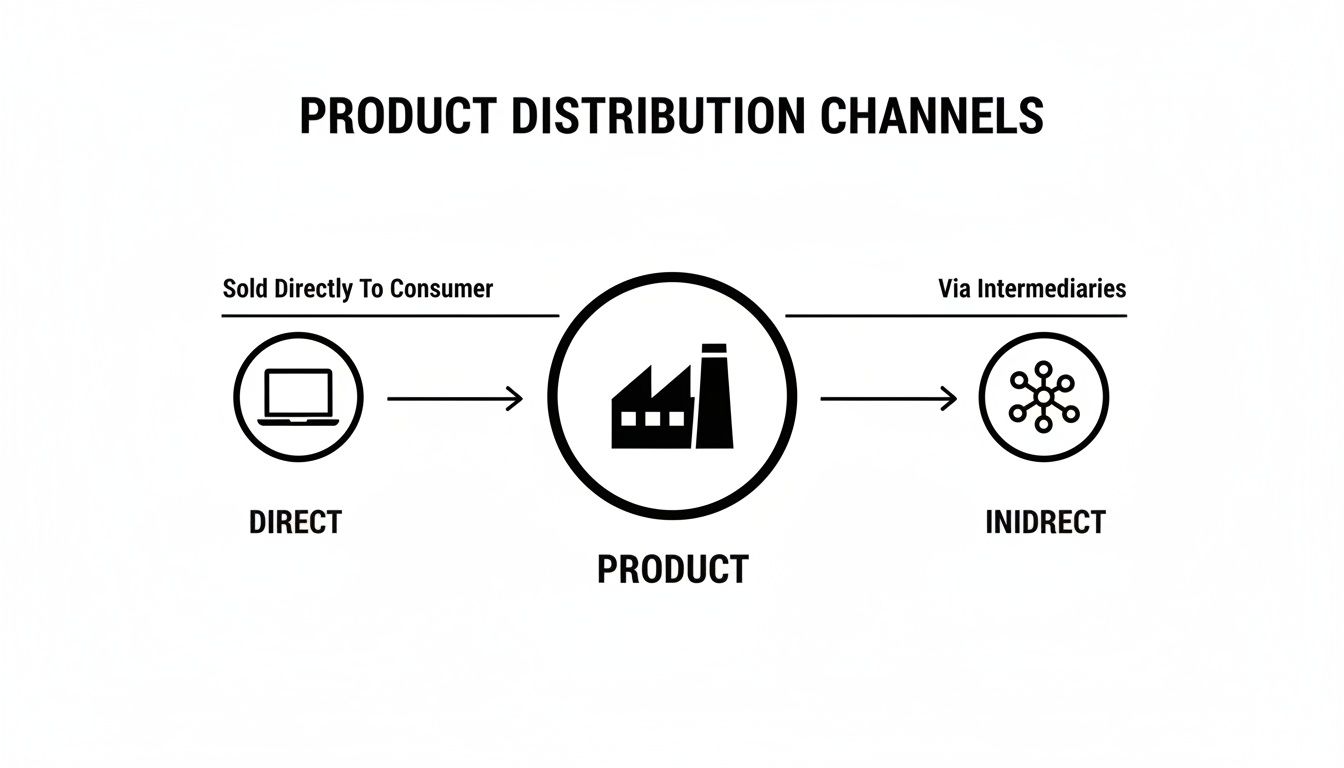
While going direct gives you total control, indirect channels offer something just as valuable: scale. You're tapping into an established network to reach far more end-users than you could on your own.
Now, let's break down the six key players who make up that network.
1. Wholesalers: The Bulk Movers
Wholesalers are the classic powerhouse of indirect distribution. Their model is beautifully simple: they buy your product in massive quantities at a discount, then turn around and sell it to retailers. Think of them as the major arteries of commerce, pumping huge volumes of goods from manufacturers to the front lines.
This is the go-to model for businesses with physical products that thrive on economies of scale—like consumer packaged goods (CPG) or electronics. By selling a truckload of inventory to a wholesaler, you offload risk and instantly tap into their vast retail network without managing hundreds of individual store relationships.
2. Agents and Brokers: The Connectors
Unlike wholesalers, agents and brokers never actually take ownership of your product. Instead, they act as expert matchmakers. They represent you, the seller, and leverage their industry connections to broker deals in exchange for a commission. They are specialized negotiators who know exactly who to call.
A real estate agent is a perfect example—they connect buyers and sellers without ever owning the house. In the commercial world, a food broker might represent a dozen small snack brands, using their established relationships to get those products onto the shelves of a major grocery chain. This channel is a game-changer when you're entering complex markets where who you know is just as important as what you sell.
3. Retailers: The Face of the Customer
Retailers are the most visible link in the chain, the final stop before a product lands in a customer's hands. They buy products from manufacturers or wholesalers and sell them directly to the public, either through brick-and-mortar stores or e-commerce sites.
Even as online sales climbed to 19.4% of global retail in 2023, the influence of major retailers is undeniable. For a direct-to-consumer (DTC) brand, getting stocked in a well-known retail chain can be a massive milestone, instantly boosting brand awareness and sales volume. Deloitte's research shows that the top 250 retailers still grew revenue by 8.5% year-over-year, proving the enduring power of these ecosystems.
4. Value-Added Resellers (VARs): The Enhancers
Value-Added Resellers (VARs) are masters of specialization. They take a core product and build on it, adding their own services or features to create a complete, turnkey solution for a specific niche. This is an incredibly effective channel in the B2B tech and SaaS worlds.
For instance, a cybersecurity firm might sell its software through a VAR that bundles it with hardware installation, employee training, and ongoing support. The VAR isn't just reselling software; they're delivering a comprehensive security solution. This lets the original software creator penetrate highly specialized markets without having to build out massive service and support teams themselves.
VARs are more than just resellers; they are solution architects. They take your core product and build a custom-fit solution around it, solving a deeper, more specific problem for the end customer.
5. Marketplaces: The Digital Town Squares
Online marketplaces like Amazon, Etsy, or the App Store are the modern-day town square. They are massive digital hubs where countless sellers can offer their products to a huge, pre-existing audience that's ready to buy. They provide the entire infrastructure—the website, payment processing, and traffic—while you simply plug in your product.
For digital products, SaaS tools, and e-commerce brands, marketplaces offer a fast track to visibility. A new mobile app can gain instant distribution by listing on the Apple App Store, potentially reaching millions of users overnight. The trade-off is that you pay a percentage of your revenue in fees and give up some brand control, but the access to that massive customer base is often too good to pass up.
6. Affiliate and Referral Partners: The Modern Advocates
This is one of the most dynamic and accessible indirect channels for any modern online business. Affiliate and referral partners are individuals or companies who promote your product to their own audience in exchange for a commission on the sales they generate.
Affiliates are typically content creators, bloggers, or influencers who use unique tracked links to drive traffic and sales.
Referral partners are often your own happy customers who recommend your product to their personal or professional networks.
For SaaS and e-commerce businesses, this is a beautiful, low-risk, high-reward model. You only pay for performance—a completed sale—which turns marketing into a predictable and scalable expense. Platforms like Blossu are built to be the operational backbone for these programs, handling everything from partner onboarding and link tracking to automatic commission payouts. This makes it incredibly simple to build and manage a powerful, performance-based sales force. To learn more, check out our guide on the key differences between affiliate and referral programs.
Evaluating the Pros and Cons of an Indirect Strategy
Every powerful business strategy comes with trade-offs, and diving into indirect distribution is no exception. It's a deliberate choice to exchange a degree of direct control for a massive boost in scale. Before you commit to building out a partner network, you have to get brutally honest about what you gain versus what you give up.
When you bring on indirect channels, you're essentially recruiting a highly specialized, performance-based sales force. It's a move that can ignite explosive growth, but it also introduces a whole new layer of complexity to your business.
The Upside: What You Gain with Indirect Channels
The biggest win with an indirect strategy is the ability to achieve rapid, almost exponential growth that would be impossible to build yourself. You're plugging into pre-built networks and instantly expanding your footprint.
Accelerated Market Penetration: Your partners already have established audiences and trusted relationships. Instead of spending years building a brand from scratch in a new region, you get to borrow their credibility for an immediate impact. This lets you punch into new markets far faster and more effectively than going it alone.
Serious Cost Efficiencies: Building a direct sales and marketing team is one of the biggest cash burns for any growing company. Indirect channels flip that massive fixed cost into a variable one. You offload the heavy lifting of lead gen and sales to your partners, and in many cases, you only pay them when a sale is actually made. This performance-based model can dramatically lower your customer acquisition costs (CAC).
Sharpened Focus on Your Core Product: By outsourcing the tangled web of sales and distribution, your team can pour its energy into what it does best—innovating and perfecting your product. This intense focus helps you maintain a competitive edge while your partners handle the front lines.
Think of it this way: Indirect channels don't just sell your product; they buy you time and focus. You're free to build the best possible offering while your partners master the logistics of getting it to market. It's a powerful, symbiotic relationship when it works.
The Downside: The Trade-Offs You Have to Accept
Of course, all that reach and efficiency comes at a price. The compromises you'll make are almost always centered on your margins, your control, and your direct connection to the people who actually use your product.
Reduced Profit Margins: This is the most straightforward drawback. Every middleman in the chain—whether it's a wholesaler, a retailer, or an affiliate—needs to get paid. That compensation, whether it comes in the form of wholesale discounts or sales commissions, means you'll share a slice of the revenue from every single transaction. Your per-unit profit will be lower than a direct sale. Period.
Loss of Direct Customer Feedback: When a third party stands between you and your customer, that direct line of communication gets cut. You lose immediate access to the invaluable feedback, raw questions, and unfiltered complaints that fuel product improvements. This distance can make it much harder to truly understand what your customers need and adapt your product quickly.
Risk of Brand Dilution: Your brand's reputation is now in your partners' hands. Inconsistent messaging, shoddy customer service, or just plain wrong product info from a partner can seriously tarnish the perception you've worked so hard to build. Keeping your brand consistent across a diverse network of indirect distribution channels takes a ton of effort and requires rock-solid partner management.
The Strategic Trade-Offs of Indirect Channels
To make a smart call, it helps to see the gains and sacrifices laid out side-by-side. The right choice for your business depends entirely on whether the advantages truly align with your long-term goals and whether you're prepared to manage the risks.
This table summarizes the core give-and-take you're committing to.
| Key Advantages of Indirect Channels | Potential Disadvantages of Indirect Channels |
|---|---|
| Rapid Scalability to enter new markets quickly. | Reduced Profit Margins due to commissions and discounts. |
| Lower Upfront Costs for sales and marketing teams. | Loss of Direct Customer Feedback and first-party data. |
| Expanded Reach through partners' established networks. | Risk of Brand Dilution and inconsistent messaging. |
| Increased Focus on core product development. | Complex Partner Management and potential channel conflict. |
Ultimately, an indirect strategy is a powerful lever for growth. But like any powerful tool, it has to be used with a clear-eyed understanding of both the incredible potential and the very real risks involved.
How to Build Your Indirect Channel Strategy
Knowing what indirect distribution channels are is one thing. Actually building one that works? That's a different game entirely. A winning strategy isn't about finding just any partner; it's about finding the right partners and setting them up to succeed. This is where theory turns into a real, revenue-generating machine.
Think of it like coaching a championship sports team. You don't just sign random players off the street. First, you define what a winning season looks like. Then, you scout for athletes who fit your system. Finally, you give them the playbook and incentives they need to go out there and win.
The following steps are your practical framework for launching a successful indirect channel strategy from the ground up.
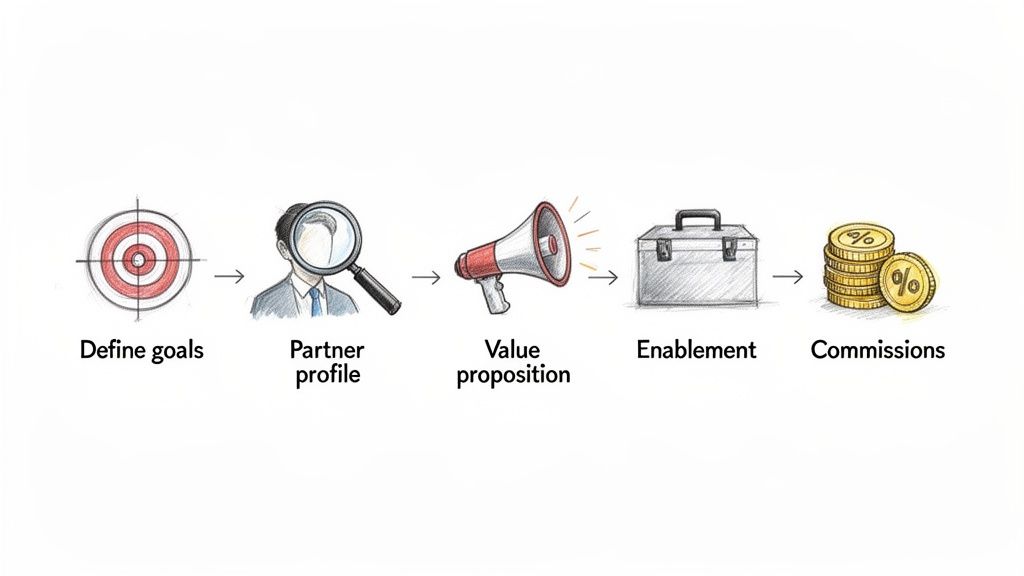
Define Your Goals and Objectives
Before you do anything else, you have to know what you're trying to achieve. Vague goals like "increase sales" are useless here. Your objectives need to be specific, measurable, and tied directly to your bigger business ambitions.
What does success look like a year from now? Are you trying to grab a specific slice of market share in a new region? Or maybe you're aiming to generate a set amount of revenue purely through partners?
Your goals could look something like this:
Revenue Targets: Generate $250,000 in new revenue through affiliate partners in the next 12 months.
Market Penetration: Acquire 500 new customers in the European market within six months.
Customer Acquisition Cost (CAC): Reduce overall CAC by 15% by shifting a portion of marketing spend to a performance-based affiliate model.
These razor-sharp goals become your North Star. They'll guide every single decision you make from here on out, from the partners you recruit to the commissions you offer.
Create Your Ideal Partner Profile
With clear goals locked in, you can now figure out who can actually help you get there. Creating an Ideal Partner Profile (IPP) is a lot like building a buyer persona, but for your future channel allies. It's a detailed sketch of the perfect partner for your brand.
Don't just look for anyone with an audience. You need alignment. Ask yourself the hard questions:
Audience Fit: Does their audience perfectly match your target customer? A partner who sells to enterprise CIOs is a terrible fit for a DTC Shopify app.
Brand Alignment: Do their values and brand voice complement yours? A mismatch can dilute your brand and leave potential customers confused.
Reach and Engagement: How big is their network? More importantly, how engaged is it? A smaller, highly engaged audience often crushes a massive, passive one.
Technical Savvy: If you're a SaaS company, do they understand your product well enough to explain its value in a compelling way?
Your IPP ensures you're not just recruiting salespeople, but true extensions of your brand who can create a seamless experience for the end customer.
Craft a Compelling Partner Value Proposition
You know who you're looking for, but why should they want to work with you? Your Partner Value Proposition is your sales pitch to potential partners, and it needs to be so good they can't say no.
This goes way beyond just the commission rate. It has to answer their core question: "What's in it for me?"
A strong value proposition isn't just about money; it's about mutual growth. It should communicate a true partnership where both sides win—your partners build their authority and income, and you build your customer base.
Your proposition should clearly spell out:
Competitive Commissions: Offer a structure that's both attractive and fair. This could be a percentage of sales, a flat fee per lead, or a tiered system that rewards your top performers.
Marketing and Sales Support: Give them the tools they need to succeed. We're talking co-branded marketing materials, product training, and sales scripts. This is often called partner enablement.
A Great Product: The easiest products to sell are the ones partners genuinely believe in. A high-quality offering makes their job easier and protects their own reputation.
For businesses looking to launch a referral or affiliate program, this whole process can be managed on a dedicated platform. For instance, the image below shows how a tool like Blossu lets you set up your program details—including your value proposition and commission structure—all in one dashboard.
This kind of software handles the technical heavy lifting, freeing you up to focus on building strong relationships. You can easily onboard new partners, track their performance in real-time, and automate payouts, making the entire system efficient and scalable. If you're considering this route, our guide on how to start an affiliate program offers a more detailed walkthrough.
How to Measure Channel Performance with the Right KPIs
Launching an indirect distribution channel without a way to measure it is like flying blind. You might be moving, but you have no idea if you're actually getting closer to your destination. To really understand if your partners are delivering, you have to track the right Key Performance Indicators (KPIs).
These numbers go way beyond just counting sales. They peel back the layers to show you the true financial impact and efficiency of your partner ecosystem, making it crystal clear where you should double down and what needs fixing.
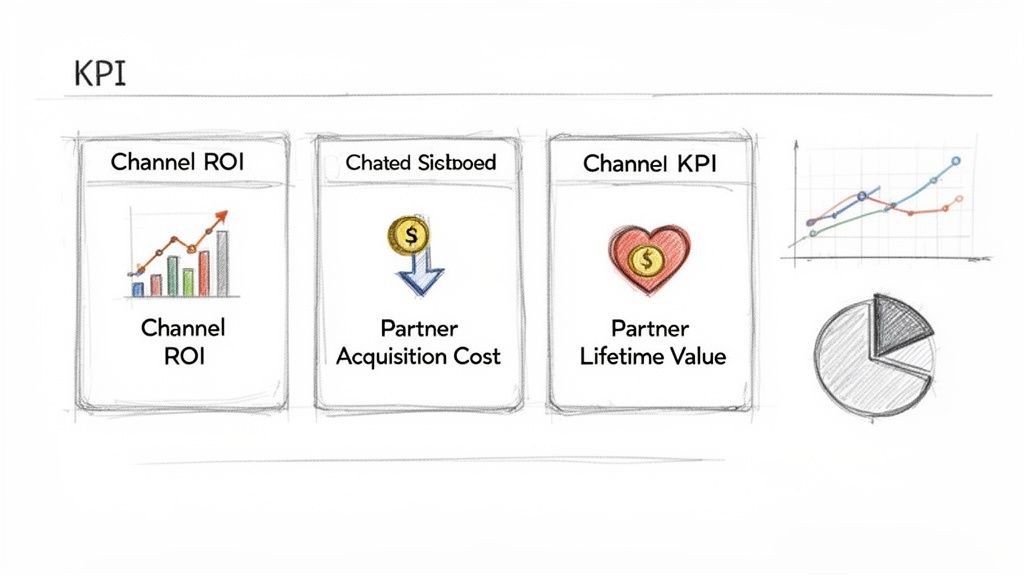
Taking a data-driven approach here is non-negotiable, especially when you consider how much commerce flows through third parties. In North America alone, over 40% of the $2.9 trillion spent on tech in 2022 was routed through indirect channels. These aren't just massive pathways; they're growing, which makes accurate measurement more critical than ever. You can dig into more of North America's go-to-market trends on IDC.com.
Core KPIs for Your Indirect Channels
To get a clear picture of how things are going, you only need to start with a few essential metrics. These three KPIs will give you a complete view of your program's health and efficiency, moving you from guesswork to genuine strategic insight.
Channel Return on Investment (ROI): This is the ultimate bottom-line metric. It tells you exactly how much money you're making for every single dollar you invest in a channel, from commissions and marketing support to the time your team spends managing it.
- Formula: (Revenue Generated by Channel - Channel Costs) / Channel Costs
- What it reveals: Is your partner program a profit driver or just another expense?
Partner Acquisition Cost (PAC): Think of this like Customer Acquisition Cost (CAC), but for your partners. It measures how much it costs to find, sign, and train a new partner who actually starts producing results.
- Formula: Total Partner Program Costs / Number of Active Partners
- What it reveals: The real efficiency of your partner recruitment and onboarding machine.
Partner Lifetime Value (PLV): This metric looks into the future, forecasting the total net profit you can expect from a single partner over the entire life of your relationship. It's a game-changer for identifying your true champions.
- Formula: (Average Annual Revenue per Partner x Gross Margin) / Partner Churn Rate
- What it reveals: Which partners are your most valuable long-term assets.
Tracking these metrics is what transforms your partner program from a simple sales channel into a predictable, scalable growth engine. You start making decisions based on hard data, not just a gut feeling.
Modern platforms are built to make this kind of tracking practically effortless. A tool like Blossu, for example, gives you real-time dashboards that automatically monitor affiliate clicks, conversions, and commissions. It turns a mountain of complex data into simple, actionable insights, so you always know which partners are moving the needle.
Getting a handle on these numbers is a cornerstone of any solid partner strategy. To learn more, check out our guide on choosing marketing attribution software. By focusing on these core KPIs, you can ensure your indirect distribution channels aren't just busy—they're truly profitable.
Common Channel Management Mistakes to Avoid
Building out an indirect channel strategy can feel like a massive growth lever, but it's a path loaded with potential tripwires. Even with a fantastic product and eager partners, a few common missteps can completely derail your progress or create problems that are a real headache to fix.
The fastest way to build a resilient and profitable partner ecosystem is to learn from the mistakes others have made.
So many of these errors boil down to one core issue: treating your channel as a simple transaction instead of a genuine partnership. That mindset breeds poor communication, mismatched incentives, and a program that just never gets off the ground.
The good news? These challenges are almost entirely avoidable. By understanding the most common stumbles, you can design your strategy to sidestep them from day one, setting your program—and your partners—up for success that actually lasts.
Ignoring Partner Training and Enablement
One of the biggest blunders is assuming that once a partner signs up, they'll magically know how to sell your product. This almost never happens. Without the right training, partners are left to piece together your value proposition on their own, which often leads to muddled or flat-out wrong messaging that can do real damage to your brand.
You have to arm your partners with the tools they need to win. This is what we call partner enablement, and it includes:
Deep Product Training: They need to understand the features, benefits, and ideal customer just as well as your own internal team does.
Marketing and Sales Assets: Give them co-branded collateral, ready-to-use email templates, and powerful case studies.
Clear Rules of Engagement: Define territories, lay out the lead registration process, and clarify how customer support issues are handled.
Think of your partners as an extension of your own sales team. You wouldn't send a new salesperson into the field without training and resources; don't make that mistake with your indirect channels.
Creating Channel Conflict
Nothing will sour your partner relationships faster than channel conflict. This is what happens when your partners find themselves competing against your own direct sales team for the same customers. It breeds distrust and crushes motivation—partners will drop your product in a heartbeat if they think their deals will get poached internally.
A recent study threw a spotlight on the chaos of a fragmented distribution landscape, finding that a staggering 98% of businesses reported losing revenue from rate misuse where partners and direct channels were busy undercutting each other.
To stop this from happening, you need to draw clear lines in the sand from the very beginning. Define specific customer segments, geographic territories, or deal sizes that belong exclusively to your partners or your direct team. A transparent deal registration system is also non-negotiable, as it gives partners the confidence that the leads they bring in are protected.
Choosing Quantity Over Quality
Finally, it's so tempting to believe that more partners automatically equals more sales. This mindset leads companies to recruit a huge number of low-quality or misaligned partners who end up generating little to no revenue. All that effort spent managing a large, unproductive network just drains resources that should be focused on supporting your real top performers.
Instead of casting a wide net, focus on recruiting partners who perfectly match your Ideal Partner Profile. A small group of highly engaged, perfectly aligned partners will almost always blow a massive network of indifferent ones out of the water.
Focus on quality, not quantity, to build an indirect sales engine that actually works.
Answering Your Questions
As you start digging into indirect distribution, the practical questions always surface. It's one thing to talk about strategy, but another to actually get it running. We get it.
Let's clear the air on the most common questions we hear from founders and growth leaders. This isn't about theory; it's about giving you the confidence to move forward.
Frequently Asked Questions
Have a question not in here? Contact us
- Can a Small Startup Use Indirect Distribution Channels?
Absolutely. You don't need a massive sales force or a household name to get started. Modern digital options like affiliate and referral programs are practically built for startups. They offer a low-risk, performance-based way to tap into the audiences of others without a huge upfront investment. For example, a new SaaS company can kick off a referral program with its first handful of passionate users. This lets them scale their reach based on actual results, making it one of the most cost-effective indirect distribution channels for a lean business.
- How Do I Prevent Conflict Between My Sales Team and Partners?
Channel conflict is a real concern, but it's completely avoidable with a little foresight. The key is to establish crystal-clear 'rules of engagement' right from the start. This means defining specific territories, customer segments, or even deal sizes for your partners versus your internal team. A deal registration system is a critical tool here. It lets a partner 'claim' a lead they're working on, guaranteeing they get credit for their hard work and building a foundation of trust. Pair that with a smart commission structure that rewards collaboration, and you'll build a healthy, productive ecosystem instead of a competitive one.
- What Is the Difference Between an Affiliate and a Referral Program?
This is a big one, and while the terms are often used interchangeably, they tap into different motivations and relationships. Affiliate Programs: Think of these as a business relationship. They typically involve partners like content creators, influencers, or other companies who promote your product to a broad, often new, audience. They drive traffic and sales from their platforms using tracked links. Referral Programs: This is all about personal relationships and trust. These programs empower your existing customers to recommend your product to their friends, family, and colleagues. It's genuine word-of-mouth, supercharged. Both are incredibly powerful indirect channels. The best part? They can often be managed through a single platform, turning different types of brand advocates into a unified engine for growth.
🎯 Key Takeaways
75% of world trade flows through indirect distribution channels - it's a massive, growing market
Choose between 6 main channel types: Wholesalers, Agents/Brokers, Retailers, VARs, Marketplaces, and Affiliate/Referral Partners
Focus on quality over quantity when recruiting partners - 10-20 aligned partners beat 100+ mismatched ones
Track the right KPIs: Channel ROI, Partner Acquisition Cost, and Partner Lifetime Value
Avoid common mistakes: inadequate partner training, channel conflict, and prioritizing quantity over quality
🚀 Ready to Scale with Indirect Distribution?
Ready to turn your happiest customers and fans into a powerful, automated sales force? With Blossu, you can launch and manage your own affiliate and referral programs in minutes, not months.
✅ Unlimited affiliates & conversions - No restrictions on any plan
✅ Automated Stripe payouts - Set it and forget it
✅ Real-time analytics - Track every click and conversion
✅ Beautiful partner portal - Keep your affiliates engaged
✅ Visual workflow builder - Create complex automations in minutes
✅ White-label experience - Your brand, not ours