
Build a Shopify Affiliate Marketing Program That Drives Real Growth
Starting a Shopify affiliate marketing program is your most direct path to performance-based growth. Forget guessing with ad spend. You're building a network of brand advocates who only get paid when they drive actual sales, creating a revenue channel that's both predictable and scalable.
Why Affiliate Marketing Is a Must-Have for Shopify Stores
Let's stop thinking of affiliate marketing as just a 'nice-to-have' for Shopify stores. The truth is, it's become a critical growth engine for any serious e-commerce brand. It's a powerful strategy that flips the script on your marketing—you stop paying for potential clicks and start rewarding confirmed sales. This performance model is the perfect answer to the constant headache of unpredictable ad spend and skyrocketing customer acquisition costs.
Think of it as building your own dedicated, motivated sales team, but without the salary overhead. Each affiliate is a trusted voice in their own community, reaching niche audiences you might otherwise never touch. They create authentic content, from in-depth product reviews to quick social media tutorials, all of which builds social proof and sends qualified traffic straight to your store. This isn't just about moving product; it's about growing a powerful community of brand champions.
The Power of Self-Hosted Programs
Sure, you could join one of the massive, impersonal affiliate networks out there, but they come with some serious downsides. You're one brand among thousands fighting for attention, you get very little control over your own branding, and their fees can take a big bite out of your margins. A self-hosted program, powered by a tool like Blossu, puts you firmly back in control.
Here's why that approach works so much better:
Complete Brand Control: You get to create a fully branded experience for your partners, from the sign-up page all the way to their personal dashboard. This reinforces your brand identity and makes affiliates feel like they're truly part of your team.
Direct Relationships: You can build a direct line of communication with your top performers. This lets you give them the support they need, share key insights, and build genuine loyalty that lasts.
Flexible Commission Structures: You're not stuck with a rigid, one-size-fits-all model. You can design custom reward systems—like tiered commissions or special bonuses for hitting milestones—that truly motivate your partners and align perfectly with your business goals.
Tapping into a Growing Industry
This shift toward performance marketing isn't just a fleeting trend; it's a fundamental change in how businesses find and win over new customers. The global affiliate marketing industry is on a tear, projected to fly past $20 billion in 2026 and hit a massive $71.74 billion by 2028. With over 90% of e-commerce businesses expected to be using this channel by 2026, having a solid program is quickly becoming a competitive must-have.
By running your own Shopify affiliate marketing program, you aren't just jumping on a bandwagon—you are strategically positioning your brand to capture a share of this performance-based growth, creating a de-risked and highly effective revenue stream.
This strategy is very different from just asking customers for referrals. While both have their place, affiliate programs are built for scalable growth with professional marketers and content creators. For a deeper look at what makes each one unique, check out our guide on the differences between an affiliate program vs a referral program. In the end, a self-hosted program gives you the control and flexibility you need to build a thriving ecosystem of people who love—and sell—your brand.
Launching Your Program in Minutes, Not Weeks
Setting up a Shopify affiliate marketing program shouldn't be a marathon. Forget the old-school idea that it takes weeks of wrestling with code and complex configurations. With the right tools built for Shopify, you can get a powerful, fully-functional program live in less than an hour. The secret is picking a platform that removes friction instead of creating it.
This is all about speed and simplicity, letting you focus on your strategy—not the setup. We'll walk you through how a platform like Blossu makes this a reality, turning what feels like an intimidating project into a few simple, straightforward steps. This isn't just theory; it's your practical guide to getting your program ready to recruit partners today.
The benefits stack up quickly, creating a powerful growth loop for your business.
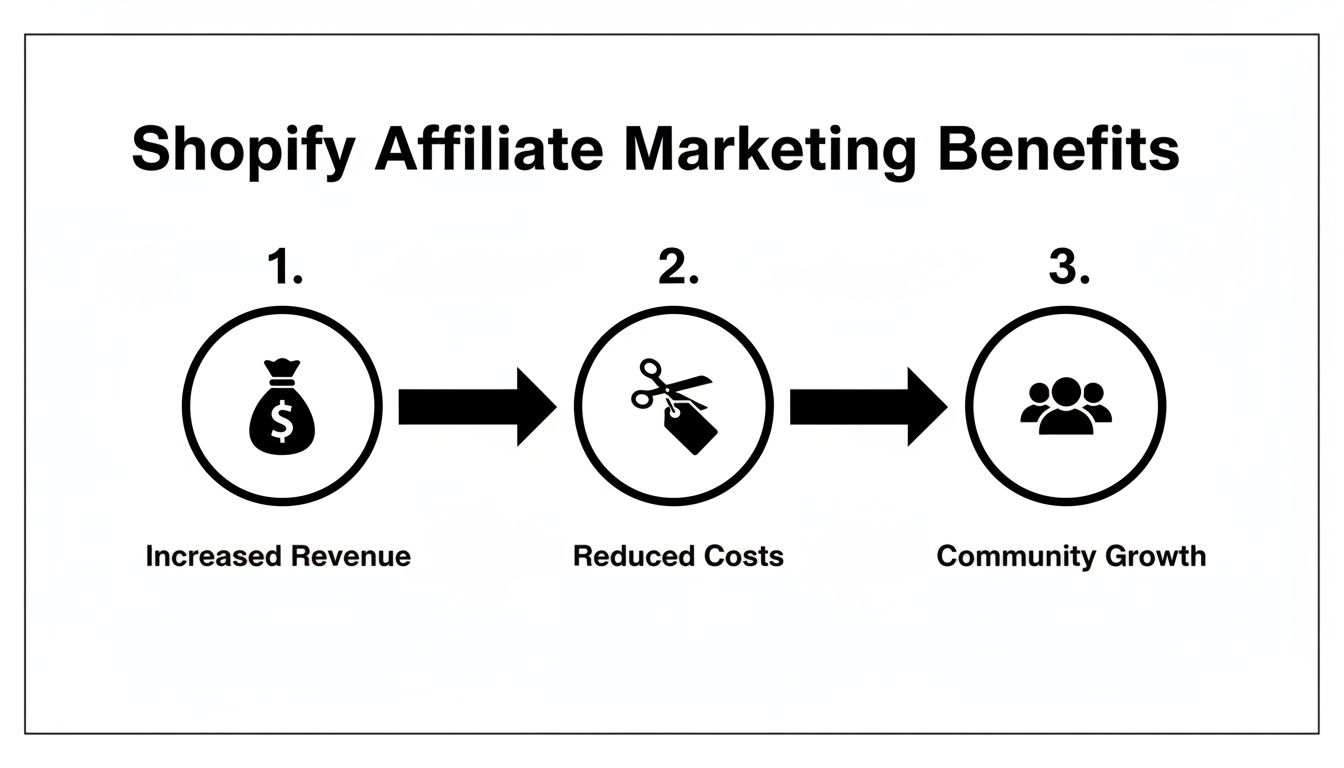
As you can see, a well-run program drives revenue, which in turn lowers your acquisition costs and frees up resources to build a loyal community of brand advocates.
1. Create the Program on Blossu
Your first move is to build the program itself, and this all happens inside the Blossu dashboard—no coding needed. This is where you set the look, feel, and rules of engagement for your partners. You're not just launching a system; you're creating a branded home for your affiliates.
In just a few minutes, you can lock in the core elements of the partner experience:
Custom Branding: Upload your logo and set your brand colors. This makes the affiliate portal feel like a seamless extension of your Shopify store, building instant trust and making partners feel like part of the team.
Commission Rules: Define your reward structure with a few clicks. Whether you're offering a simple percentage of sales, a flat rate per new customer, or a more advanced tiered system, you can set it up here.
Welcome Materials: Get your welcome email, starter promotional assets, and clear program guidelines ready. This ensures your new partners have everything they need to start succeeding from day one.
This whole setup phase is designed to be intuitive. You're guided through every decision, from setting your cookie duration to crafting the copy on your affiliate sign-up page. The goal is to have the entire framework built before you even think about your Shopify site.
2. Add the Tracking Snippet to Shopify
Once your program rules are set in Blossu, you need to connect it to your Shopify store to track conversions. In the past, this could be a real headache involving multiple scripts that bog down your website. And a slow site is a conversion killer—studies show that a one-second delay in page load time can slash conversions by 7%.
Blossu solves this with a single, lightweight JavaScript snippet. This one piece of code is the entire engine that powers your affiliate tracking, and Blossu handles everything behind the scenes.
Key Takeaway: The beauty of this approach is its efficiency. The snippet is asynchronous, meaning it loads independently without slowing down the rest of your site. It won't block your page from rendering, so your customer experience and site speed are never compromised.
You just copy this snippet from your Blossu dashboard and paste it into your Shopify theme, usually in the theme.liquid file. This ensures it's present on every page, ready to track the entire customer journey from the first affiliate click to the final sale. For a deeper dive, check out this guide on how to start an affiliate program that walks through these initial steps.
3. Connect Shopify for Automation
With the tracking script in place, the final step is to formally link your Blossu account with your Shopify store. This is where the real magic happens, automating the entire process and eliminating the manual work that plagues so many homegrown programs.
This isn't some complicated API integration that requires a developer. Blossu offers a direct, one-click integration with Shopify. By authorizing the connection, you give Blossu secure permission to talk to your store's backend.
Here's what this final step accomplishes instantly:
Automated Conversion Verification: When an affiliate drives a sale, Blossu automatically checks it against your Shopify sales data. This confirms the order is legitimate and prevents you from paying commissions on refunded or fraudulent purchases.
Seamless Data Sync: All the important order details, like the total sale amount, are synced automatically. This means your commission calculations are always accurate and based on real-time data.
Elimination of Manual Work: No more exporting sales reports from Shopify and trying to match them up with affiliate clicks in a spreadsheet. The entire process, from tracking to verification, is handled for you.
By following these three steps—creating the program, adding the snippet, and connecting your store—you can launch a sophisticated and reliable Shopify affiliate marketing program in record time. You'll go from an idea to a fully operational growth channel, ready to bring on affiliates and start driving performance-based revenue.
Crafting a Commission Structure That Actually Motivates
With the technical pieces in place, it's time to focus on what really drives a successful Shopify affiliate marketing program: the money. Your commission structure is the heart of your entire program. It's not just about paying people—it's about crafting an incentive that attracts the right partners, keeps them fired up, and perfectly aligns their wins with yours.
Think of your commission structure as the language you use to communicate value to your affiliates. If you get it right, you'll build a motivated, high-performing sales force. But if you get it wrong, you'll end up with low-quality traffic, disengaged partners, and wasted effort. The key is to design a system that's both competitive in your niche and sustainable for your bottom line.
Choosing Your Core Commission Model
First things first: how are you actually going to reward your partners for a sale? Most Shopify stores kick off their programs with one of three fundamental models. A flexible platform like Blossu makes setting these up a breeze, so you can pick the one that makes the most sense for your products and profit margins.
Percentage-Based Commissions: This is the gold standard for e-commerce. You give affiliates a slice of the total sale for every customer they send your way. It's clean, easy for everyone to understand, and it naturally scales with your average order value.
Fixed-Rate Rewards: Instead of a percentage, you pay a flat dollar amount for each conversion. This works incredibly well for stores with consistent pricing (like a single-product brand) or for lead generation campaigns where a sale isn't the immediate goal.
Tiered Models: Now this is where you can really light a fire under your best partners. A tiered structure automatically bumps up an affiliate's commission rate as they hit certain sales milestones. For instance, a new partner might start at a 10% commission, but after they drive $1,000 in sales in a month, their rate automatically jumps to 15%.
Pro Tip: Tiered models are absolute magic for motivation. They gamify the process, giving your top performers a clear target to aim for. It shows you recognize their hard work and are willing to reward it, which is a fantastic way to keep your best affiliates from getting complacent or poached by a competitor.
Setting Competitive Yet Profitable Rates
This is the question that keeps most merchants up at night: how much should I actually pay? You need a rate that's juicy enough to attract serious partners but doesn't cannibalize your profits. This takes a little bit of research and some back-of-the-napkin math.
Start by getting a handle on your Customer Lifetime Value (LTV) and your product margins. If you know a customer will stick around and make multiple purchases, you can afford to be more generous with the commission on that first sale to get them in the door.
Next, you have to scope out the competition and industry benchmarks. While the average affiliate marketing conversion rate hovers around 1–2%, the pros can hit anywhere from 5–10%. Commission rates are just as varied, from 8–15% for fashion and apparel brands to recurring commissions of 30% or more for SaaS products. Knowing what's normal in your space gives you a realistic starting point.
Commission Model Comparison for Shopify Stores
Choosing the right commission model isn't a one-size-fits-all decision. It really comes down to your product catalog, your average order value, and what you're trying to achieve with your program. To make it clearer, let's compare how these models stack up in the real world.
| Commission Model | Best For | Typical Rate (Example) | Key Benefit |
|---|---|---|---|
| Percentage-Based | Most e-commerce stores with varied product prices. | 10% on a $75 sale = $7.50 commission | Simple, scalable, and fair. Rewards affiliates for driving higher-value orders. |
| Fixed-Rate | Stores with uniform product pricing or lead-gen goals. | $20 flat commission per new subscription sign-up. | Predictable cost per acquisition. Ideal when the sale value is always the same. |
| Tiered Model | Businesses looking to motivate and retain top partners. | Tier 1: 10% (0-10 sales/mo), Tier 2: 15% (11-50 sales/mo). | Incentivizes growth and rewards high-performing affiliates automatically. |
Ultimately, a flexible platform is your best friend here. An affiliate tool like Blossu lets you experiment without getting locked into one structure. You can launch with a simple percentage-based model, and a few months later, introduce a tiered system to reward your rising stars. You could even run a flash sale where affiliates earn a special fixed-rate bonus on a specific product. This kind of adaptability is what allows your Shopify affiliate marketing program to grow and evolve right alongside your business.
Your affiliates are more than just walking billboards; think of them as an extension of your marketing team. To turn them into true, high-performing brand partners, you need to give them the right tools and create an experience that makes them feel valued.
A generic, unbranded portal and a "good luck" email just won't cut it. A professional onboarding process is what separates the thriving affiliate programs from the ones that never get off the ground. The goal is to eliminate friction and make promoting your products as effortless as possible.
When your partners feel supported and have easy access to professional resources, they become more confident, more engaged, and ultimately, far more effective at driving sales for your Shopify store.
Build a Branded Affiliate Home
First impressions matter. When an affiliate joins your program, their dashboard should feel like a seamless part of your brand, not some generic third-party tool. This is where using a platform with white-label features, like Blossu, becomes a game-changer for your Shopify affiliate marketing program.
Instead of a dashboard plastered with another company's logo, you can create a fully branded affiliate portal. This involves a few key steps:
Customizing with Your Logo and Colors: Upload your brand assets to make the portal instantly recognizable. It's a small touch that reinforces professionalism and brand consistency right away.
Creating a Custom Domain: Set up your portal on a subdomain like
partners.yourbrand.com. This simple move builds trust and makes the entire experience feel secure and official.
A branded portal communicates that you take your program—and your partners—seriously. It makes them feel like they've joined an exclusive, well-run operation, which is a huge motivator from day one.
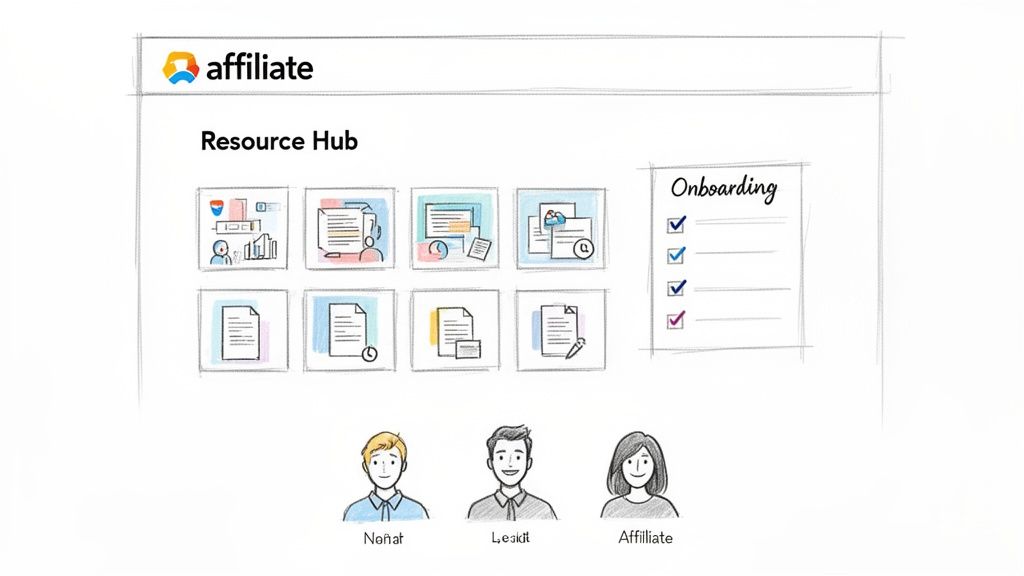
Create a Central Resource Hub
The single most valuable thing you can provide your affiliates is a well-organized resource hub. This is their one-stop shop for everything they need to promote you effectively, preventing endless back-and-forth emails and empowering them to grab what they need, whenever they need it.
Make sure your hub is packed with high-quality, ready-to-use assets.
Key Insight: Don't just dump a folder of images on them. Curate your assets thoughtfully. The easier you make it for affiliates to create compelling content, the more likely they are to do it consistently. Their success is your success.
Here's a quick checklist of must-have items for your resource library:
Brand Guidelines: A simple one-pager outlining your brand's voice, tone, and visual identity is perfect. Be sure to include your official logos, color codes, and any "dos and don'ts" for representing your brand.
High-Quality Product Imagery: Provide a library of professional product shots, lifestyle photos, and even short video clips. Ensure they are high-resolution and organized into logical folders so they're easy to find.
Ready-Made Swipe Copy: Craft a collection of pre-written text that partners can easily adapt for different channels. Think social media captions, email blurbs, and key talking points about your products. This is a massive time-saver for them.
By providing these foundational tools, you ensure brand consistency across all affiliate promotions and dramatically lower the barrier to entry for new partners.
Automate and Personalize Your Onboarding
A strong start sets the tone for the entire partnership. An automated yet personal welcome sequence is crucial for getting new affiliates engaged and helping them make their first sale quickly. Your goal is to guide them through the first critical steps without overwhelming them.
Your welcome email is the first piece of this puzzle. It shouldn't just be a transactional "you're approved" message. A powerful welcome email confirms their approval, provides their unique affiliate link, and directs them straight to the resource hub.
Here's a simple but effective template you can adapt:
Subject: Welcome to the [Your Brand] Partner Program!
Body: Start with a warm, enthusiastic welcome.
Key Info: Clearly display their unique affiliate link so they can't miss it.
Next Steps: Provide a direct link to the affiliate portal and resource hub.
Call to Action: Encourage them to start exploring the assets and planning their first promotion.
Beyond that first email, consistent communication is key. Set up automated check-ins or a monthly partner newsletter to share new product launches, upcoming promotions, and success stories from other affiliates. This ongoing engagement keeps your brand top-of-mind and ensures your partners always have something fresh to talk about.
Getting Your Shopify Affiliate Program Set Up with Blossu
Let's be honest, launching an affiliate marketing program shouldn't feel like a three-month engineering project. With a tool like Blossu, you can get from idea to a fully functioning, partner-ready program in less than an hour. It's not about weeks of technical wrangling; it's about a few key moves: building the program, setting up tracking, and plugging it into your store.
Forget the intimidating tech hurdles. The real goal here is to get you live, onboarding partners, and driving sales—fast.
Create Your Program on Blossu
First things first, you need to build the home for your affiliate program right inside the Blossu dashboard. This isn't just a settings page; it's where you define the rules of the game and create a professional, branded hub for your partners.
In just a few minutes, you can lock in the essentials:
Set Your Commission Rules: How will you pay your partners? It could be a straight 15% cut on all sales, a flat $20 for every new subscriber they send your way, or even a tiered system that gives your top performers a bigger slice of the pie. You can set this up with a few clicks.
Brand the Partner Portal: Slap your logo on it, set your brand colors, and make the whole thing feel like a natural extension of your Shopify store. When an affiliate logs in, you want them to feel like they're in your world, not some generic third-party app.
Prepare Onboarding Materials: Get your welcome email written and pull together some initial creative assets. A strong start makes your partners feel supported and ready to hit the ground running from day one.
The entire process is designed to be intuitive, walking you through each step without ever asking you to look at a line of code.
Add the Tracking Snippet to Your Shopify Store
Okay, with the program's foundation built, it's time for the most critical piece of the puzzle: tracking. This is the magic that connects a partner's promotion to a sale in your Shopify store. In the old days, this meant loading up your site with clunky scripts that would kill your page speed—a huge problem when a one-second delay can slash conversions by 7%.
Blossu sidesteps this whole issue with a single, feather-light JavaScript snippet. This one little piece of code is the entire engine that powers your affiliate tracking.
The snippet is asynchronous, which is a fancy way of saying it loads on its own without making your customers wait. It won't slow down your site's rendering, so your user experience and conversion rates stay exactly where they should be.
All you have to do is copy the snippet from your Blossu dashboard and paste it into your Shopify theme's code, usually in the theme.liquid file. That one small action activates the script on every page, making sure every sale is attributed to the right partner, every time.
Connect Shopify for Seamless Automation
The final piece is the one-click integration that ties it all together. With the tracking snippet in place, you'll formally connect your Blossu account to your Shopify store. This is where the real automation kicks in, wiping out the manual, spreadsheet-heavy work that makes so many affiliate programs a nightmare to manage.
This isn't some complex API project that requires a developer. It's a simple, secure authorization that lets Blossu talk directly to your store's backend.
Here's what that final connection instantly unlocks:
Automated Conversion Verification: When an affiliate drives a sale, Blossu automatically checks it against your Shopify sales data. This instantly confirms the order is legit and stops you from paying commissions on fraudulent or refunded purchases.
Accurate Data Syncing: Order details, like the total sale amount and the specific products purchased, are pulled in automatically. This guarantees your commission calculations are always spot-on.
Elimination of Manual Spreadsheets: Kiss goodbye to the days of exporting sales reports and manually trying to match them to affiliate clicks. The entire process, from referral to verified payout, is completely hands-off.
By bringing these automated systems together, you're building a much more powerful and cohesive growth engine. To see how this fits into a bigger strategy, check out our guide on multi-channel marketing automation. Following these three steps—creating your program, adding the snippet, and connecting your store—is how you turn your Shopify affiliate marketing program from an idea into an automated revenue channel that just works.
Common Questions About Shopify Affiliate Programs
Jumping into affiliate marketing for your Shopify store always brings up a few questions. Getting straight answers is the key to building your program with confidence. Let's tackle some of the most common things merchants ask when they're just getting started.
Frequently Asked Questions
Have a question not in here? Contact us
- How Much Should I Pay My Affiliates on Shopify?
There's no magic number here. The right commission really depends on your product margins, what's normal in your industry, and your customer's lifetime value. For most e-commerce stores selling physical products, a good starting point is somewhere between 10% and 20%. If you're selling digital products or subscriptions where margins are higher, rates from 20% to 40% are pretty common and competitive. The main thing is to offer a rate that's attractive enough to get quality partners on board, while still making sense for your bottom line.
- Can I Run an Affiliate Program on Shopify Without an App?
Technically, you could try to manage a program manually with spreadsheets and unique discount codes, but it's a recipe for disaster. It's incredibly inefficient and almost impossible to scale. You'd be stuck painstakingly tracking every single click, sale, and payout by hand. Not only is that a massive time sink, but it's also wide open to expensive mistakes. For any business that's serious about growth, the manual route just isn't an option. A dedicated platform like Blossu puts the whole thing on autopilot—from generating unique tracking links to calculating commissions and handling payouts.
- How Do I Find Affiliates for My New Shopify Program?
Your best first recruits are often hiding in plain sight: your existing customers. These are the people who already love what you do. Announce your program to your email list and social media followers, do some targeted outreach to bloggers and content creators in your niche whose audience matches your ideal customer, and make sure to set new partners up for success with everything they need to win from day one.
- What Is the Difference Between an Affiliate and a Referral Program?
They might sound similar, but they're built for different goals. Affiliate programs are usually open to anyone—professional marketers, content creators, you name it—who wants to promote your products for a cash commission. The main goal is driving new customers at scale. Referral programs, on the other hand, are typically for your existing customers to share your brand with friends and family. The rewards are often non-cash perks like store credit, discounts on their next order, or free products.
Ready to turn your best customers and biggest fans into a powerful, performance-based sales team? With Blossu, you can launch a fully automated Shopify affiliate marketing program in minutes, not weeks. Stop guessing with ad spend and start driving predictable, profitable growth. Learn more and start your free plan today at Blossu.com.